


Identification and characterization of novel SNPs in CHEK2 in Ashkenazi Jewish men with prostate cancer
- PMID: 18571837
- PMCID: PMC2969172
- DOI: 10.1016/j.canlet.2008.05.006
Identification and characterization of novel SNPs in CHEK2 in Ashkenazi Jewish men with prostate cancer
Abstract
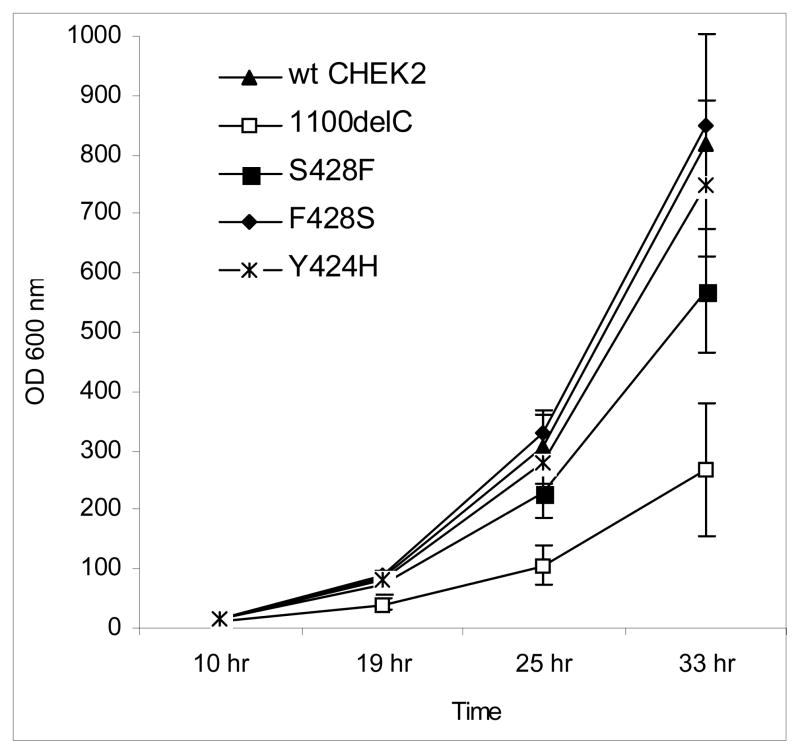
Checkpoint kinase 2 (CHEK2) is a protein involved in arresting cell cycle in response to DNA damage. To investigate whether it plays an important role in the development of prostate cancer (PRCA) in the Ashkenazi Jewish (AJ) population, we sequenced CHEK2 in 75 AJ individuals with prostate, breast, or no cancer (n=25 each). We identified seven coding SNPs (five are novel) that changed the amino-acid sequence, resulting in R3W, E394F, Y424H, S428F, D438Y, P509S, and P509L. We determined the frequency of each variant in 76 AJ families collected by members of the International Consortium for Prostate Cancer Genetics (ICPCG) where >or=2 men were affected by PRCA. Only one variant, Y424H in exon 11, was identified in more than two families. Exon 11 was then screened in nine additional AJ ICPCG families (a total of 85 families). The Y424H variant occurred in nine affected cases from four different families; however, it did not completely segregate with the disease. We performed bioinformatics analysis, which showed that Y424H is a non-conservative missense substitution that falls at a position that is invariant in vertebrate CHEK2 orthologs. Both SIFT and Align-GVGD predict that Y424H is a loss of function mutation. However, the frequency of Y424H was not significantly different between unselected AJ cases from Montreal/Memorial Sloan Kettering Cancer Centre (MSKCC) and AJ controls from Israel/MSKCC (OR 1.18, 95%CI: 0.34-4.61, p=.99). Moreover, functional assays using Saccharomyces cerevisiae revealed that the Y424H substitution did not alter function of CHEK2 protein. Although we cannot rule out a subtle influence of the CHEK2 variants on PRCA risk, these results suggest that germline CHEK2 mutations have a minor role in, if any, PRCA susceptibility in AJ men.
Figures
References
-
- Jacobs EJ, Rodriguez C, Mondul AM, Connell CJ, Henley SJ, Calle EE, Thun MJ. A large cohort study of aspirin and other nonsteroidal anti-inflammatory drugs and prostate cancer incidence. J Natl Cancer Inst. 2005;97:975–80. - PubMed
-
- Gronberg H, Damber L, Damber JE. Familial prostate cancer in Sweden. A nationwide register cohort study. Cancer. 1996;77:138–43. - PubMed
-
- Matikaine MP, Pukkala E, Schleutker J, Tammela TL, Koivisto P, Sankila R, Kallioniemi OP. Relatives of prostate cancer patients have an increased risk of prostate and stomach cancers: a population-based, cancer registry study in Finland. Cancer Causes Control. 2001;12:223–30. - PubMed
Publication types
MeSH terms
Substances
Grants and funding
LinkOut - more resources
Full Text Sources
Medical
Molecular Biology Databases
