


Calf muscle hemoglobin oxygen saturation characteristics and exercise performance in patients with intermittent claudication
- PMID: 18572363
- PMCID: PMC2759322
- DOI: 10.1016/j.jvs.2008.04.005
Calf muscle hemoglobin oxygen saturation characteristics and exercise performance in patients with intermittent claudication
Abstract
Purpose: This study was conducted to determine the association between the characteristics of calf muscle hemoglobin oxygen saturation (StO(2)) and exercise performance in patients with intermittent claudication.
Methods: The study comprised 39 patients with peripheral arterial disease limited by intermittent claudication. Patients were characterized on calf muscle StO(2) before, during, and after a graded treadmill test, as well as on demographic and cardiovascular risk factors, ankle-brachial index (ABI), ischemic window, initial claudication distance (ICD), and absolute claudication distance (ACD).
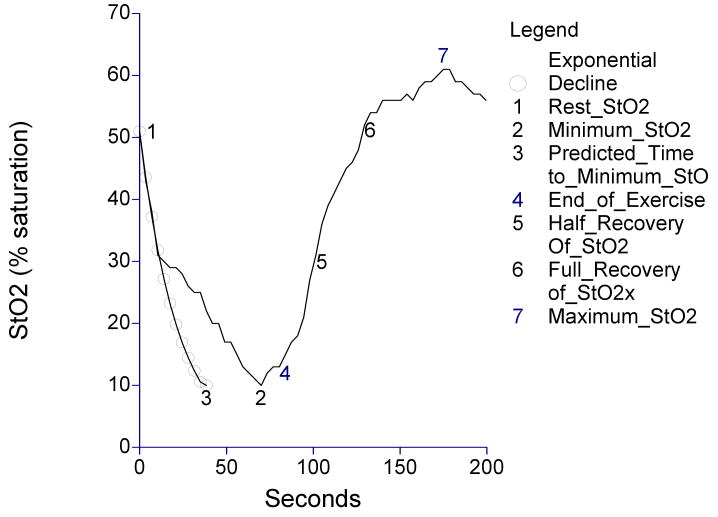
Results: Calf muscle StO(2) decreased 72%, from 55% +/- 18% (mean +/- SD) saturation at rest to the minimum value of 17% +/- 19% saturation attained 459 +/- 380 seconds after the initiation of exercise. After exercise, recovery half-time of calf muscle StO(2) was attained at 129 +/- 98 seconds, whereas full recovery to the resting value was reached at 225 +/- 140 seconds. After adjusting for sex, race, and grouping according to the initial decline constant in calf muscle StO(2) during exercise, the exercise time to minimum calf muscle StO(2) was correlated with the ischemic window (r = -0.493, P = .002), ICD (r = 0.339, P = .043), and ACD (r = 0.680, P < .001). After treadmill exercise, the recovery half-time of calf muscle StO(2) was correlated with the ischemic window (r = 0.531, P < .001), ICD (r = -0.598, P < .001), and ACD (r = -0.491, P = .003).
Conclusion: In patients limited by intermittent claudication, shorter ICD and ACD values are associated with reaching a minimum value in calf muscle StO(2) sooner during treadmill exercise and with having a delayed recovery in calf muscle StO(2) after exercise.
Figures
References
-
- Weitz JI, Byrne J, Clagett GP, et al. Diagnosis and treatment of chronic arterial insufficiency of the lower extremities: a critical review. Circulation. 1996;94:3026–3049. - PubMed
-
- Bonde-Petersen F. Physical performance capacity in patients with dysbasia arteriosclerotica. II. Bicycle ergometry, walking tolerance and arteriographic diagnosis. Scand J Rehabil Med. 1974;6:26–30. - PubMed
-
- Gardner AW. Claudication pain and hemodynamic responses to exercise in younger and older peripheral arterial disease patients. J Gerontol. 1993;48:M231–M236. - PubMed
-
- Gardner AW, Ricci MA, Case TD, Pilcher DB. Practical equations to predict claudication pain distances from a graded treadmill test. Vasc Med. 1996;1:91–96. - PubMed
-
- Hiatt WR, N D, R J, H KR. The evaluation of exercise performance in patients with peripheral vascular disease. J Cardiopulmonary Rehabil. 1988;12:525–532.
Publication types
MeSH terms
Substances
Grants and funding
LinkOut - more resources
Full Text Sources
