


doi: 10.1021/ja802883k.
Epub 2008 Jun 24.
A photoactivatable push-pull fluorophore for single-molecule imaging in live cells
Affiliations
- PMID: 18572940
- PMCID: PMC2688641
- DOI: 10.1021/ja802883k
Item in Clipboard
A photoactivatable push-pull fluorophore for single-molecule imaging in live cells
J Am Chem Soc.
.
Abstract
We have reengineered a red-emitting dicyanomethylenedihydrofuran push-pull fluorophore so that it is dark until photoactivated with a short burst of low-intensity violet light. Photoactivation of the dark fluorogen leads to conversion of an azide to an amine, which shifts the absorption to long wavelengths. After photoactivation, the fluorophore is bright and photostable enough to be imaged on the single-molecule level in living cells. This proof-of-principle demonstration provides a new class of bright photoactivatable fluorophores, as are needed for super-resolution imaging schemes that require active control of single molecule emission.
Figures
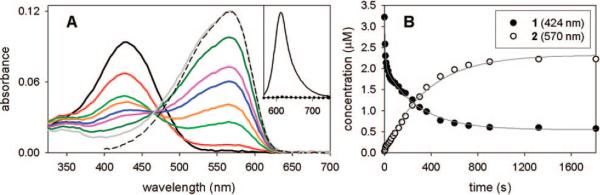
(A) Absorption curves in ethanol (bubbled with N2) showing photoactivation of 1 (λabs = 424 nm) over time to fluorescent product 2 (λabs = 570 nm). Different colored curves represent 0, 10, 90, 150, 240, 300, 480, and 1320 s of illumination by 3.1 mW/cm2 of diffuse 407-nm light. The sliding isosbestic point may indicate a build-up of reaction intermediates. Dashed line is the absorbance of pure, synthesized 2. (Inset) Dotted line is weak pre-activation fluorescence of 1 excited at 594 nm; solid line is strong post-activation fluorescence resulting from exciting 2 at 594 nm, showing >100-fold turn-on ratio. (B) Photoactivation kinetics from data in A. The total yield of the reaction ([2]f/[1]i) is 69%. Photoconversion data for 1 were fit using two exponentials (τ = 7.4 and 291 s); data for 2 were fit using one exponential (τ = 353 s).
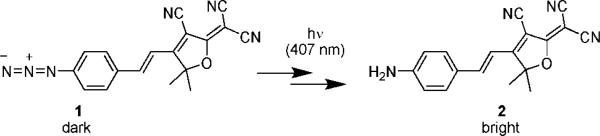
Photochemical Activation of the Azido-DCDHF Fluorogen
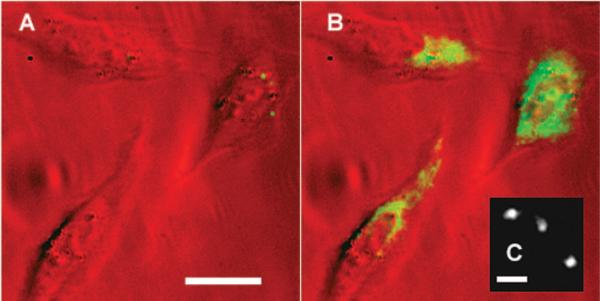
(A) Three CHO cells incubated with fluorogen 1 are dark before activation. (B) The fluorophore 2 lights up in the cells after activation with a 10-s flash of diffuse, low-irradiance (0.4 W/cm2) 407-nm light. (False color: red is the white-light transmission image and green shows the fluorescence images, excited at 594 nm.) Scalebar: 20 μm. (C) Single molecules of activated 2 in a cell under higher magnification. Background was subtracted and the image was smoothed with a 1-pixel Gaussian. Scalebar: 800 nm.
References
Publication types
MeSH terms
Substances
Grants and funding
LinkOut - more resources
Full Text Sources
Other Literature Sources
