Comparative Study
. 2008 Jun 26;58(6):967-73.
doi: 10.1016/j.neuron.2008.04.027.

Striatal activity underlies novelty-based choice in humans

Affiliations
Comparative Study

Striatal activity underlies novelty-based choice in humans

Bianca C Wittmann et al. Neuron. .

Abstract

The desire to seek new and unfamiliar experiences is a fundamental behavioral tendency in humans and other species. In economic decision making, novelty seeking is often rational, insofar as uncertain options may prove valuable and advantageous in the long run. Here, we show that, even when the degree of perceptual familiarity of an option is unrelated to choice outcome, novelty nevertheless drives choice behavior. Using functional magnetic resonance imaging (fMRI), we show that this behavior is specifically associated with striatal activity, in a manner consistent with computational accounts of decision making under uncertainty. Furthermore, this activity predicts interindividual differences in susceptibility to novelty. These data indicate that the brain uses perceptual novelty to approximate choice uncertainty in decision making, which in certain contexts gives rise to a newly identified and quantifiable source of human irrationality.


Figures
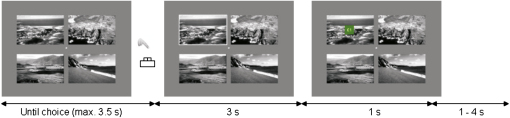
Figure 1
Figure 1
Experimental Design Following a familiarization phase, participants were shown four pictures on each trial and asked to choose one. Both familiarized and novel pictures were presented at randomized locations that changed on each trial. Each picture was repeated for an average of 20 trials and then replaced. Participants were informed that each picture had been assigned a unique probability of winning £1 that would not change as long as that picture was repeated. They were given feedback at the end of each trial indicating whether they had won or received nothing.
Figure 2
Figure 2
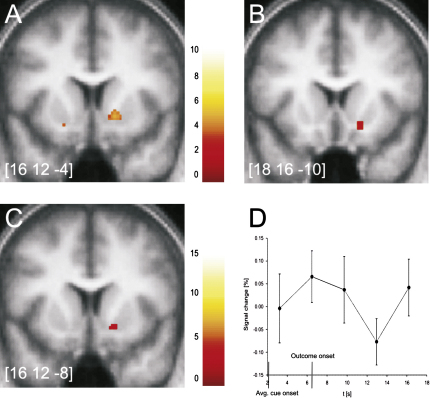
Ventral Striatal Response to Prediction Error and Novelty Peak coordinates are given in MNI space on all images. Color bars indicate T values. (A) Activation in right ventral striatum correlated significantly with reward prediction errors generated by the standard TD model (p < 0.001 uncorrected, p < 0.05 SVC, cluster > 5 voxels). (B) Activation in right ventral striatum correlated significantly with additional prediction error due to inclusion of a novelty bonus (p < 0.001 uncorrected, p < 0.05 SVC, cluster > 5 voxels). (C) Significant overlap between activation in right ventral striatum for the novelty bonus (see [B]) and activation obtained for standard model (see [A]) derived by inclusively masking (B) with (A) (p < 0.005, uncorrected, for both contrasts, cluster > 5 voxels). (D) Striatal activation time courses calculated for the first two trials a novel stimulus is chosen minus the first two choices of familiar stimuli, shown for the peak voxel correlating with the novelty bonus (MNI coordinates: 14, 20, −10). Trials are aligned by the time of reward outcome at 6.5 s; the average stimulus onset time is also indicated. Error bars indicate SEM.
Figure 3
Figure 3
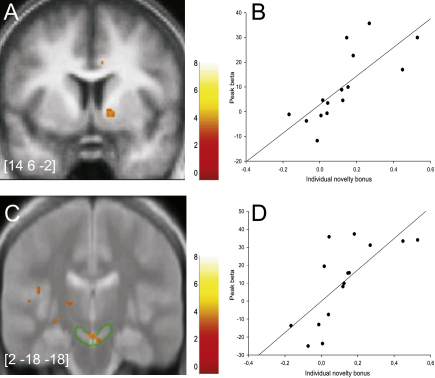
Individual Variation in Novelty Response Areas in which the level of activation by novelty bonus signal correlated significantly with individual subject measures of novelty seeking (p < 0.005 uncorrected, p < 0.05 SVC, cluster > 5 voxels). Peak coordinates are given in MNI space on all images. Color bars indicate T values. (A) Activation in right ventral striatum correlating with individual novelty seeking as measured in the behavioral task. Image is masked by “novelty bonus” contrast image from Figure 2B. (B) Peak beta values from (A) plotted against individual novelty-seeking measures. (C) Activation in right substantia nigra/ventral tegmental area correlating with individual novelty seeking as measured in the behavioral task, superimposed on a magnetization transfer image for better visualization of the substantia nigra (Bunzeck and Duzel, 2006). Image is masked by “novelty bonus” contrast image from Figure 2B. Substantia nigra is indicated by green circles. (D) Peak beta values from (C) plotted against individual novelty-seeking measures.

References

    1. Anastasi G., Cutroneo G., Tomasello F., Lucerna S., Vitetta A., Bramanti P., Di Bella P., Parenti A., Porzionato A., Macchi V., De Caro R. In vivo basal ganglia volumetry through application of NURBS models to MR images. Neuroradiology. 2006;48:338–345. - PubMed
    1. Andersson J.L., Hutton C., Ashburner J., Turner R., Friston K. Modeling geometric deformations in EPI time series. Neuroimage. 2001;13:903–919. - PubMed
    1. Aron A.R., Shohamy D., Clark J., Myers C., Gluck M.A., Poldrack R.A. Human midbrain sensitivity to cognitive feedback and uncertainty during classification learning. J. Neurophysiol. 2004;92:1144–1152. - PubMed
    1. Berns G.S., McClure S.M., Pagnoni G., Montague P.R. Predictability modulates human brain response to reward. J. Neurosci. 2001;21:2793–2798. - PMC - PubMed
    1. Brafman R.I., Tennenholtz M. R-MAX - A general polynomial time algorithm for near-optimal reinforcement learning. J. Mach. Learn. Res. 2003;3:213–231.

Publication types

LinkOut - more resources