


Imaging of the Yellow Cameleon 3.6 indicator reveals that elevations in cytosolic Ca2+ follow oscillating increases in growth in root hairs of Arabidopsis
- PMID: 18583529
- PMCID: PMC2492656
- DOI: 10.1104/pp.108.123638
Imaging of the Yellow Cameleon 3.6 indicator reveals that elevations in cytosolic Ca2+ follow oscillating increases in growth in root hairs of Arabidopsis
Abstract
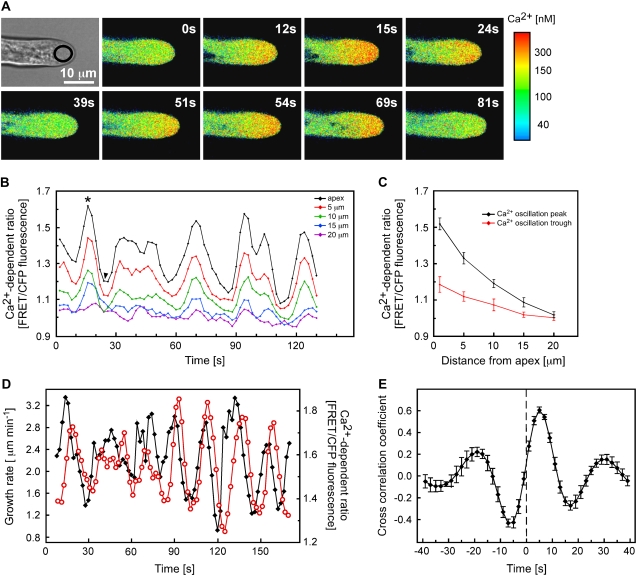
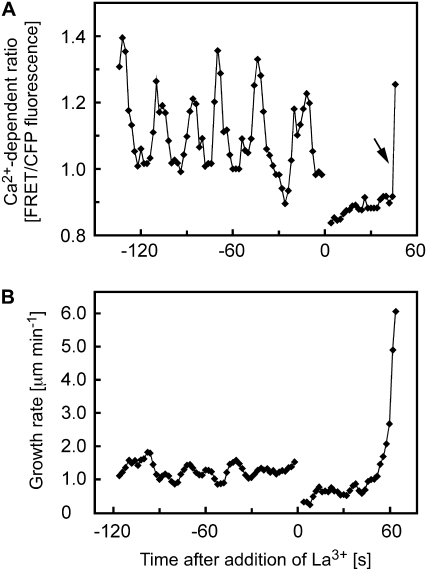
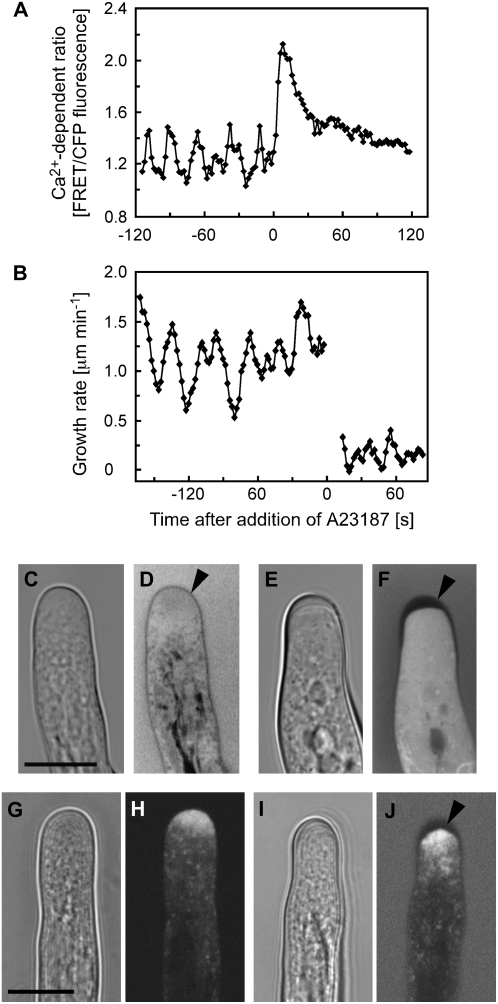
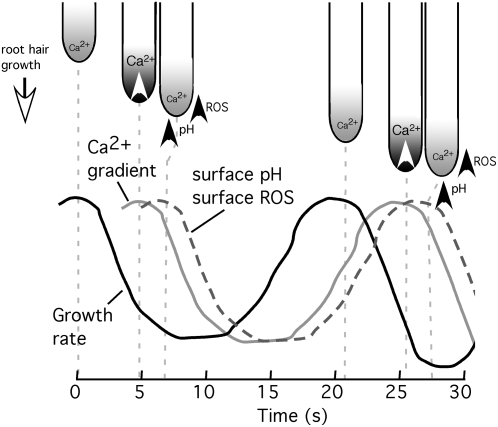
In tip-growing cells, the tip-high Ca(2+) gradient is thought to regulate the activity of components of the growth machinery, including the cytoskeleton, Ca(2+)-dependent regulatory proteins, and the secretory apparatus. In pollen tubes, both the Ca(2+) gradient and cell elongation show oscillatory behavior, reinforcing the link between the two. We report that in growing root hairs of Arabidopsis (Arabidopsis thaliana), an oscillating tip-focused Ca(2+) gradient can be resolved through imaging of a cytosolically expressed Yellow Cameleon 3.6 fluorescence resonance energy transfer-based Ca(2+) sensor. Both elongation of the root hairs and the associated tip-focused Ca(2+) gradient show a similar dynamic character, oscillating with a frequency of 2 to 4 min(-1). Cross-correlation analysis indicates that the Ca(2+) oscillations lag the growth oscillations by 5.3 +/- 0.3 s. However, growth never completely stops, even during the slow cycle of an oscillation, and the concomitant tip Ca(2+) level is always slightly elevated compared with the resting Ca(2+) concentration along the distal shaft, behind the growing tip. Artificially increasing Ca(2+) using the Ca(2+) ionophore A23187 leads to immediate cessation of elongation and thickening of the apical cell wall. In contrast, dissipating the Ca(2+) gradient using either the Ca(2+) channel blocker La(3+) or the Ca(2+) chelator EGTA is accompanied by an increase in the rate of cell expansion and eventual bursting of the root hair tip. These observations are consistent with a model in which the maximal oscillatory increase in cytosolic Ca(2+) is triggered by cell expansion associated with tip growth and plays a role in the subsequent restriction of growth.
Figures
References
-
- Allwood EG, Smertenko AP, Hussey PJ (2001) Phosphorylation of plant actin-depolymerising factor by calmodulin-like domain protein kinase. FEBS Lett 499 97–100 - PubMed
-
- Bibikova T, Gilroy S (2002) Root hair development. J Plant Growth Regul 21 383–415
-
- Bibikova TN, Zhigilei A, Gilroy S (1997) Root hair growth in Arabidopsis thaliana is directed by calcium and an endogenous polarity. Planta 203 495–505 - PubMed
Publication types
MeSH terms
Substances
Grants and funding
LinkOut - more resources
Full Text Sources
Other Literature Sources
Miscellaneous
