


Accuracy of patients' reports of comorbid disease and their association with mortality in ESRD
- PMID: 18589216
- PMCID: PMC2587104
- DOI: 10.1053/j.ajkd.2008.02.001
Accuracy of patients' reports of comorbid disease and their association with mortality in ESRD
Abstract
Background: Patient awareness of chronic diseases is low. Unawareness may represent poor understanding of chronic illness and may be associated with poor outcomes in patients with end-stage renal disease (ESRD).
Study design: Concurrent prospective national cohort study.
Setting & participants: Incident hemodialysis and peritoneal dialysis patients enrolled in the Choices for Healthy Outcomes in Caring for ESRD Study and followed up until 2004.
Predictor: Inaccurate patient self-report of 8 comorbid diseases compared with the medical record.
Outcomes & measurements: All-cause mortality was the primary outcome. Cox proportional hazard models were used to assess the contribution of demographics and clinical measures in the relation of inaccurate self-report to mortality.
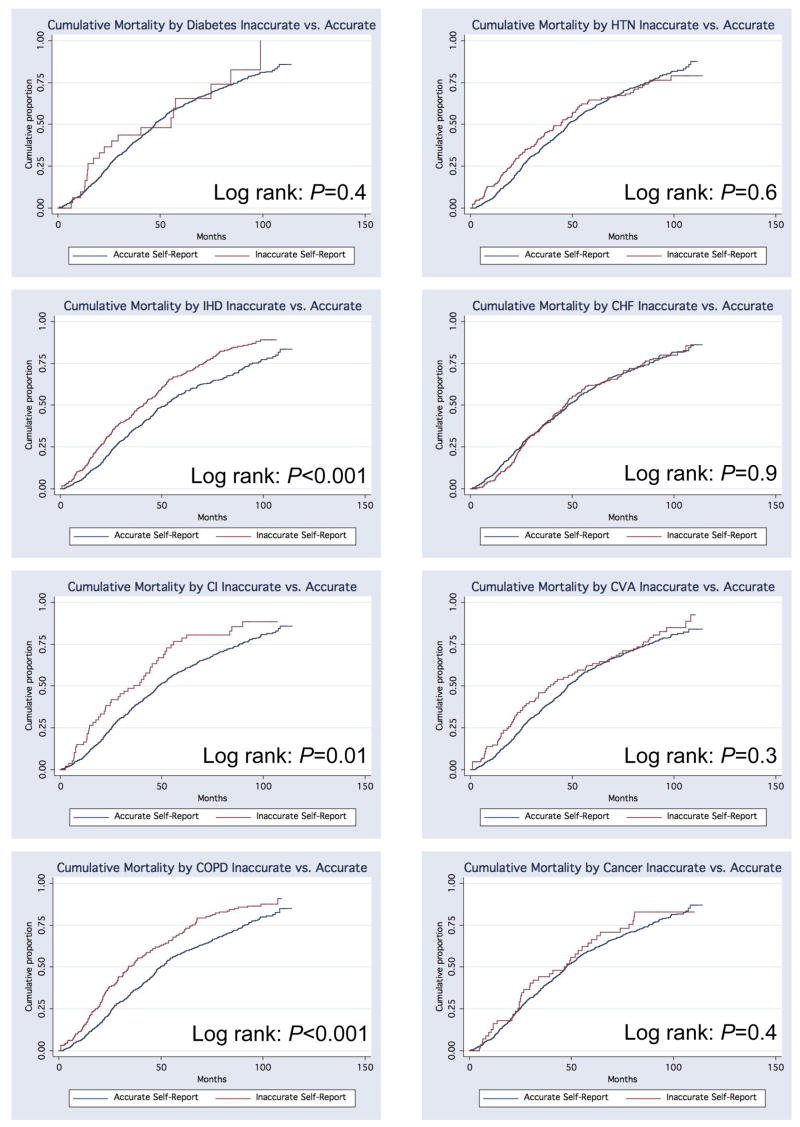
Results: In 965 patients, the proportion of inaccurate self-reporters ranged from 3% for diabetes mellitus to 35% for congestive heart failure. Generally, inaccurate self-reporters were older and had more chronic diseases. Greater risk of death was found for inaccurate self-reporters of ischemic heart disease (hazard ratio [HR], 1.34; 95% confidence interval, 1.12 to 1.59; P = 0.001), coronary intervention (HR, 1.46; 95% confidence interval, 1.08 to 1.97; P = 0.01), and chronic obstructive pulmonary disease (HR, 1.40; 95% confidence interval, 1.14 to 1.70; P = 0.001). The greater risk of death remained significant for chronic obstructive pulmonary disease (HR, 1.36; 95% confidence interval, 1.11 to 1.66; P = 0.003) after adjustment for age, sex, and race. In patients receiving peritoneal dialysis, greater risk of death (HR, 2.06; 95% confidence interval, 1.34 to 3.15; P = 0.001) was found for inaccurate self-reporters of ischemic heart disease.
Limitations: Includes potential for residual confounding, medical record error, misclassification of patient accuracy of self-report, and low inaccurate self-report of some chronic diseases, reducing the power to measure associations.
Conclusions: Accuracy of self-report depends on the specific comorbid disease. Patients with ESRD, especially those receiving peritoneal dialysis, who inaccurately report heart disease may be less aware of their chronic comorbid disease and may be at greater risk of mortality compared with those who accurately report their comorbid disease.
Figures
References
-
- Coresh J, Byrd-Holt D, Astor BC, et al. Chronic kidney disease awareness, prevalence, and trends among U.S. adults, 1999 to 2000. J Am Soc Nephrol. 2005;16:180–188. - PubMed
-
- Hajjar I, Kotchen TA. Trends in prevalence, awareness, treatment, and control of hypertension in the United States, 1988–2000. Jama. 2003;290:199–206. - PubMed
-
- Joffres MR, Ghadirian P, Fodor JG, Petrasovits A, Chockalingam A, Hamet P. Awareness, treatment, and control of hypertension in Canada. Am J Hypertens. 1997;10:1097–1102. - PubMed
-
- Aranda JM, Jr, Vazquez R. Awareness of hypertension and diabetes in the Hispanic community. Clin Cornerstone. 2004;6:7–13. discussion 14–15. - PubMed
-
- Gnasso A, Calindro MC, Carallo C, et al. Awareness, treatment and control of hyperlipidaemia, hypertension and diabetes mellitus in a selected population of southern Italy. Eur J Epidemiol. 1997;13:421–428. - PubMed
Publication types
MeSH terms
Grants and funding
LinkOut - more resources
Full Text Sources
Medical
