


Associations of maternal long-chain polyunsaturated fatty acids, methyl mercury, and infant development in the Seychelles Child Development Nutrition Study
- PMID: 18590765
- PMCID: PMC2574624
- DOI: 10.1016/j.neuro.2008.06.002
Associations of maternal long-chain polyunsaturated fatty acids, methyl mercury, and infant development in the Seychelles Child Development Nutrition Study
Erratum in
- Neurotoxicology. 2011 Dec;32(6):990
Abstract
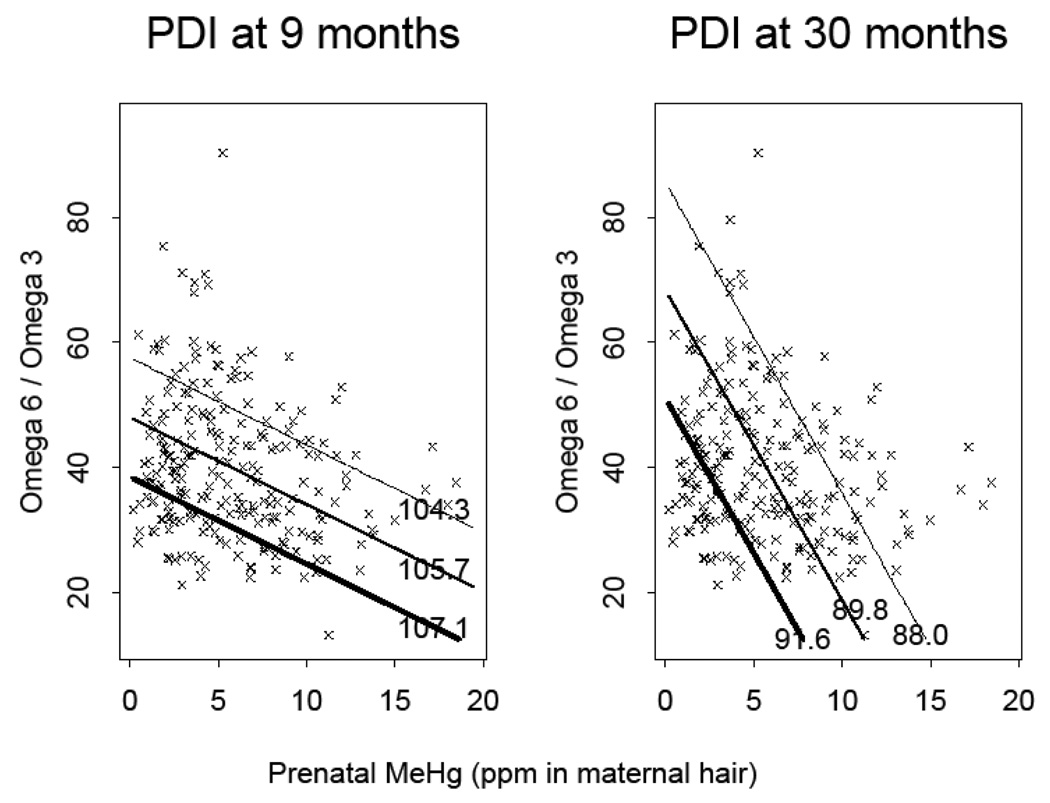
Fish consumption during gestation can provide the fetus with long-chain polyunsaturated fatty acids (LCPUFA) and other nutrients essential for growth and development of the brain. However, fish consumption also exposes the fetus to the neurotoxicant, methyl mercury (MeHg). We studied the association between these fetal exposures and early child development in the Seychelles Child Development Nutrition Study (SCDNS). Specifically, we examined a priori models of Omega-3 and Omega-6 LCPUFA measures in maternal serum to test the hypothesis that these LCPUFA families before or after adjusting for prenatal MeHg exposure would reveal associations with child development assessed by the BSID-II at ages 9 and 30 months. There were 229 children with complete outcome and covariate data available for analysis. At 9 months, the PDI was positively associated with total Omega-3 LCPUFA and negatively associated with the ratio of Omega-6/Omega-3 LCPUFA. These associations were stronger in models adjusted for prenatal MeHg exposure. Secondary models suggested that the MeHg effect at 9 months varied by the ratio of Omega-6/Omega-3 LCPUFA. There were no significant associations between LCPUFA measures and the PDI at 30 months. There were significant adverse associations, however, between prenatal MeHg and the 30-month PDI when the LCPUFA measures were included in the regression analysis. The BSID-II mental developmental index (MDI) was not associated with any exposure variable. These data support the potential importance to child development of prenatal availability of Omega-3 LCPUFA present in fish and of LCPUFA in the overall diet. Furthermore, they indicate that the beneficial effects of LCPUFA can obscure the determination of adverse effects of prenatal MeHg exposure in longitudinal observational studies.
Figures
References
-
- Auestad N, Scott DT, Janowsky JS, et al. Visual, cognitive, and language assessments at 39 months: a follow-up study of children fed formulas containing long-chain polyunsaturated fatty acids to 1 year of age. Pediatrics. 2003;112:E177–E183. - PubMed
-
- Bouwestra H, Dijck-Brouwer DA, Boehm G, et al. Long-chain polyunsaturated fatty acids and neurological developmental outcome at 18 months in healthy term infants. Acta Paediatr. 2005;94:26–32. - PubMed
-
- Carnielli VP, Simonata M, Verlato G, et al. Synthesis of long-chain polyunsaturated fatty acids in preterm infants fed formula with pong chain polyunsaturated fatty acids. Am J Clin Nutr. 2007;86:1323–1330. - PubMed
-
- Carlson SE. Docosahexaenoic acid and arachidonic acid in infant development. Semin Neonatal. 2001;6:437–449. - PubMed
-
- Cheatham CL, Colombo J, Carlson SE. N-3 fatty acids and cognitive and visual acuity development: methodologic and conceptual considerations. Am J Clin Nutr. 2006;83:1458S–1466S. - PubMed
Publication types
MeSH terms
Substances
Grants and funding
LinkOut - more resources
Full Text Sources
Medical
