


Genomic association analysis suggests chromosome 12 locus influencing antihypertensive response to thiazide diuretic
- PMID: 18591461
- PMCID: PMC2692710
- DOI: 10.1161/HYPERTENSIONAHA.107.104273
Genomic association analysis suggests chromosome 12 locus influencing antihypertensive response to thiazide diuretic
Abstract
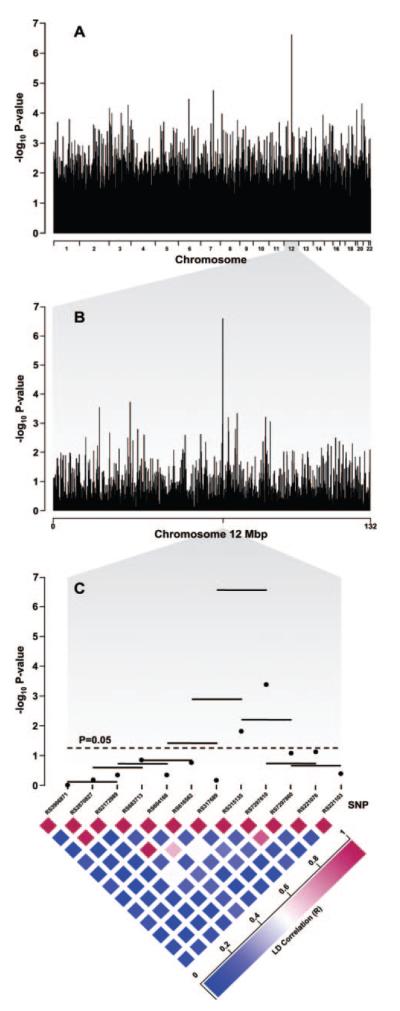
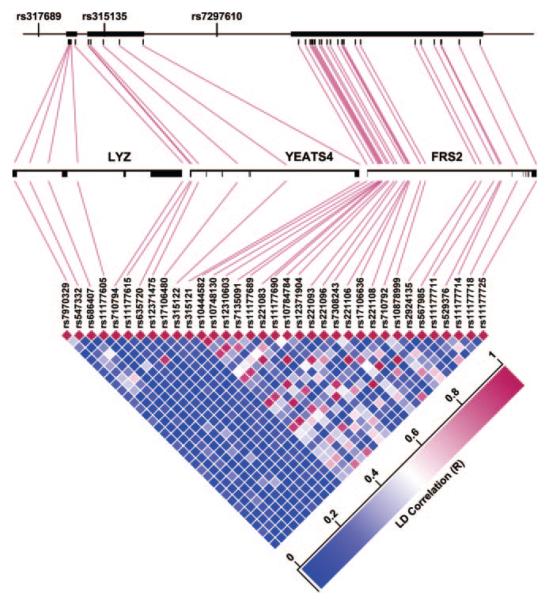
We conducted a genome-wide association study to identify novel genes influencing diastolic blood pressure (BP) response to hydrochlorothiazide, a commonly prescribed thiazide diuretic preferred for the treatment of high BP. Affymetrix GeneChip Human Mapping 100K Arrays were used to measure single nucleotide polymorphisms across the 22 autosomes in 194 non-Hispanic black subjects and 195 non-Hispanic white subjects with essential hypertension selected from opposite tertiles of the race- and sex-specific distributions of age-adjusted diastolic BP response to hydrochlorothiazide (25 mg daily, PO, for 4 weeks). The black sample consisted of 97 "good" responders (diastolic BP response [mean+/-SD]=-18.3+/-4.2 mm Hg; age=47.1+/-6.1 years; 51.5% women) and 97 "poor" responders (diastolic BP response=-0.18+/-4.3; age=47.4+/-6.5 years; 51.5% women). Haplotype trend regression identified a region of chromosome 12q15 in which haplotypes constructed from 3 successive single nucleotide polymorphisms (rs317689, rs315135, and rs7297610) in proximity to lysozyme (LYZ), YEATS domain containing 4 (YEATS4), and fibroblast growth receptor substrate 2 (FRS2) were significantly associated with diastolic BP response (nominal P=2.39 x 10(-7); Bonferroni corrected P=0.024; simulated experiment-wise P=0.040). Genotyping of 35 additional single nucleotide polymorphisms selected to "tag" linkage disequilibrium blocks in these genes provided corroboration that variation in LYZ and YEATS4 was associated with diastolic BP response in a statistically independent data set of 291 black subjects and in the sample of 294 white subjects. These results support the use of genome-wide association analyses to identify novel genes influencing antihypertensive drug responses.
Figures
References
-
- Meissner I, Whisnant JP, Sheps SG, Schwartz GL, O’Fallon WM, Covalt JL, Sicks JD, Bailey KR, Wiebers DO. Detection and control of high blood pressure in the community: do we need a wake-up call? Hypertension. 1999;34:466–471. - PubMed
-
- Turner ST, Schwartz GL, Chapman AB, Hall WD, Boerwinkle E. Antihypertensive pharmacogenetics: getting the right drug into the right patient. J Hypertens. 2001;19:1–11. - PubMed
-
- Laragh JH, Lamport B, Sealey J, Alderman MH. Diagnosis ex juvantibus. Individual response patterns to drugs reveal hypertension mechanisms and simplify treatment. Hypertension. 1988;12:223–226. - PubMed
-
- Chobanian AV, Bakris GL, Black HR, Cushman WC, Green LA, Izzo JL, Jr, Jones DW, Materson BJ, Oparil S, Wright JT, Jr, Roccella EJ, the National High Blood Pressure Education Program Coordinating Committee Seventh report of the Joint National Committee on Prevention, Detection, Evaluation, and Treatment of High Blood Pressure. Hypertension. 2003;42:1206–1252. - PubMed
Publication types
MeSH terms
Substances
Grants and funding
LinkOut - more resources
Full Text Sources
Medical
Molecular Biology Databases
