


Variable cortisol circadian rhythms in children with autism and anticipatory stress
- PMID: 18592041
- PMCID: PMC2441887
Variable cortisol circadian rhythms in children with autism and anticipatory stress
Abstract
Objective: Autism is characterized by impairment in communication and social interaction, by repetitive behaviours and by difficulty in adapting to novel experiences. The objective of the current investigation was to replicate and extend our previous findings showing variable circadian rhythm and significant elevations in cortisol following exposure to a novel stimulus (mock magnetic resonance imaging [MRI]).
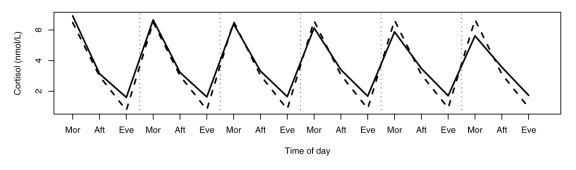
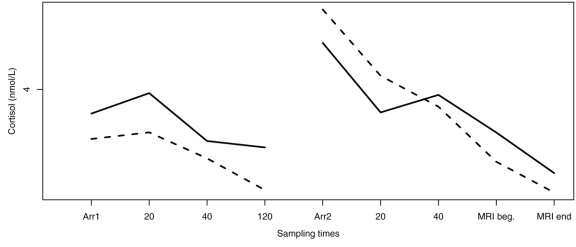
Methods: Circadian rhythms of cortisol were estimated in 22 children with and 22 children without autism via analysis of salivary samples collected in the morning, afternoon and evening over 6 separate days. We assessed hypothalamic-pituitary-adrenal (HPA) responsiveness by examining changes in salivary cortisol in response to a mock MRI. One-half of the children were re-exposed to the MRI environment.
Results: Children with autism showed a decrease in cortisol in the morning over 6 days while maintaining higher evening values. Children with autism also showed more within-and between-subject variability in circadian rhythms. Although the cortisol values tended to be higher in some of the children with autism, a statistically significant elevation in cortisol in response to the initial mock MRI was not observed. Rather, both groups showed heightened cortisol at the arrival to the second visit to the imaging centre, suggesting an anticipatory response to the re-exposure to the mock MRI.
Conclusion: Children with autism showed dysregulation of the circadian rhythm evidenced by variability between groups, between children and within individual child comparisons. Both groups demonstrated increased salivary cortisol in anticipation of re-exposure to the perceived stressor.
Objectif: L'autisme est caractérisé par un déficit de la communication et de l'interaction sociale, par des comportements répétitifs et par la difficulté d'adaptation aux expériences nouvelles. L'étude en cours visait à reproduire et à étendre nos résultats antérieurs montrant un rythme circadien variable et des élévations importantes du cortisol à la suite d'une exposition à un stimulus nouveau (imagerie par résonance magnétique [IRM] fictive).
Méthodes: On a estimé les rythmes circadiens du cortisol chez 22 enfants sans autisme et 22 enfants atteints d'autisme en analysant des échantillons de salive prélevés le matin, l'après-midi et le soir pendant six jours. Nous avons évalué la sensibilité hypothalamus-hypophyse-surrénales (hypothalamic-pituitary-adrenal ou HPA) en étudiant des changements du cortisol salivaire en réponse à une IRM fictive. La moitié des enfants ont été exposés de nouveau à l'environnement de l'IRM.
Résultats: Chez les enfants atteints d'autisme, le cortisol baissait le matin pendant les six jours tandis que les valeurs se maintenaient à un niveau plus élevé le soir. Les rythmes circadiens des enfants atteints d'autisme ont aussi varié davantage chez un même sujet et d'un sujet à l'autre. Même si les valeurs du cortisol avaient tendance à être plus élevées chez certains des enfants atteints d'autisme, on n'a pas observé d'élévation statistiquement significative du cortisol en réponse à l'IRM fictive initiale. On a plutôt constaté une élévation du cortisol chez les deux groupes à leur arrivée à la deuxième visite au centre d'imagerie, ce qui indique une réaction d'anticipation à la réexposition à l'IRM fictive.
Conclusion: Les enfants atteints d'autisme présentaient une dysrégulation du rythme circadien démontrée par la variabilité entre les groupes, d'un enfant à l'autre et chez un même enfant. Le cortisol salivaire a augmenté chez les deux groupes en anticipation d'une réexposition au facteur de stress perçu.
Keywords: autistic disorder; circadian rhythm; cortisol; stress.
Figures
References
-
- American Psychiatric Association. Diagnostic and statistical manual of mental disorders. 4th ed. Washington: The Association; 1994.
-
- Corbett BA, Mendoza S, Abdullah M, et al. Cortisol circadian rhythms and response to stress in children with autism. Psychoneuroendocrinology 2006;31:59-68. - PubMed
-
- Hill SD, Wagner EA, Shedlarski JG Jr, et al. Diurnal cortisol and temperature variation of normal and autistic children. Dev Psychobiol 1977;10:579-83. - PubMed
-
- Jansen LM, Gispen-de Wied CC, Van der Gaag RJ, et al. Unresponsiveness to psychosocial stress in a subgroup of autistic-like children, multiple complex developmental disorder. Psychoneuroendocrinology 2000;25:753-64. - PubMed
-
- Jansen LM, Gispen-de Wied CC, van der Gaag RJ, et al. Differentiation between autism and multiple complex developmental disorder in response to psychosocial stress. Neuropsychopharmacology 2003;28:582-90. - PubMed
Publication types
MeSH terms
Substances
Grants and funding
LinkOut - more resources
Full Text Sources
Other Literature Sources
Medical