Review
. 2008 Jul;88(1):7-15.
doi: 10.1007/s12185-008-0120-5. Epub 2008 Jul 2.

Body iron metabolism and pathophysiology of iron overload

Affiliations
Review

Body iron metabolism and pathophysiology of iron overload

Yutaka Kohgo et al. Int J Hematol. 2008 Jul.

Abstract

Iron is an essential metal for the body, while excess iron accumulation causes organ dysfunction through the production of reactive oxygen species. There is a sophisticated balance of body iron metabolism of storage and transport, which is regulated by several factors including the newly identified peptide hepcidin. As there is no passive excretory mechanism of iron, iron is easily accumulated when exogenous iron is loaded by hereditary factors, repeated transfusions, and other diseased conditions. The free irons, non-transferrin-bound iron, and labile plasma iron in the circulation, and the labile iron pool within the cells, are responsible for iron toxicity. The characteristic features of advanced iron overload are failure of vital organs such as liver and heart in addition to endocrine dysfunctions. For the estimation of body iron, there are direct and indirect methods available. Serum ferritin is the most convenient and widely available modality, even though its specificity is sometimes problematic. Recently, new physical detection methods using magnetic resonance imaging and superconducting quantum interference devices have become available to estimate iron concentration in liver and myocardium. The widely used application of iron chelators with high compliance will resolve the problems of organ dysfunction by excess iron and improve patient outcomes.


Figures
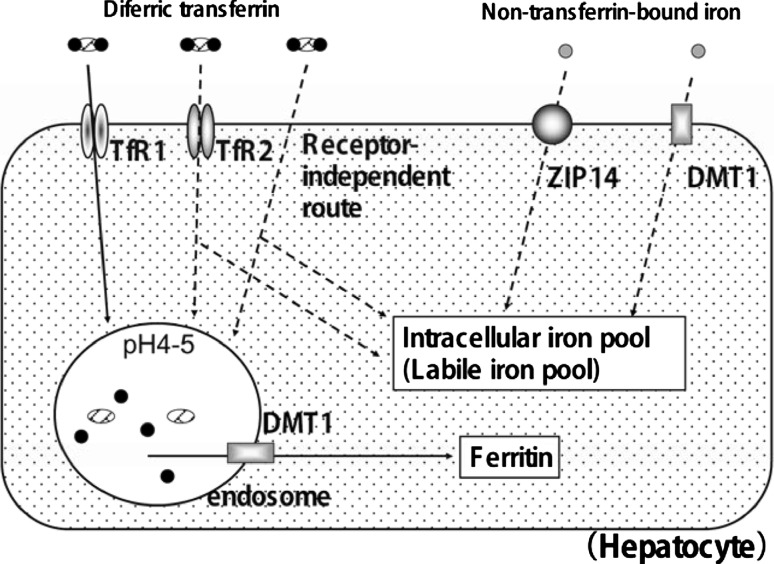
Fig. 1
Fig. 1
Routes for iron uptake by hepatocytes. Hepatocytes have several pathways for iron uptake from the circulation. Concerning uptake of Tf-bound iron (Fe2-Tf) at physiological concentrations, there are three pathways involving TfR1, TfR2, and TfR-independent mechanisms. The pathway via TfR1 is a classical one and is well elucidated. When serum Fe2-Tf binds to TfR1, the Fe2Tf-TfR1 complex is internalized by endocytosis, and iron is released within the endosome when endosomal pH is acidic. The resulting apotransferrin-TfR1 complex is then recycled back to the cell surface for re-utilization. Released iron into the endosome is transferred to the cytoplasm by DMT1; the resulting cytoplasmic free iron is used for iron-related biological functions, and the rest of the iron is stored as ferritin. In addition to TfR1, TfR2 and the mechanism that is independent of TfR1 and TfR2, are also considered to be important routes for iron uptake in hepatocytes, but the details of these routes remain to be elucidated. Concerning the hepatic uptake of NTBI, which is present in the serum during conditions of iron overload, DMT1 and ZIP14 are considered to be involved
Fig. 2
Fig. 2
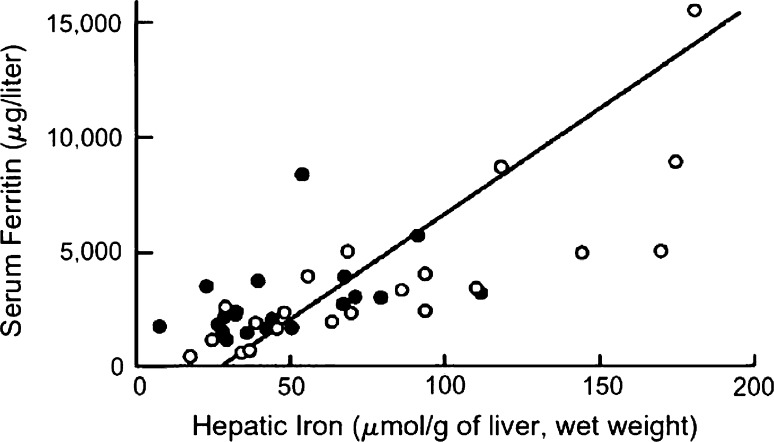
Comparison of hepatic iron and serum ferritin concentrations. Indirect estimation is compared with the reference method, based on the direct measurement of hepatic iron levels by chemical analysis or magnetic-susceptibility studies. Open circles denote the values at the start of the trial (before deferiprone therapy), and solid circles the values at the time of the final analysis. The diagonal line denotes the simple linear least-squares regression between the two variables. (From [31]. Reproduced with permission. Olivieri NF et al. N Engl J Med. 1995;332:918–22. Copyright ©1995 Massachusetts Medical Society. All rights reserved)

References

    1. Andrews NC. Disorders of iron metabolism. N Engl J Med. 1999;341:1986–95. doi: 10.1056/NEJM199912233412607. - DOI - PubMed
    1. McKie AT, Latunde-Dada GO, Miret S, et al. Molecular evidence for the role of a ferric reductase in iron transport. Biochem Soc Trans. 2002;30:722–4. doi: 10.1042/bst0300722. - DOI - PubMed
    1. Trinder D, Fox C, Vautier G, Olynyk JK. Molecular pathogenesis of iron overload. Gut. 2002;51:290–5. doi: 10.1136/gut.51.2.290. - DOI - PMC - PubMed
    1. Sargent PJ, Farnaud S, Evans RW. Structure/function overview of proteins involved in iron storage and transport. Curr Med Chem. 2005;12:2683–93. doi: 10.2174/092986705774462969. - DOI - PubMed
    1. Cabantchik ZI, Breuer W, Zanninelli G, Cianciulli P. LPI-labile plasma iron in iron overload. Best Pract Res Clin Haematol. 2005;18:277–87. doi: 10.1016/j.beha.2004.10.003. - DOI - PubMed