


doi: 10.1901/jaba.2008.41-237.
Using joint activity schedules to promote peer engagement in preschoolers with autism
Affiliations
- PMID: 18595287
- PMCID: PMC2408340
- DOI: 10.1901/jaba.2008.41-237
Item in Clipboard
Using joint activity schedules to promote peer engagement in preschoolers with autism
J Appl Behav Anal.
2008 Summer.
Abstract
We assessed the use of a joint activity schedule to increase peer engagement for preschoolers with autism. We taught 3 dyads of preschoolers with autism to follow joint activity schedules that cued both members of the pair to play a sequence of interactive games together. Results indicated that joint activity schedules increased peer engagement and the number of games completed for all dyads. Schedule following was maintained without additional prompting when activities were resequenced and when new games were introduced for 2 of the 3 dyads.
Figures
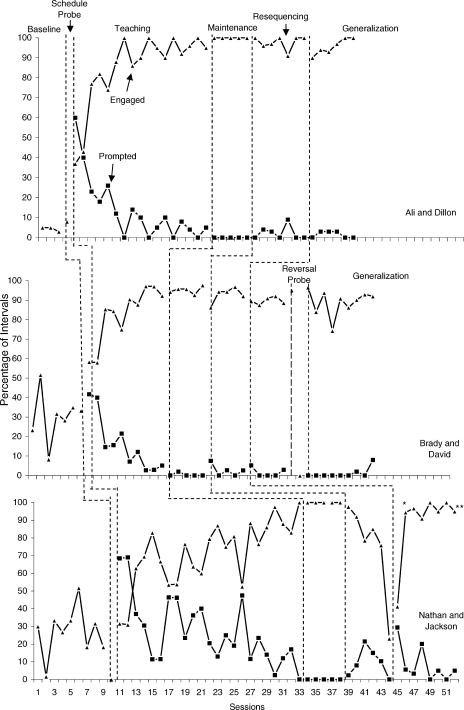
Results of the joint activity schedule intervention for Ali and Dillon (top), Brady and David (middle), and Nathan and Jackson (bottom). The asterisk represents the session in which manual prompts were reintroduced for Nathan and Jackson. The double asterisks represent the session in which those prompts were completely faded.
References
-
- McClannahan L.E, Krantz P.J. Activity schedules for children with autism: Teaching independent behavior. Bethesda, MD: Woodbine House; 1999.
-
- Stevenson C.L, Krantz P.J, McClannahan L.E. Social interaction skills for children with autism: A script-fading procedure for nonreaders. Behavioral Interventions. 2000;15:1–20. - PubMed
MeSH terms
LinkOut - more resources
Full Text Sources
Medical
