. 2008 Aug;36(13):4417-23.
doi: 10.1093/nar/gkn409. Epub 2008 Jul 2.

Effect of polymorphisms within probe-target sequences on olignonucleotide microarray experiments

Affiliations

Effect of polymorphisms within probe-target sequences on olignonucleotide microarray experiments

David Benovoy et al. Nucleic Acids Res. 2008 Aug.

Abstract

Hybridization-based technologies, such as microarrays, rely on precise probe-target interactions to ensure specific and accurate measurement of RNA expression. Polymorphisms present in the probe-target sequences have been shown to alter probe- hybridization affinities, leading to reduced signal intensity measurements and resulting in false-positive results. Here, we characterize this effect on exon and gene expression estimates derived from the Affymetrix Exon Array. We conducted an association analysis between expression levels of probes, exons and transcripts and the genotypes of neighboring SNPs in 57 CEU HapMap individuals. We quantified the dependence of the effect of genotype on signal intensity with respect to the number of polymorphisms within target sequences, number of affected probes and position of the polymorphism within each probe. The effect of SNPs is quite severe and leads to considerable false-positive rates, particularly when the analysis is performed at the exon level and aimed at detecting alternative splicing events. Finally, we propose simple solutions, based on 'masking' probes, which are putatively affected by polymorphisms and show that such strategy results in a large decrease in false-positive rates, with a very modest reduction in coverage of the transcriptome.


Figures
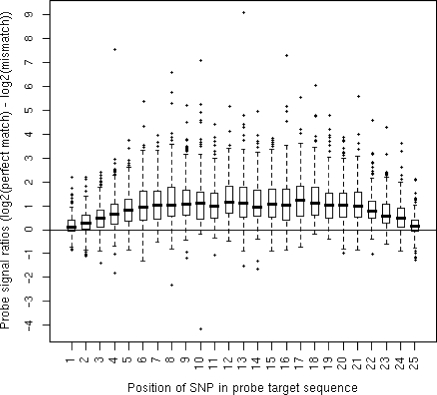
Figure 1.
Figure 1.
Boxplots illustrating the positional effect of SNPs within the probe target region. Probe signal ratios between perfect complementary regions and regions with a single mismatch.
Figure 2.
Figure 2.
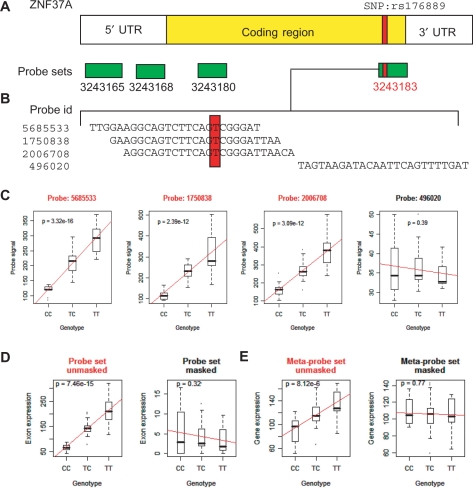
ZNF37A is an example of a false-positive induced by a SNP (rs176889). (A) The ZNF37A mRNA molecule is illustrated with the coding region in yellow and the 5′ and 3′ UTRs is represented in white. The horizontal green rectangles represent the 4 probe sets that target this transcript. The red bars represent the position of SNP rs176889 in the coding sequence of this transcript. (B) The alignment of the 4 probe sequences that constitute probe set 3 243 183 and SNP rs176889 falls within each of these probes (red box). (C) Plots illustrating the association between each of the 4 probes and the different genotypes for SNP rs176889. Probe 496 020 does not contain any SNP and the association is non-significant. It is the only probe used to estimate probe set 3 243 183 expression scores. (D) Probe set 3 243 183 is no longer a false-positive after our masking procedure. (E) The same is observed at the meta-probe set level, where this gene is not significantly associated with SNP rs176889 or any other neighboring SNPs (results not shown).
Figure 3.
Figure 3.
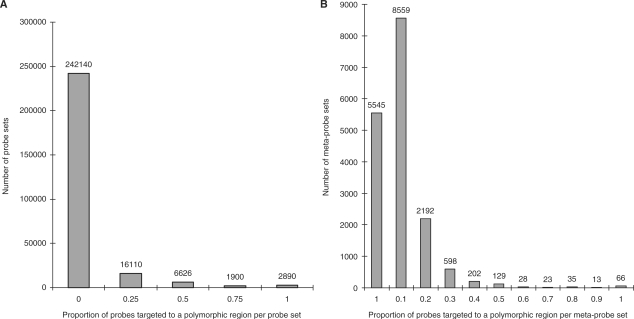
Distribution of probe sets and meta-probe sets containing SNPs. (A) Proportion of affected probes per exon (B) Proportion of probes that contain SNPs per transcript.

References

    1. Komura D, Shen F, Ishikawa S, Fitch KR, Chen W, Zhang J, Liu G, Ihara S, Nakamura H, Hurles ME, et al. Genome-wide detection of human copy number variations using high-density DNA oligonucleotide arrays. Genome Res. 2006;16:1575–1584. - PMC - PubMed
    1. Stranger BE, Forrest MS, Dunning M, Ingle CE, Beazley C, Thorne N, Redon R, Bird CP, de Grassi A, Lee C, et al. Relative impact of nucleotide and copy number variation on gene expression phenotypes. Science. 2007;315:848–853. - PMC - PubMed
    1. Kwan T, Benovoy D, Dias C, Gurd S, Provencher C, Beaulieu P, Hudson TJ, Sladek R, Majewski J. Genome-wide analysis of transcript isoform variation in humans. Nat. Genet. 2008;40:225–231. - PubMed
    1. Morley M, Molony CM, Weber TM, Devlin JL, Ewens KG, Spielman RS, Cheung VG. Genetic analysis of genome-wide variation in human gene expression. Nature. 2004;430:743–747. - PMC - PubMed
    1. Cheung VG, Spielman RS, Ewens KG, Weber TM, Morley M, Burdick JT. Mapping determinants of human gene expression by regional and genome-wide association. Nature. 2005;437:1365–1369. - PMC - PubMed

Publication types

Substances