. 2008 Sep;82(18):9206-15.
doi: 10.1128/JVI.00399-08. Epub 2008 Jul 2.

Temporal and spatial dynamics of human immunodeficiency virus type 1 circulating recombinant forms 08_BC and 07_BC in Asia

Affiliations

Temporal and spatial dynamics of human immunodeficiency virus type 1 circulating recombinant forms 08_BC and 07_BC in Asia

Kok Keng Tee et al. J Virol. 2008 Sep.

Abstract

Human immunodeficiency virus type 1 (HIV-1) CRF08_BC and CRF07_BC are two major recombinants descended from subtypes B' and C. Despite their massive epidemic impact in China, their migration patterns and divergence times remain unknown. Phylogenetic and population genetic analyses were performed on 228 HIV-1 sequences representing CRF08_BC, CRF07_BC, and subtype C strains from different locations across China, India, and Myanmar. Genome-specific rates of evolution and divergence times were estimated using a Bayesian Markov chain Monte Carlo framework under various evolutionary models. CRF08_BC originated in 1990.3 (95% credible region [CR], 1988.6 to 1991.9) in Yunnan province before spreading to Guangxi (south) and Liaoning (northeast) around 1995. Inside Guangxi region, the eastward expansion of CRF08_BC continued from Baise city (west) to Binyang (central) between 1997 and 1998 and later spread into Pingxiang around 1999 in the south, mainly through injecting drug users. Additionally, CRF07_BC diverged from its common ancestor in 1993.3 (95% CR, 1991.2 to 1995.2) before crossing the border into southern Taiwan in late 1990s. Phylogenetic analysis indicates that both CRF08_BC and CRF07_BC can trace their origins to Yunnan. The parental Indian subtype C lineage likely entered China around 1981.2 (95% CR, 1976.7 to 1985.9). Using a multiple unlinked locus model, we also showed that the dates of divergence calculated in this study may not be significantly affected by intrasubtype recombination among different lineages. This is the first phylodynamic study depicting the spatiotemporal dynamics of HIV/AIDS in East Asia.


Figures
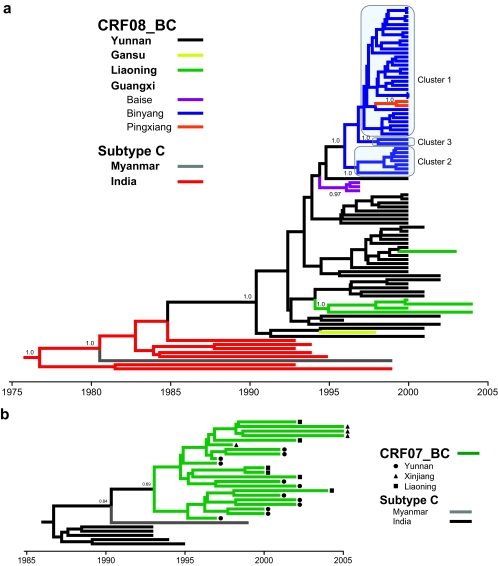
FIG. 1.
FIG. 1.
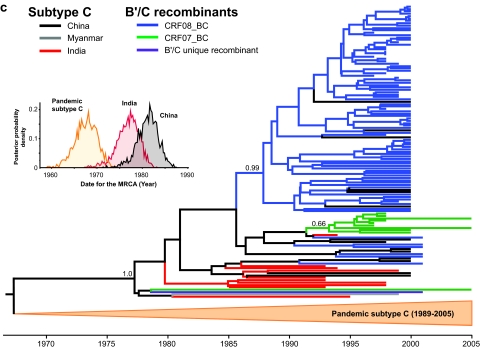
Maximum-likelihood phylogenetic analyses of HIV-1 CRF08_BC, CRF07_BC, and subtype C in China. (a) Phylogenetic reconstructions of CRF08_BC gag-pol genes (HXB2 nucleotides 1918 to 2852) isolated from HIV-1 patients in the Yunnan (Kunming, Honghe, and Wenshan), Gansu, Liaoning (Shenyang), and Guangxi (Baise, Binyang, and Pingxiang) regions of China. (b) Maximum clade credibility trees of the HIV-1 CRF07_BC sequences from Yunnan, Xinjiang, and Liaoning provinces, based on the gag gene (HXB2 nucleotides 790 to 1218). (c) The env (HXB2 nucleotides 6984 to 7328) phylogeny of subtype C, CRF08_BC, CRF07_BC, and a B′/C unique recombinant form isolated from China. Ancestral relationships are estimated using PAUP*, version 4.0 beta (40), and BEAST, version 1.4 (7). Subtype C of Indian origin, thought to be the putative parent of both CRF08_BC and CRF07_BC (19, 20), is also included. The CRF08_BC gag-pol and CRF07_BC gag tree branches are colored according to their respective geographical locations while the env tree branches show the respective HIV-1 subtype/CRF. Posterior probabilities greater than 0.5 are shown at their respective nodes.
FIG. 1.
FIG. 1.
Maximum-likelihood phylogenetic analyses of HIV-1 CRF08_BC, CRF07_BC, and subtype C in China. (a) Phylogenetic reconstructions of CRF08_BC gag-pol genes (HXB2 nucleotides 1918 to 2852) isolated from HIV-1 patients in the Yunnan (Kunming, Honghe, and Wenshan), Gansu, Liaoning (Shenyang), and Guangxi (Baise, Binyang, and Pingxiang) regions of China. (b) Maximum clade credibility trees of the HIV-1 CRF07_BC sequences from Yunnan, Xinjiang, and Liaoning provinces, based on the gag gene (HXB2 nucleotides 790 to 1218). (c) The env (HXB2 nucleotides 6984 to 7328) phylogeny of subtype C, CRF08_BC, CRF07_BC, and a B′/C unique recombinant form isolated from China. Ancestral relationships are estimated using PAUP*, version 4.0 beta (40), and BEAST, version 1.4 (7). Subtype C of Indian origin, thought to be the putative parent of both CRF08_BC and CRF07_BC (19, 20), is also included. The CRF08_BC gag-pol and CRF07_BC gag tree branches are colored according to their respective geographical locations while the env tree branches show the respective HIV-1 subtype/CRF. Posterior probabilities greater than 0.5 are shown at their respective nodes.
FIG. 2.
FIG. 2.
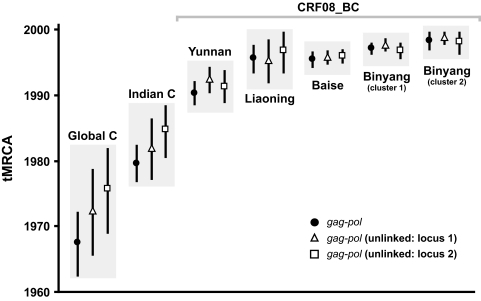
Dates of the MRCA of HIV-1 subtype C and CRF08_BC estimated in a multiple unlinked locus model. The gag-pol gene was partitioned (locus 1 and 2), and Bayesian estimation for each locus was performed in BEAST, assuming a shared demographic history among all loci. The mean coalescence time estimates with 95% highest posterior density for HIV subtype C and CRF08_BC from various geographical origins are illustrated.
FIG. 3.
FIG. 3.
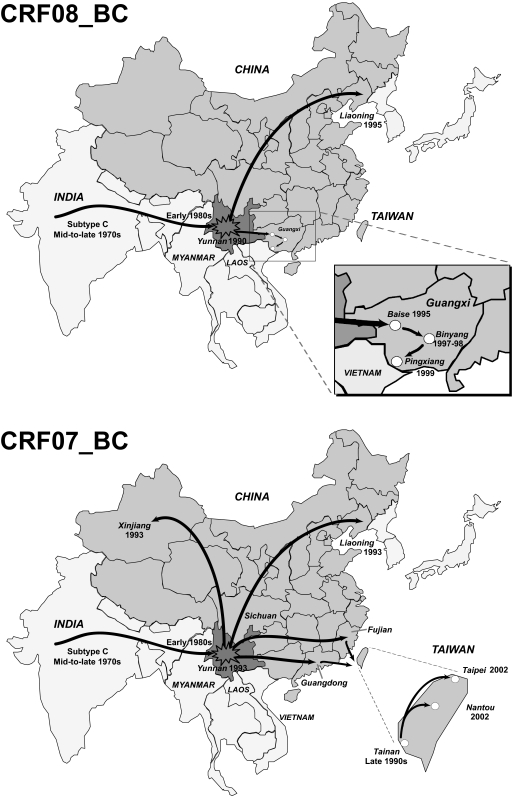
Plausible site of origin and migration routes of HIV-1 CRF08_BC and CRF07_BC. HIV-1 subtype C of Indian origin entered the Yunnan province (darker shade) in southern China in the early 1980s, possibly via Myanmar. Cocirculation of subtype C and the endemic subtype B′ (10, 45) led to genetic recombination and the generation of CRF08_BC (26) and CRF07_BC (38), two related but distinct B′/C recombinants in Yunnan. Further spread of CRF08_BC and CRF07_BC into other regions in the 1990s mainly through injection drug use (2) has been implicated as the major force spurring the HIV/AIDS epidemic in China. The tMRCAs of CRF08_BC, CRF07_BC, and subtype C strains representing different geographical locations are summarized in Table 2.

References

    1. Abecasis, A. B., P. Lemey, N. Vidal, T. de Oliveira, M. Peeters, R. Camacho, B. Shapiro, A. Rambaut, and A. M. Vandamme. 2007. Recombination confounds the early evolutionary history of human immunodeficiency virus type 1: subtype G is a circulating recombinant form. J. Virol. 818543-8551. - PMC - PubMed
    1. Beyrer, C., M. H. Razak, K. Lisam, J. Chen, W. Lui, and X. F. Yu. 2000. Overland heroin trafficking routes and HIV-1 spread in South and South-East Asia. AIDS 1475-83. - PubMed
    1. Cheng, H., J. Zhang, J. Capizzi, N. L. Young, and T. D. Mastro. 1994. HIV-1 subtype E in Yunnan, China. Lancet 344953-954. - PubMed
    1. De Sa Filho, D. J., M. C. Sucupira, M. M. Caseiro, E. C. Sabino, R. S. Diaz, and L. M. Janini. 2006. Identification of two HIV type 1 circulating recombinant forms in Brazil. AIDS Res. Hum. Retrovir. 221-13. - PubMed
    1. Drummond, A. J., S. Y. Ho, M. J. Phillips, and A. Rambaut. 2006. Relaxed phylogenetics and dating with confidence. PLoS Biol. 4e88. - PMC - PubMed

Publication types