


Associations between the genotypes of Staphylococcus aureus bloodstream isolates and clinical characteristics and outcomes of bacteremic patients
- PMID: 18596141
- PMCID: PMC2546778
- DOI: 10.1128/JCM.00905-08
Associations between the genotypes of Staphylococcus aureus bloodstream isolates and clinical characteristics and outcomes of bacteremic patients
Abstract
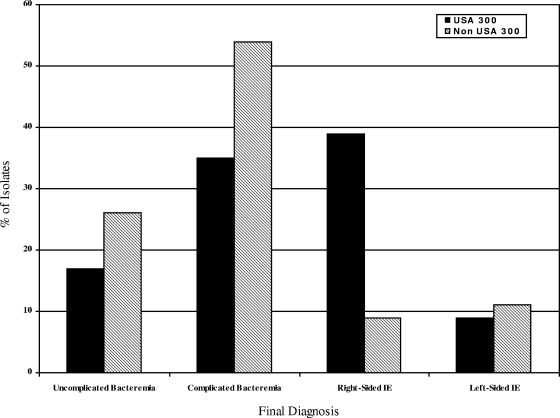
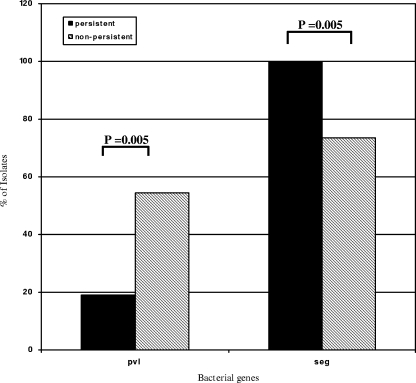
We investigated associations between the genotypic and phenotypic features of Staphylococcus aureus bloodstream isolates and the clinical characteristics of bacteremic patients enrolled in a phase III trial of S. aureus bacteremia and endocarditis. Isolates underwent pulsed-field gel electrophoresis, PCR for 33 putative virulence genes, and screening for heteroresistant glycopeptide intermediate S. aureus (hGISA). A total of 230 isolates (141 methicillin-susceptible S. aureus and 89 methicillin-resistant S. aureus [MRSA]) were analyzed. North American and European S. aureus isolates differed in their genotypic characteristics. Overall, 26% of the MRSA bloodstream isolates were USA 300 strains. Patients with USA 300 MRSA bacteremia were more likely to be injection drug users (61% versus 15%; P < 0.001), to have right-sided endocarditis (39% versus 9%; P = 0.002), and to be cured of right-sided endocarditis (100% versus 33%; P = 0.01) than patients with non-USA 300 MRSA bacteremia. Patients with persistent bacteremia were less likely to be infected with Panton-Valentine leukocidin gene (pvl)-constitutive MRSA (19% versus 56%; P = 0.005). Although 7 of 89 MRSA isolates (8%) exhibited the hGISA phenotype, no association with persistent bacteremia, daptomycin resistance, or bacterial genotype was observed. This study suggests that the virulence gene profiles of S. aureus bloodstream isolates from North America and Europe differ significantly. In this study of bloodstream isolates collected as part of a multinational randomized clinical trial, USA 300 and pvl-constitutive MRSA strains were associated with better clinical outcomes.
Figures
References
-
- Campbell, S. J., H. S. Deshmukh, C. L. Nelson, I. G. Bae, M. E. Stryjewski, J. J. Federspiel, G. T. Tonthat, T. H. Rude, S. L. Barriere, R. Corey, and V. G. Fowler, Jr. 2007. Genotypic characteristics of Staphylococcus aureus isolates from a multinational trial of complicated skin and skin structure infections. J. Clin. Microbiol. 46678-684. - PMC - PubMed
-
- Charles, P. G., P. B. Ward, P. D. Johnson, B. P. Howden, and M. L. Grayson. 2004. Clinical features associated with bacteremia due to heterogeneous vancomycin-intermediate Staphylococcus aureus. Clin. Infect. Dis. 38448-451. - PubMed
-
- Diep, B. A., S. R. Gill, R. F. Chang, T. H. Phan, J. H. Chen, M. G. Davidson, F. Lin, J. Lin, H. A. Carleton, E. F. Mongodin, G. F. Sensabaugh, and F. Perdreau-Remington. 2006. Complete genome sequence of USA 300, an epidemic clone of community-acquired methicillin-resistant Staphylococcus aureus. Lancet 367731-739. - PubMed
-
- Fluit, A. C., M. E. Jones, F. J. Schmitz, J. Acar, R. Gupta, and J. Verhoef. 2000. Antimicrobial susceptibility and frequency of occurrence of clinical blood isolates in Europe from the SENTRY antimicrobial surveillance program, 1997 and 1998. Clin. Infect. Dis. 30454-460. - PubMed
-
- Fowler, V. G., Jr., H. W. Boucher, G. R. Corey, E. Abrutyn, A. W. Karchmer, M. E. Rupp, D. P. Levine, H. F. Chambers, F. P. Tally, G. A. Vigliani, C. H. Cabell, A. S. Link, I. DeMeyer, S. G. Filler, M. Zervos, P. Cook, J. Parsonnet, J. M. Bernstein, C. S. Price, G. N. Forrest, G. Fatkenheuer, M. Gareca, S. J. Rehm, H. R. Brodt, A. Tice, and S. E. Cosgrove. 2006. Daptomycin versus standard therapy for bacteremia and endocarditis caused by Staphylococcus aureus. N. Engl. J. Med. 355653-665. - PubMed
Publication types
MeSH terms
LinkOut - more resources
Full Text Sources
Medical
