


Evaluation of a new Etest vancomycin-teicoplanin strip for detection of glycopeptide-intermediate Staphylococcus aureus (GISA), in particular, heterogeneous GISA
- PMID: 18596146
- PMCID: PMC2546754
- DOI: 10.1128/JCM.00265-08
Evaluation of a new Etest vancomycin-teicoplanin strip for detection of glycopeptide-intermediate Staphylococcus aureus (GISA), in particular, heterogeneous GISA
Abstract
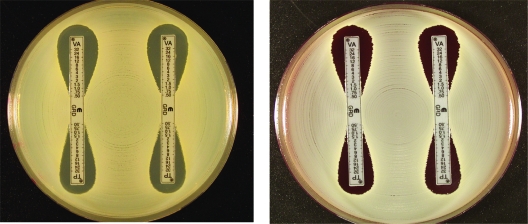
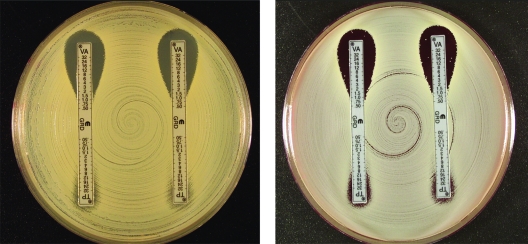
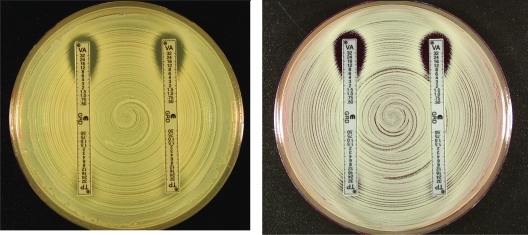
Glycopeptide-intermediate Staphylococcus aureus (GISA) and, in particular, heterogeneous GISA (hGISA) are difficult to detect by standard MIC methods, and thus, an accurate detection method for clinical practice and surveillances is needed. Two prototype Etest strips designed for hGISA/GISA resistance detection (GRD) were evaluated using a worldwide collection of hGISA/GISA strains covering the five major clonal lineages. A total of 150 strains comprising 15 GISA and 60 hGISA strains (defined by population analysis profiles-area under the curve [PAP-AUC]), 70 glycopeptide-susceptible S. aureus (GSSA) strains, and 5 S. aureus ATCC reference strains were tested. For standardized Etest vancomycin (VA) MIC testing, the modified Etest macromethod with VA and teicoplanin (TP) strips tested with a heavier inoculum using brain heart infusion agar (BHI) and two glycopeptide screening agar plates (6 microg/ml VA/BHI and 5 microg/ml Mueller-Hinton agar [MHA]) were tested in parallel with the two new Etest GRD strips: a VA 32 (0.5-microg/ml)-TP 32 (0.5-microg/ml) double-sided gradient (E-VA/TP) with one prototype overlaid with a nutrient (E-VA/TP+S) to enhance the growth of hGISA. The Etest GRD strips were tested with a standard 0.5-McFarland standard inoculum using MHA and MHA plus 5% blood (MHB) and were read at 18 to 24 and 48 h. The interpretive MIC cutoffs used for the new Etest GRD strips at 24 and 48 h were as follows: for GISA, TP or VA, >or=8, and a standard VA MIC of >or=6; for hGISA, TP or VA, >or=8, and a standard VA MIC of <or=4. The results on MHB at 48 h showed that E-VA/TP+S had high specificity (94%) and sensitivity (95%) in comparison to PAP-AUC and was able to detect all GISA (n = 15) and 98% of hGISA (n = 60) strains. In contrast, the glycopeptide screening plates performed poorly for hGISA. The new Etest GRD strip (E-VA/TP+S), utilizing standard media and inocula, is a simple and acceptable tool for detection of hGISA/GISA for clinical and epidemiologic purposes.
Figures
References
-
- Anonymous. 2004. Vancomycin-resistant Staphylococcus aureus—New York, 2004. MMWR Morb. Mortal. Wkly. Rep. 53322-323. - PubMed
-
- Anonymous. 2002. Vancomycin-resistant Staphylococcus aureus—Pennsylvania, 2002. MMWR Morb. Mortal. Wkly. Rep. 51902. - PubMed
-
- Appelbaum, P. C. 2006. The emergence of vancomycin-intermediate and vancomycin-resistant Staphylococcus aureus. Clin. Microbiol. Infect. 12(Suppl. 1)16-23. - PubMed
-
- Berger-Bachi, B. 2002. Resistance mechanisms of gram-positive bacteria. Int. J. Med. Microbiol. 29227-35. - PubMed
-
- Charles, P. G., P. B. Ward, P. D. Johnson, B. P. Howden, and M. L. Grayson. 2004. Clinical features associated with bacteremia due to heterogeneous vancomycin-intermediate Staphylococcus aureus. Clin. Infect. Dis. 38448-451. - PubMed
MeSH terms
Substances
LinkOut - more resources
Full Text Sources
Medical
Molecular Biology Databases
Research Materials
