


In vitro activity of tigecycline against gram-positive and gram-negative pathogens as evaluated by broth microdilution and Etest
- PMID: 18596149
- PMCID: PMC2546738
- DOI: 10.1128/JCM.00637-08
In vitro activity of tigecycline against gram-positive and gram-negative pathogens as evaluated by broth microdilution and Etest
Abstract
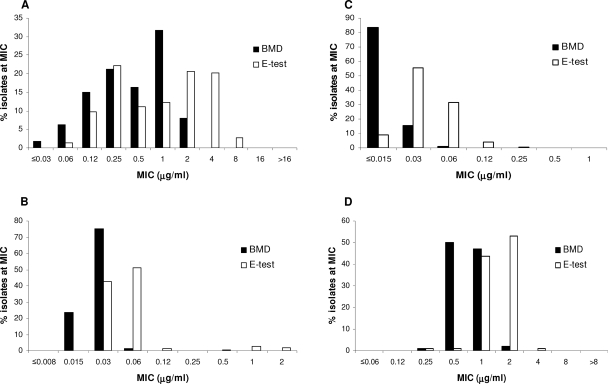
The current surveillance establishes the activity profile of tigecycline against recent clinical U.S. isolates of target pathogens. Findings from a distributed surveillance that utilized Etest yielded a tigecycline activity profile that varied from that observed in a separate centralized broth microdilution (BMD) surveillance (D. C. Draghi et al., Poster D-0701, 46th Intersci. Conf. Antimicrob. Agents Chemother., San Francisco, CA). Differences were noted among Acinetobacter spp. and Serratia marcescens and, to a lesser extent, with Streptococcus pyogenes. To address whether these differences were due to discordance in testing methodology or to variations among the analyzed populations, isolates from the current surveillance were concurrently tested by BMD and Etest. In all, 1,800 Staphylococcus aureus, 259 S. pyogenes, 226 Streptococcus pneumoniae, 93 Enterococcus faecalis, 1,356 Enterobacteriaceae, and 227 Acinetobacter baumannii strains were evaluated. Tigecycline had potent activity by BMD, with >99.6% susceptibility (%S) observed for all pathogens with interpretive criteria, excluding Enterobacter cloacae (98.3% S) and E. faecalis (86.0% S), and MIC(90)s ranged from 0.03 mug/ml (S. pyogenes/S. pneumoniae) to 1 mug/ml (Enterobacteriaceae/A. baumannii). Similar profiles were observed by Etest, with the exception of A. baumannii, although for most evaluated pathogens Etest MICs trended one doubling-dilution higher than BMD MICs. Major or very major errors were infrequent, and a high degree of essential agreement was observed, excluding A. baumannii, S. marcescens, and S. pneumoniae, for which >/=4-fold differences in MICs were observed for 29, 27.1, and 34% of the isolates, respectively. Further analysis regarding the suitability of the tigecycline Etest for testing S. marcescens, Acinetobacter spp., and S. pneumoniae is warranted.
Figures
References
-
- Bouchillon, S. K., D. J. Hoban, B. M. Johnson, J. L. Johnson, A. Hsiung, and M. J. Dowzicky. 2005. In vitro activity of tigecycline against 3989 gram-negative and gram-positive clinical isolates from the United States Tigecycline Evaluation and Surveillance Trial (TEST Program, 2004). Diagn. Microbiol. Infect. Dis. 52173-179. - PubMed
-
- Bradford, P. A., D. T. Weaver-Sands, and P. J. Petersen. 2005. In vitro activity of tigecycline against isolates from patients enrolled in phase 3 clinical trials of treatment for complicated skin and skin-structure infections and complicated intra-abdominal infections. Clin. Infect. Dis. 41(Suppl. 5)S315-S332. - PubMed
-
- Clinical and Laboratory Standards Institute. 2006. Methods for dilution antimicrobial susceptibility test for bacteria that grow aerobically; approved standard, 7th ed. CLSI document M7-A7. Clinical and Laboratory Standards Institute, Wayne, PA.
-
- Clinical and Laboratory Standards Institute. 2007. Performance standards for antimicrobial susceptibility testing; 17th informational supplement. CLSI document M100-S17. Clinical and Laboratory Standards Institute, Wayne, PA.
Publication types
MeSH terms
Substances
LinkOut - more resources
Full Text Sources
Medical
Miscellaneous
