


WRN is required for ATM activation and the S-phase checkpoint in response to interstrand cross-link-induced DNA double-strand breaks
- PMID: 18596239
- PMCID: PMC2526706
- DOI: 10.1091/mbc.e07-07-0698
WRN is required for ATM activation and the S-phase checkpoint in response to interstrand cross-link-induced DNA double-strand breaks
Abstract
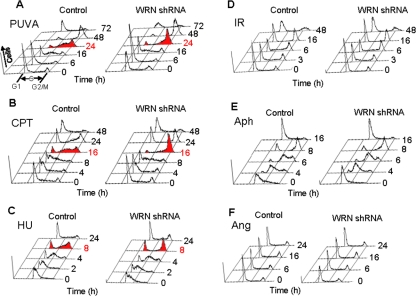
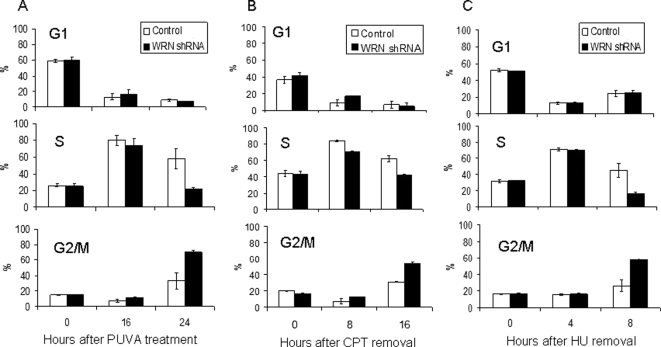
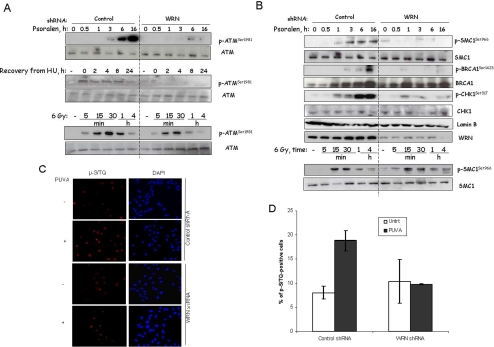
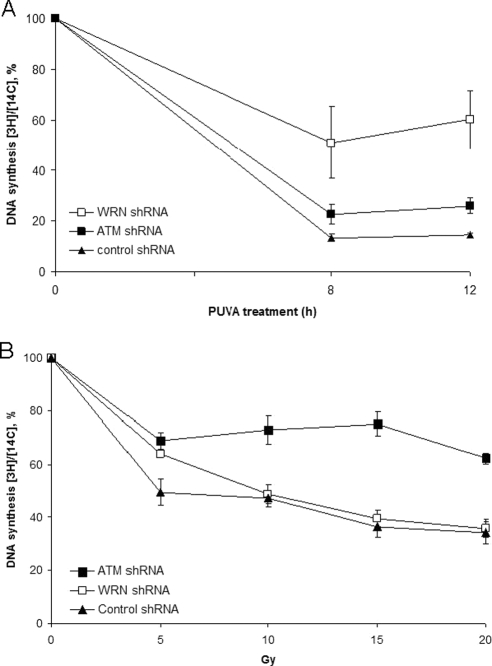
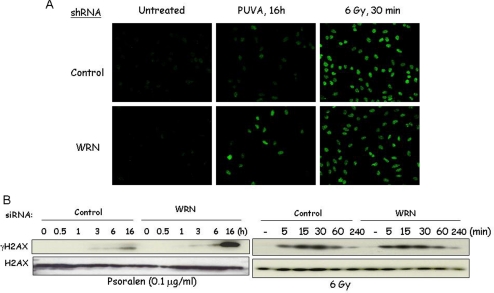
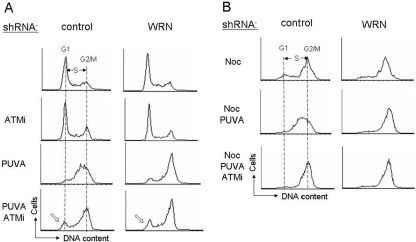
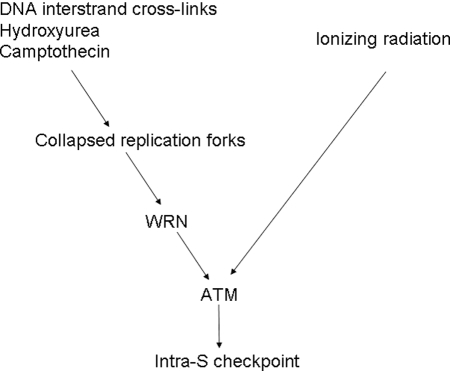
Werner syndrome (WS) is a human genetic disorder characterized by extensive clinical features of premature aging. Ataxia-telengiectasia (A-T) is a multisystem human genomic instability syndrome that includes premature aging in some of the patients. WRN and ATM, the proteins defective in WS and A-T, respectively, play significant roles in the maintenance of genomic stability and are involved in several DNA metabolic pathways. A role for WRN in DNA repair has been proposed; however, this study provides evidence that WRN is also involved in ATM pathway activation and in a S-phase checkpoint in cells exposed to DNA interstrand cross-link-induced double-strand breaks. Depletion of WRN in such cells by RNA interference results in an intra-S checkpoint defect, and interferes with activation of ATM as well as downstream phosphorylation of ATM target proteins. Treatment of cells under replication stress with the ATM kinase inhibitor KU 55933 results in a S-phase checkpoint defect similar to that observed in WRN shRNA cells. Moreover, gamma H2AX levels are higher in WRN shRNA cells than in control cells 6 and 16 h after exposure to psoralen DNA cross-links. These results suggest that WRN and ATM participate in a replication checkpoint response, in which WRN facilitates ATM activation in cells with psoralen DNA cross-link-induced collapsed replication forks.
Figures
References
-
- Abraham R. T. PI3-kinase related kinases: ‘big’ players in stress-induced signaling pathways. DNA Repair. 2004;3:883–887. - PubMed
-
- Abraham R. T. Cell cycle checkpoint signaling through the ATM and ATR kinases. Genes Dev. 2001;15:2177–2196. - PubMed
-
- Ajiro K., Yoda K., Utsumi K., Nishikawa Y. Alteration of cell cycle-dependent histone phosphorylations by okadaic acid. Induction of mitosis-specific H3 phosphorylation and chromatin condensation in mammalian interphase cells. J. Biol. Chem. 1996;271:13197–13201. - PubMed
-
- Alderton G. K., Galbiati L., Griffith E., Surinya K. H., Neitzel H., Jackson A. P., Jeggo P. A., O'Driscoll M. Regulation of mitotic entry by microcephalin and its overlap with ATR signalling. Nat. Cell Biol. 2006;8:725–733. - PubMed
-
- Bakkenist C. J., Kastan M. B. DNA damage activates ATM through intermolecular autophosphorylation and dimer dissociation. Nature. 2003;421:499–506. - PubMed
Publication types
MeSH terms
Substances
Grants and funding
LinkOut - more resources
Full Text Sources
Research Materials
Miscellaneous
