


Oligomerization of STIM1 couples ER calcium depletion to CRAC channel activation
- PMID: 18596693
- PMCID: PMC2712442
- DOI: 10.1038/nature07065
Oligomerization of STIM1 couples ER calcium depletion to CRAC channel activation
Abstract
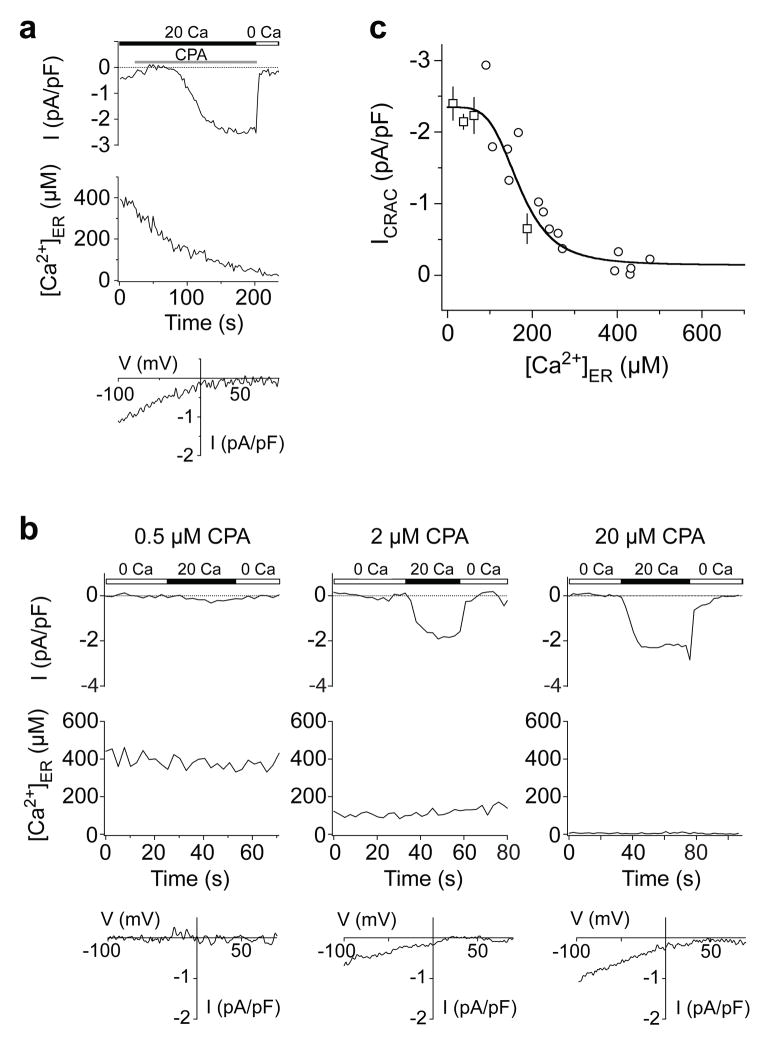
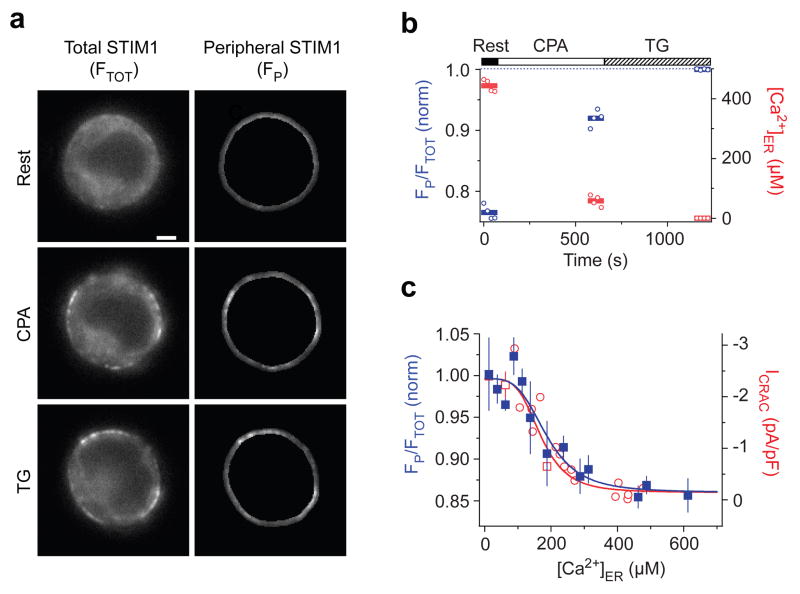
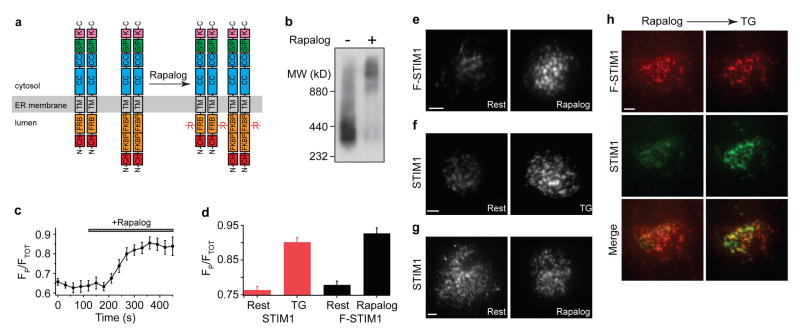
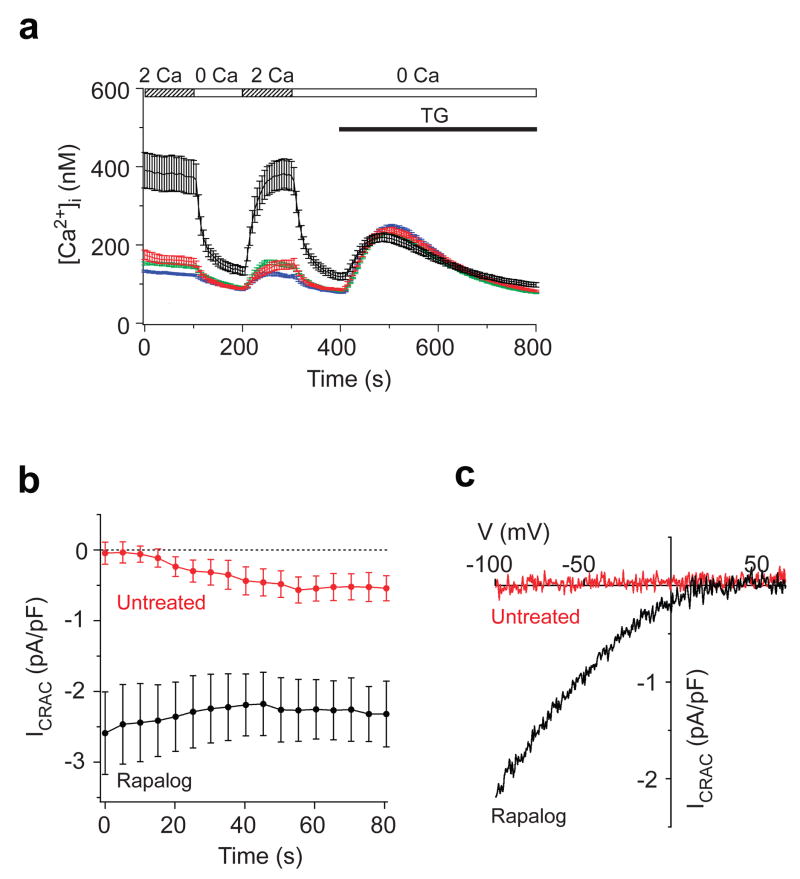
Ca(2+)-release-activated Ca(2+) (CRAC) channels generate sustained Ca(2+) signals that are essential for a range of cell functions, including antigen-stimulated T lymphocyte activation and proliferation. Recent studies have revealed that the depletion of Ca(2+) from the endoplasmic reticulum (ER) triggers the oligomerization of stromal interaction molecule 1 (STIM1), the ER Ca(2+) sensor, and its redistribution to ER-plasma membrane (ER-PM) junctions where the CRAC channel subunit ORAI1 accumulates in the plasma membrane and CRAC channels open. However, how the loss of ER Ca(2+) sets into motion these coordinated molecular rearrangements remains unclear. Here we define the relationships among [Ca(2+)](ER), STIM1 redistribution and CRAC channel activation and identify STIM1 oligomerization as the critical [Ca(2+)](ER)-dependent event that drives store-operated Ca(2+) entry. In human Jurkat leukaemic T cells expressing an ER-targeted Ca(2+) indicator, CRAC channel activation and STIM1 redistribution follow the same function of [Ca(2+)](ER), reaching half-maximum at approximately 200 microM with a Hill coefficient of approximately 4. Because STIM1 binds only a single Ca(2+) ion, the high apparent cooperativity suggests that STIM1 must first oligomerize to enable its accumulation at ER-PM junctions. To assess directly the causal role of STIM1 oligomerization in store-operated Ca(2+) entry, we replaced the luminal Ca(2+)-sensing domain of STIM1 with the 12-kDa FK506- and rapamycin-binding protein (FKBP12, also known as FKBP1A) or the FKBP-rapamycin binding (FRB) domain of the mammalian target of rapamycin (mTOR, also known as FRAP1). A rapamycin analogue oligomerizes the fusion proteins and causes them to accumulate at ER-PM junctions and activate CRAC channels without depleting Ca(2+) from the ER. Thus, STIM1 oligomerization is the critical transduction event through which Ca(2+) store depletion controls store-operated Ca(2+) entry, acting as a switch that triggers the self-organization and activation of STIM1-ORAI1 clusters at ER-PM junctions.
Figures
References
-
- Parekh AB, Putney JW., Jr Store-operated calcium channels. Physiol Rev. 2005;85:757–810. - PubMed
-
- Feske S. Calcium signalling in lymphocyte activation and disease. Nat Rev Immunol. 2007;7:690–702. - PubMed
-
- Stathopulos PB, Li GY, Plevin MJ, Ames JB, Ikura M. Stored Ca2+ depletion-induced oligomerization of STIM1 via the EF-SAM region: An initiation mechanism for capacitive Ca2+ entry. J Biol Chem. 2006;281:35855–35862. - PubMed
Publication types
MeSH terms
Substances
Grants and funding
LinkOut - more resources
Full Text Sources
Other Literature Sources
Molecular Biology Databases
Miscellaneous
