


Fatty liver and insulin resistance: not always linked
- PMID: 18596860
- PMCID: PMC2442699
Fatty liver and insulin resistance: not always linked
Abstract
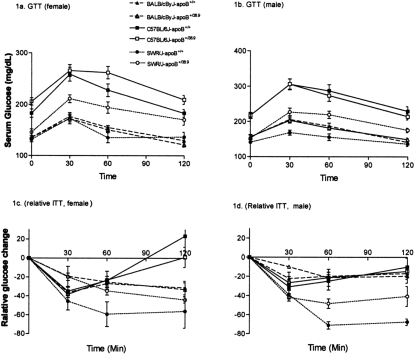
One significant clinical symptom of familial hypobetalipoproteinemia [FHBL] due to defects in apolipoprotein B (apoB) is steatohepatosis. However, the increased hepatic fat content in apoB-related FHBL subjects was not associated with glucose intolerance, in contrast with what is the case in the metabolic syndrome. Meanwhile, in human subjects with similar apoB truncations, degree of obesity and insulin sensitivity, their liver triglyceride (TG) contents may vary considerably, suggesting that, in addition to defective apoB, other genes may affect the magnitude of hepatic TG accumulation. We hypothesized that genetic background affects the severity of hepatic steatosis and the expression of insulin sensitivity. To test the hypotheses, mouse apoB38.9-bearing congenies were bred under high, medium and low liver triglyceride (TG) backgrounds using "speed congenics" approach. These mice were fed on regular diet for 12 weeks. Their insulin sensitivity, serum and liver lipids were assessed. The highest liver fat strain [BALB/cByJ] accumulated significantly higher TG in the liver under apoB38.9 heterozygous condition, while the lowest liver fat strain [SWR/J] had the smallest liver TG change, suggesting that the genetic backgrounds affected the hepatic TG responses to the presence of the apoB38.9 mutation. Interestingly, only the low liver fat strain [SWR/J-apoB38.9] showed significant upward shifts of both glucose tolerance test (GTT) and insulin tolerance test (ITT) curves. Neither the glucose nor the insulin tolerance curves were altered in the two cognate congenics with higher liver fat content [BALB/cByJ and C57BL/6J]. Thus, hepatic TG contents and measures of glucose metabolism were dissociated from each other. It is tempting to conclude that hepatic TG per se may not be responsible for the insulin resistance seen in fatty liver. The genetic/molecular bases for the differences between SWR/J and the other two strains with respect to their glucose metabolic responses to increases in hepatic TG contents remain to be elucidated.
Figures
References
-
- Fisher EA, Ginsberg HN. Complexity in the secretory pathway: the assembly and secretion of apolipoprotein B-containing lipoproteins. J Biol Chem. 2002;277(20):17377–80. - PubMed
-
- Levy E, Stan S, Delvin E, et al. Localization of microsomal triglyceride transfer protein in the Golgi: possible role in the assembly of chylomicrons. J Biol Chem. 2002;277(19):16470–7. - PubMed
-
- Chen Z, Fitzgerald RL, Li G, Davidson NO, Schonfeld G. Hepatic secretion of apoB-100 is impaired in hypobetalipoproteinemic mice with an apoB-38.9-specifying allele. J Lipid Res. 2004;45(1):155–63. - PubMed
-
- Burnett JR, Shan J, Miskie BA, et al. A novel nontruncating APOB gene mutation, R463W, causes familial hypobetalipoproteinemia. J Biol Chem. 2003;278(15):13442–52. - PubMed
MeSH terms
Substances
Grants and funding
LinkOut - more resources
Full Text Sources
Miscellaneous