


Loss of p21 permits carcinogenesis from chronically damaged liver and kidney epithelial cells despite unchecked apoptosis
- PMID: 18598944
- PMCID: PMC2526059
- DOI: 10.1016/j.ccr.2008.05.004
Loss of p21 permits carcinogenesis from chronically damaged liver and kidney epithelial cells despite unchecked apoptosis
Abstract
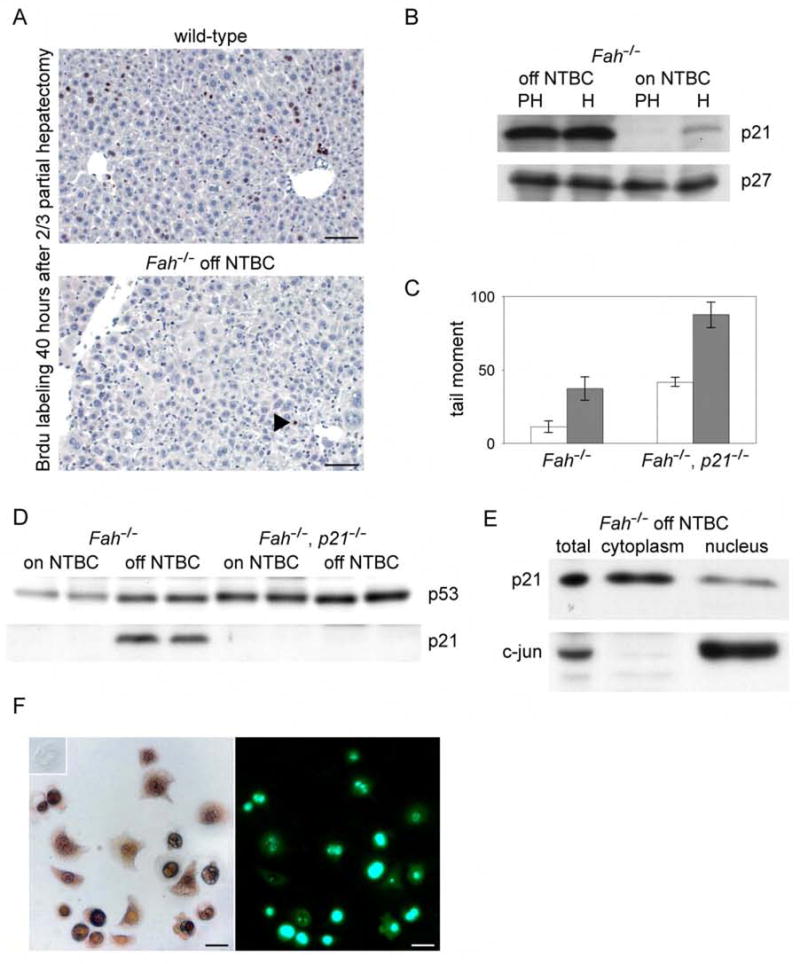
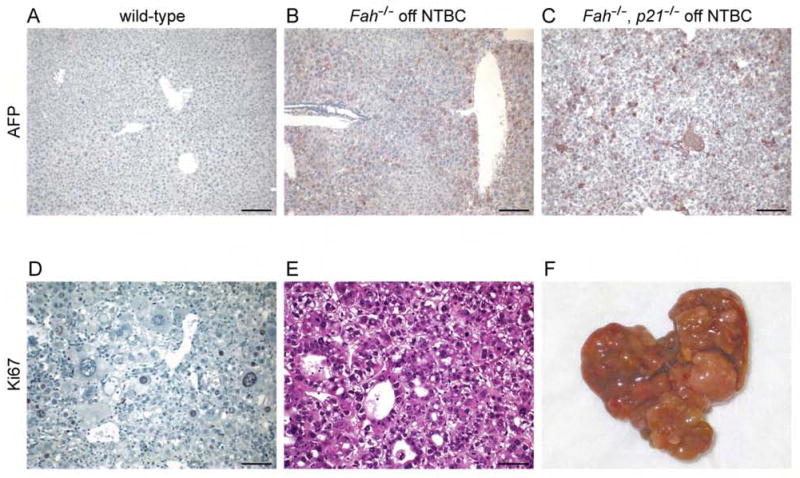
Accumulation of toxic metabolites in hereditary tyrosinemia type I (HT1) patients leads to chronic DNA damage and the highest risk for hepatocellular carcinomas (HCCs) of any human disease. Here we show that hepatocytes of HT1 mice exhibit a profound cell-cycle arrest that, despite concomitant apoptosis resistance, causes mortality from impaired liver regeneration. However, additional loss of p21 in HT1 mice restores the proliferative capabilities of hepatocytes and renal proximal tubular cells. This growth response compensates cell loss due to uninhibited apoptosis and enables animal survival but rapidly leads to HCCs, renal cysts, and renal carcinomas. Thus, p21's antiproliferative function is indispensable for the suppression of carcinogenesis from chronically injured liver and renal epithelial cells and cannot be compensated by apoptosis.
Figures



Comment in
-
A dual role of p21 in liver regeneration and hepatocarcinogenesis.Hepatology. 2008 Nov;48(5):1713-4. doi: 10.1002/hep.22588. Hepatology. 2008. PMID: 18972555 No abstract available.
References
-
- Al-Dhalimy M, Overturf K, Finegold M, Grompe M. Long-term therapy with NTBC and tyrosine-restricted diet in a murine model of hereditary tyrosinemia type I. Mol Genet Metab. 2002;75:38–45. - PubMed
-
- Albrecht JH, Poon RY, Ahonen CL, Rieland BM, Deng C, Crary GS. Involvement of p21 and p27 in the regulation of CDK activity and cell cycle progression in the regenerating liver. Oncogene. 1998;16:2141–2150. - PubMed
-
- Bartosiewicz MJ, Jenkins D, Penn S, Emery J, Buckpitt A. Unique gene expression patterns in liver and kidney associated with exposure to chemical toxicants. J Pharmacol Exp Ther. 2001;297:895–905. - PubMed
-
- Bhunia AK, Piontek K, Boletta A, Liu L, Qian F, Xu PN, Germino FJ, Germino GG. PKD1 induces p21(waf1) and regulation of the cell cycle via direct activation of the JAK-STAT signaling pathway in a process requiring PKD2. Cell. 2002;109:157–168. - PubMed
-
- Brugarolas J, Chandrasekaran C, Gordon JI, Beach D, Jacks T, Hannon GJ. Radiation-induced cell cycle arrest compromised by p21 deficiency. Nature. 1995;377:552–557. - PubMed
Publication types
MeSH terms
Substances
Grants and funding
LinkOut - more resources
Full Text Sources
Other Literature Sources
Molecular Biology Databases
