


Functional organisation of Escherichia coli transcriptional regulatory network
- PMID: 18599074
- PMCID: PMC2726282
- DOI: 10.1016/j.jmb.2008.05.054
Functional organisation of Escherichia coli transcriptional regulatory network
Abstract
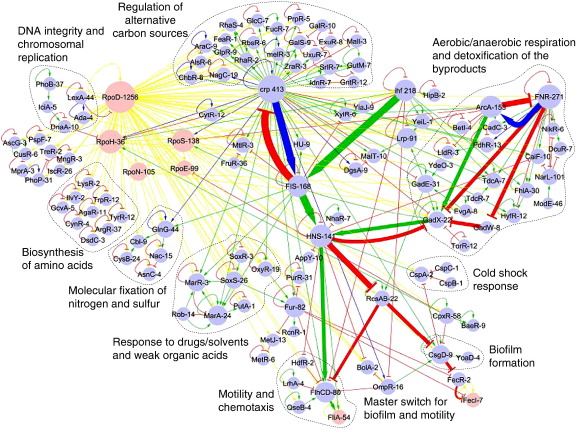
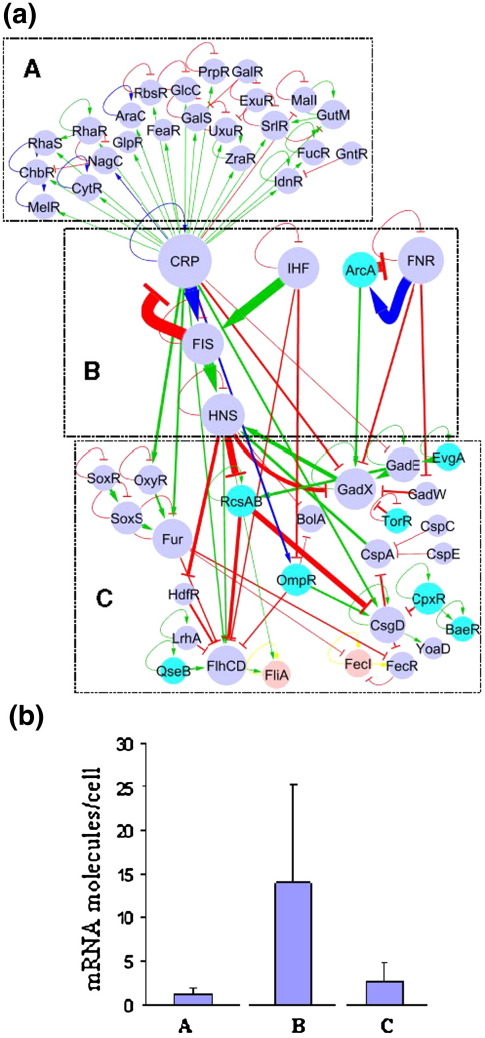
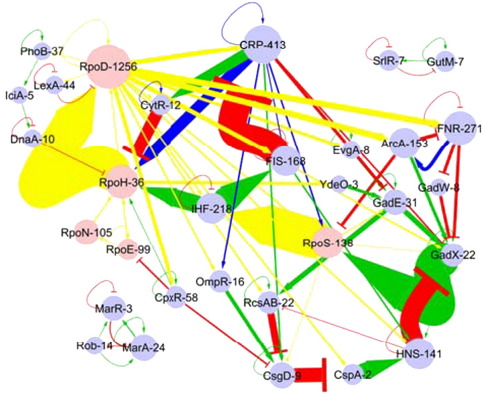
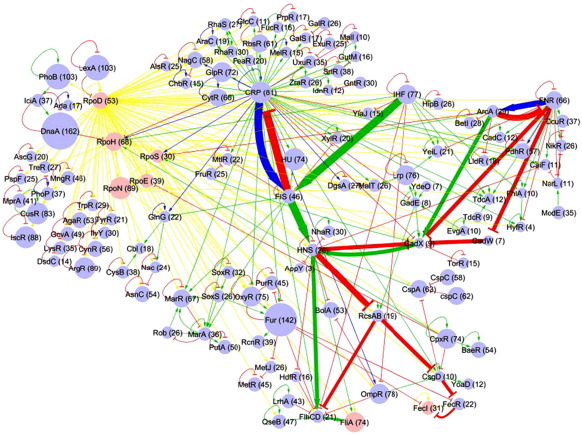
Taking advantage of available functional data associated with 115 transcription and 7 sigma factors, we have performed a structural analysis of the regulatory network of Escherichia coli. While the mode of regulatory interaction between transcription factors (TFs) is predominantly positive, TFs are frequently negatively autoregulated. Furthermore, feedback loops, regulatory motifs and regulatory pathways are unevenly distributed in this network. Short pathways, multiple feed-forward loops and negative autoregulatory interactions are particularly predominant in the subnetwork controlling metabolic functions such as the use of alternative carbon sources. In contrast, long hierarchical cascades and positive autoregulatory loops are overrepresented in the subnetworks controlling developmental processes for biofilm and chemotaxis. We propose that these long transcriptional cascades coupled with regulatory switches (positive loops) for external sensing enable the coexistence of multiple bacterial phenotypes. In contrast, short regulatory pathways and negative autoregulatory loops enable an efficient homeostatic control of crucial metabolites despite external variations. TFs at the core of the network coordinate the most basic endogenous processes by passing information onto multi-element circuits. Transcriptional expression data support broader and higher transcription of global TFs compared to specific ones. Global regulators are also more broadly conserved than specific regulators in bacteria, pointing to varying functional constraints.
Figures
References
-
- Jacob F. Une Histoire de L'Hérédité; Gallimard, Paris: 1970. La Logique du Vivant.
-
- Martinez-Antonio A., Janga S.C., Salgado H., Collado-Vides J. Internal-sensing machinery directs the activity of the regulatory network in Escherichia coli. Trends Microbiol. 2006;14:22–27. - PubMed
-
- Balaban N.Q., Merrin J., Chait R., Kowalik L., Leibler S. Bacterial persistence as a phenotypic switch. Science. 2004;305:1622–1625. - PubMed
MeSH terms
Substances
LinkOut - more resources
Full Text Sources
Other Literature Sources
