. 2008 Sep;148(1):212-22.
doi: 10.1104/pp.108.120006. Epub 2008 Jul 3.

Arabidopsis mitogen-activated protein kinase kinases MKK1 and MKK2 have overlapping functions in defense signaling mediated by MEKK1, MPK4, and MKS1

Affiliations

Arabidopsis mitogen-activated protein kinase kinases MKK1 and MKK2 have overlapping functions in defense signaling mediated by MEKK1, MPK4, and MKS1

Jin-Long Qiu et al. Plant Physiol. 2008 Sep.

Abstract

The Arabidopsis (Arabidopsis thaliana) MKK1 and MKK2 mitogen-activated protein kinase kinases have been implicated in biotic and abiotic stress responses as part of a signaling cascade including MEKK1 and MPK4. Here, the double loss-of-function mutant (mkk1/2) of MKK1 and MKK2 is shown to have marked phenotypes in development and disease resistance similar to those of the single mekk1 and mpk4 mutants. Because mkk1 or mkk2 single mutants appear wild type, basal levels of MPK4 activity are not impaired in them, and MKK1 and MKK2 are in part functionally redundant in unchallenged plants. These findings are confirmed and extended by biochemical and molecular analyses implicating the kinases in jasmonate- and salicylate-dependent defense responses, mediated in part via the MPK4 substrate MKS1. In addition, transcriptome analyses delineate overlapping and specific effects of the kinases on global gene expression patterns demonstrating both redundant and unique functions for MKK1 and MKK2.


Figures
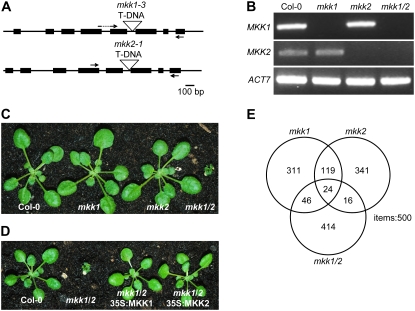
Figure 1.
Figure 1.
Mutant phenotypes. A, Gene structure of MKK1 and MKK2. Exons are represented by black boxes, and introns and untranslated regions by black lines. Triangles indicate T-DNA insertions; the T-DNA was located 1,332 bp downstream of the translational initiation codon in mkk1 and 1,387 bp downstream of the initiation codon in mkk2. Primers used for RT-PCR in B are indicated by arrows. B, MKK1 and MKK2 mRNA levels in wild type, mkk1, and mkk2 detected by RT-PCR. C, Morphology of Col-0 wild type, mkk1, mkk2, and the mkk1/2 double mutant. D, Complementation of mkk1/2 by CaMV 35S promoter-driven MKK1 or MKK2 cDNA. E, Venn diagram of global gene expression signatures of mkk1, mkk2, and mkk1/2 mutants compared to wild type. Here, intersections are between the top 500 most significantly differentially expressed genes as measured by the Affymetrix GeneChip, ATH1 (22,810 probe sets). If at random, 11 genes are expected to overlap between any two gene sets and approximately 0.2 genes between three gene sets.
Figure 2.
Figure 2.
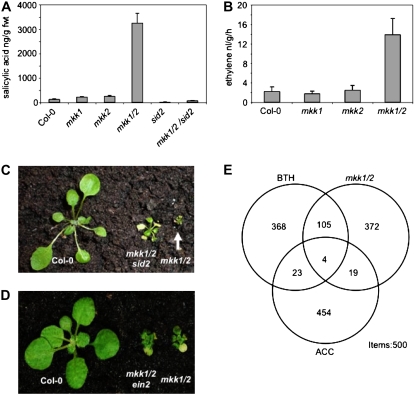
Hormone levels and growth phenotypes of mkk1/2/sid2 and mkk1/2/ein2 triple mutants. A and B, Free SA (A) and ET (B) levels. Error bars represent se of the mean. C and D, Phenotypes of mkk1/2/sid2 (C) and mkk1/2/ein2 triple mutants (D). E, Venn diagram showing overlapping gene expression signatures between BTH- or ACC-treated wild-type plants and the mkk1/2 double mutant. Overlap is between the top 500 most significantly differentially expressed genes as measured by the ATH1 Affymetrix GeneChip.
Figure 3.
Figure 3.
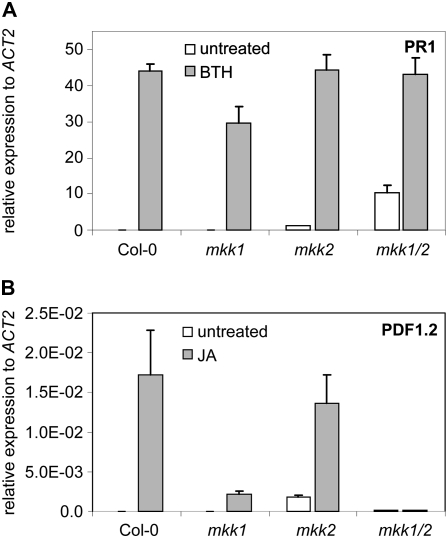
Defense gene expression in the mutants. PR1 (A) and PDF1.2 (B) mRNA levels were monitored by real-time RT-PCR after treatment of the mutants with BTH or JA, respectively. Means ± sd are shown.
Figure 4.
Figure 4.
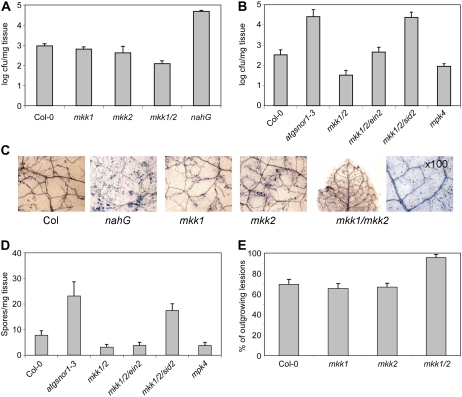
Disease resistance in mutants. A, Response to infection by P. syringae of wild-type Col-0, mkk1, mkk2, and mkk1/2 compared to nahG transgenic. B, Response to P. syringae of mkk1/2 compared to mkk1/2/ein2 and mkk1/2/sid2 triple mutants, atgsnor1-3, and mpk4. C and D, Growth of H. parasitica detected by trypan blue staining (C) and corresponding conidial counts/milligram tissue (D). E, Growth of B. cinerea in mutants assayed as the number of outgrowing lesions developed 3 d after inoculation. Experiments were repeated three times with similar results and error bars represent se.
Figure 5.
Figure 5.
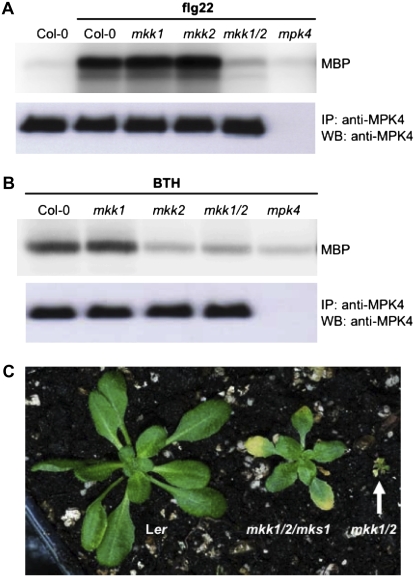
MKK1 and MKK2 function upstream of MPK4. A and B, MPK4 kinase activity in single and double mutants. MPK4 protein was immunoprecipitated out of total protein extracts from plants treated for 30 min with 10 μm flg22 (A) or 100 μm BTH (B) and used in an in vitro kinase assay with myelin basic protein as substrate. Duplicate gels were subjected to western blotting to monitor MPK4 protein levels. C, Phenotype of mkk1/2/mks1 triple mutant in comparison to mkk1/2 and wild type.
Figure 6.
Figure 6.
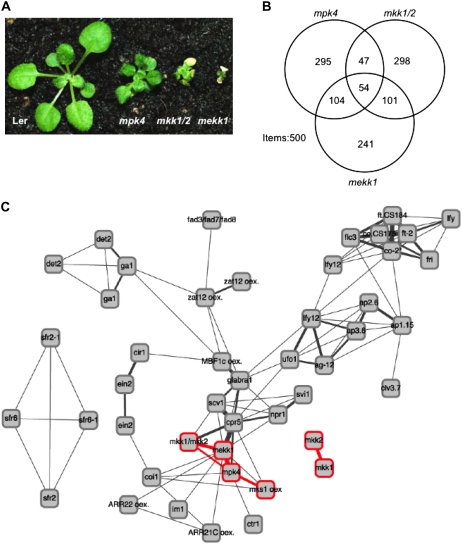
MEKK1, MKK1/2, and MPK4 function in the same pathway. A, Morphological phenotypes of Landsberg erecta wild type, mekk1, mkk1/2, and mpk4. B, Venn diagram showing overlapping gene expression changes in mekk1, mkk1/2, and mpk4. Overlap is between the top 500 most significantly differentially expressed genes as measured by the ATH1 Affymetrix GeneChip. C, FARO genotype graph illustrating the intersections between gene expression signatures of a series of mutants and overexpressors. The thickness of the edges illustrates the size of the intersections between transcriptional signatures of the mutants (nodes). Highlighted in red are mkk1, mkk2, mkk1/2, mekk1, mpk4, and the MKS1 overexpressor. Only response signature intersections exceeding 250 genes are drawn. Mutants assayed multiple times by independent laboratories (i.e. det2, ein2, ga1, zat12 oex., and lfy12) are represented by a node for each assay.

References

    1. Alonso JM, Stepanova AN, Leisse TJ, Kim CJ, Chen H, Shinn P, Stevenson DK, Zimmerman J, Barajas P, Cheuk R, et al (2003) Genome-wide insertional mutagenesis of Arabidopsis thaliana. Science 301 653–657 - PubMed
    1. Alzwiy IA, Morris PC (2007) A mutation in the Arabidopsis MAP kinase kinase 9 gene results in enhanced seedling stress tolerance. Plant Sci 173 302–308
    1. Andreasson E, Jenkins T, Brodersen P, Thorgrimsen S, Petersen NH, Zhu S, Qiu JL, Micheelsen P, Rocher A, Petersen M, et al (2005) The MAP kinase substrate MKS1 is a regulator of plant defense responses. EMBO J 24 2579–2589 - PMC - PubMed
    1. Asai T, Tena G, Plotnikova J, Willmann MR, Chiu WL, Gomez-Gomez L, Boller T, Ausubel FM, Sheen J (2002) MAP kinase signalling cascade in Arabidopsis innate immunity. Nature 415 977–983 - PubMed
    1. Becker D, Kemper E, Schell J, Masterson R (1992) New plant binary vectors with selectable markers located proximal to the left T-DNA border. Plant Mol Biol 20 1195–1197 - PubMed

Publication types

MeSH terms