. 2008 Jul 4;321(5885):126-9.
doi: 10.1126/science.1156951.

Robust, tunable biological oscillations from interlinked positive and negative feedback loops

Affiliations

Robust, tunable biological oscillations from interlinked positive and negative feedback loops

Tony Yu-Chen Tsai et al. Science. .

Abstract

A simple negative feedback loop of interacting genes or proteins has the potential to generate sustained oscillations. However, many biological oscillators also have a positive feedback loop, raising the question of what advantages the extra loop imparts. Through computational studies, we show that it is generally difficult to adjust a negative feedback oscillator's frequency without compromising its amplitude, whereas with positive-plus-negative feedback, one can achieve a widely tunable frequency and near-constant amplitude. This tunability makes the latter design suitable for biological rhythms like heartbeats and cell cycles that need to provide a constant output over a range of frequencies. Positive-plus-negative oscillators also appear to be more robust and easier to evolve, rationalizing why they are found in contexts where an adjustable frequency is unimportant.


Figures
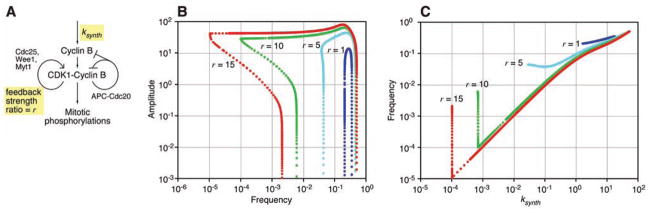
Fig. 1
Fig. 1
Positive feedback provides an oscillator with a tunable frequency and nearly constant amplitude. (A) Schematic view of the Xenopus embryonic cell cycle. (B) Amplitude/frequency curves for various strengths of positive feedback (r). The frequency of the oscillator was changed by varying the rate constant for cyclin B synthesis, ksynth. (C) Frequency as a function of ksynth for various strengths of positive feedback.
Fig. 2
Fig. 2
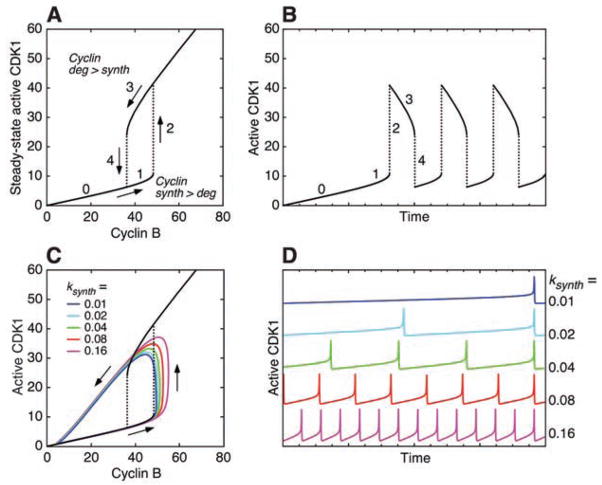
From a hysteretic switch to a relaxation oscillator. (A) Hysteretic steady-state response of CDK1 to cyclin B, on the basis of previous experimental studies (16, 17). (B) CDK1 activation and inactivation in the limit of slow cyclin B synthesis and degradation. (C and D) Cell cycle model run with biologically realistic parameters, showing a looser relation between the oscillations and the hysteretic steady-state response.
Fig. 3
Fig. 3
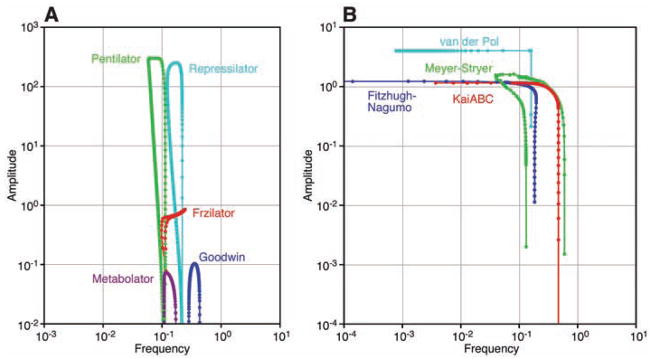
Amplitude/frequency curves for various legacy oscillators. (A) Negative feedback–only models. (B) Positive-plus-negative feedback models.
Fig. 4
Fig. 4
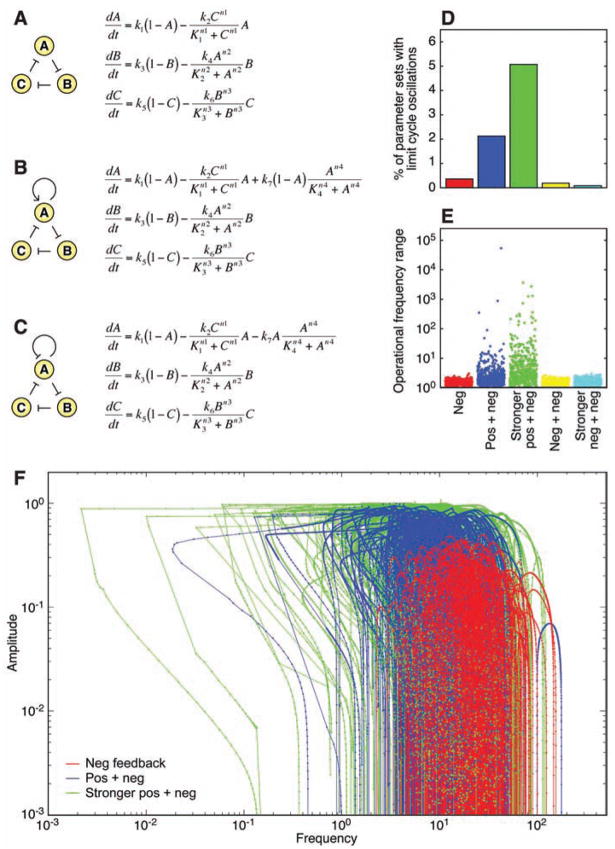
Randomly parameterized oscillator models. (A) Negative feedback–only. A, B, and C, the fractions of proteins A, B, and C that are active; K, median effective concentration values of the Hill functions; n, Hill coefficients; k, rate constants. (B) Positive-plus-negative feedback. (C) Negative-plus-negative feedback. (D) Percentage of parameter sets that yielded limit cycle oscillations. For the positive-plus-negative and negative-plus-negative models, we looked at two ranges of feedback strengths: (i) k7 = 0 to 100 (weak) and (ii) k7 = 500 to 600 (strong). (E) Operational frequency ranges for the oscillators. Each point represents freqmax/freqmin for one of the 2500 parameter sets that produced oscillations, with k3 as the bifurcation parameter. Mean operational frequency ranges were 1.6, 370, 63, 1.6, and 1.6. Medians were 1.6, 2.2, 3.3, 1.6, and 1.6. (F) Amplitude/frequency curves for the randomly parameterized models. We show 300 out of 500 curves for the negative feedback–only model (red) and the positive-plus-negative feedback model with weak (blue) or strong (green) positive feedback. Curves for the negative-plus-negative feedback model are shown in fig. S1.

References

    1. Thron CD. Biophys Chem. 1996;57:239. - PubMed
    1. Goldbeter A, et al. Chaos. 2001;11:247. - PubMed
    1. Tyson JJ, Chen KC, Novak B. Curr Opin Cell Biol. 2003;15:221. - PubMed
    1. Smolen P, Baxter DA, Byrne JH. Am J Physiol. 1998;274:C531. - PubMed
    1. Goldbeter A. Nature. 2002;420:238. - PubMed

Publication types

MeSH terms