. 2008 Jul 7:4:17.
doi: 10.1186/1746-4811-4-17.

Identification of a cis-regulatory element by transient analysis of co-ordinately regulated genes

Affiliations

Identification of a cis-regulatory element by transient analysis of co-ordinately regulated genes

Andrew P Dare et al. Plant Methods. .

Abstract

Background: Transcription factors (TFs) co-ordinately regulate target genes that are dispersed throughout the genome. This co-ordinate regulation is achieved, in part, through the interaction of transcription factors with conserved cis-regulatory motifs that are in close proximity to the target genes. While much is known about the families of transcription factors that regulate gene expression in plants, there are few well characterised cis-regulatory motifs.In Arabidopsis, over-expression of the MYB transcription factor PAP1 (PRODUCTION OF ANTHOCYANIN PIGMENT 1) leads to transgenic plants with elevated anthocyanin levels due to the co-ordinated up-regulation of genes in the anthocyanin biosynthetic pathway. In addition to the anthocyanin biosynthetic genes, there are a number of un-associated genes that also change in expression level. This may be a direct or indirect consequence of the over-expression of PAP1.

Results: Oligo array analysis of PAP1 over-expression Arabidopsis plants identified genes co-ordinately up-regulated in response to the elevated expression of this transcription factor. Transient assays on the promoter regions of 33 of these up-regulated genes identified eight promoter fragments that were transactivated by PAP1. Bioinformatic analysis on these promoters revealed a common cis-regulatory motif that we showed is required for PAP1 dependent transactivation.

Conclusion: Co-ordinated gene regulation by individual transcription factors is a complex collection of both direct and indirect effects. Transient transactivation assays provide a rapid method to identify direct target genes from indirect target genes. Bioinformatic analysis of the promoters of these direct target genes is able to locate motifs that are common to this sub-set of promoters, which is impossible to identify with the larger set of direct and indirect target genes. While this type of analysis does not prove a direct interaction between protein and DNA, it does provide a tool to characterise cis-regulatory sequences that are necessary for transcription activation in a complex list of co-ordinately regulated genes.


Figures
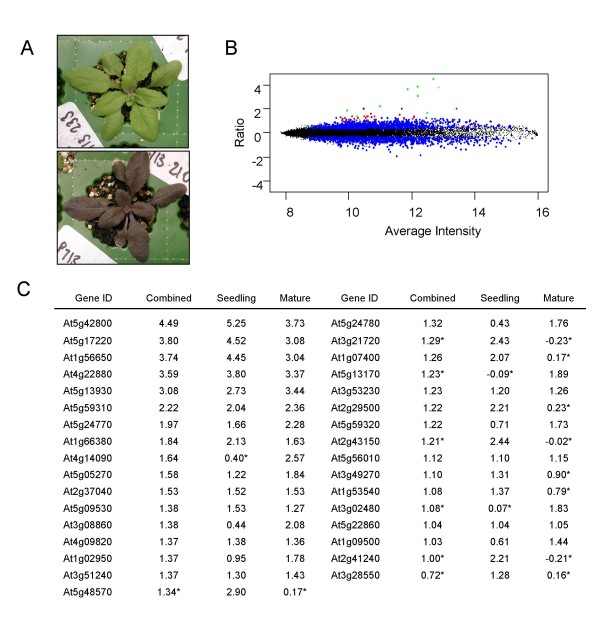
Figure 1
Figure 1
Analysis of transgenic Arabidopsis over-expressing PAP1. A, Plants at the 21 day stage containing vector only (top) and 35S-PAP1 (bottom) B, Comparison of intensity-ratio plot of gene expression in transgenic plants; Blue dot represents genes that change in expression with an adjusted P value <0.05, red dot represents 33 genes cloned for promoter analysis and green dot represents genes with significant transactivation when co-infiltrated with the 35S-PAP1 construct. The grey dot represents PAP1 that was over-expressed. C, Comparison of the 33 genes selected for promoter analysis. Ratios generated between wild type and PAP1 over-expression plants are shown. Ratios from seedlings (Seedling), mature plants (Mature) and a combined dataset of mature plants and seedlings (Combined) are given. Ratios with * are not selected.
Figure 2
Figure 2
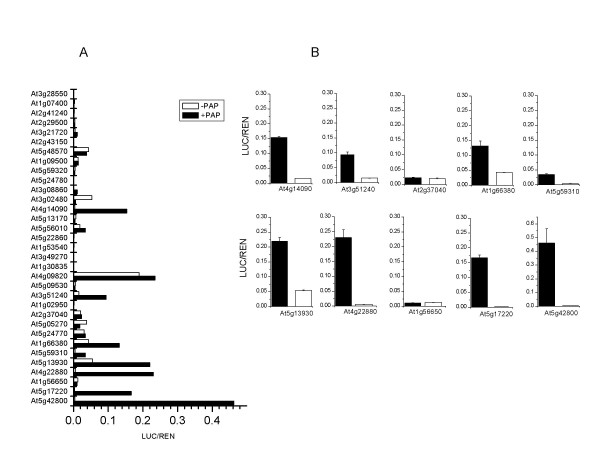
Transient assay data for promoters up-regulated in PAP1 over-expression transgenic plants. A, High-throughput screen of 33 promoters assayed with (black bars) or without (white bars) co-infiltration of PAP1. B, Re-analysis and transactivation standard error estimation for eight promoters identified in primary screen and two non-responsive control promoters (At2g37040 and At1g56650). Average transactivation values were calculated from 6 fold experimental replicates. Standard errors were calculated for error bars.
Figure 3
Figure 3
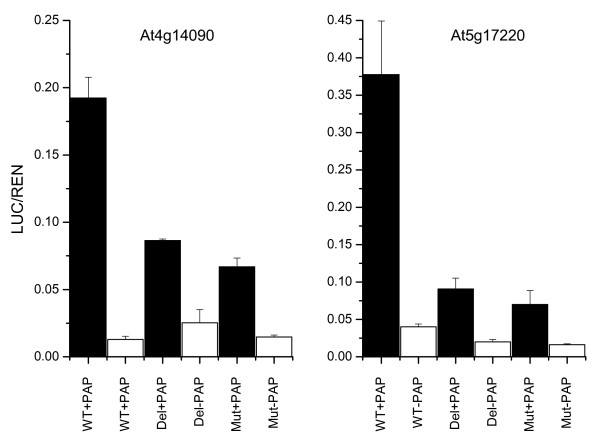
Deletion and mutation of PAP1 cis-regulatory elements from At5g17220 and At4g14090 promoters. Transactivation data of At5g17220 and At4g14090 promoters displaying the effect of deleting and mutating the 10 bp PCE from At5g17220 and At4g14090 promoters. Wild-type (WT) promoter, PCE deletion promoter (Del) and PCE mutation promoter (Mut) are shown and transactivation data as black bars (with PAP1), and white bars (without PAP1).
Figure 4
Figure 4
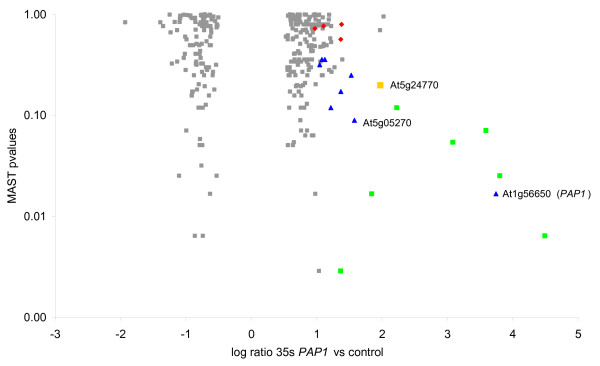
Occurrence of the PAP1 cis-regulatory element in the top 300 microarray selected genes. A 3 kb promoter fragment for each of the top 300 genes was analysed for the presence of PCEs using MAST. The average fold change from all microarrays was compared with the P-value obtained from the MAST analysis. Genes highlighted in green represent those genes that have a PCE and were transactivated by PAP1. Blue represents those that have a putative PCE but not in the first 1 kb tested. Yellow represents a gene with a PCE in the first 1 kb but was not transactivated. Red represents genes with no PCE and not transactivated. Grey represents untested genes.

References

    1. Wray GA, Hahn MW, Abouheif E, Balhoff JP, Pizer M, Rockman MV, Romano LA. The evolution of transcriptional regulation in eukaryotes. Mol Biol Evol. 2003;20:1377–1419. - PubMed
    1. The Arabidopsis Genome Initiative Analysis of the genome sequence of the flowering plant Arabidopsis thaliana. Nature. 2000;408:796–815. - PubMed
    1. Palaniswamy SK, James S, Sun H, Lamb RS, Davuluri RV, Grotewold E. AGRIS and AtRegNet. A platform to link cis-regulatory elements and transcription factors into regulatory networks. Plant Physiol. 2006;140:818–829. - PMC - PubMed
    1. Galas DJ, Schmitz A. DNAase footprinting a simple method for the detection of protein-DNA binding specificity. Nucleic Acids Res. 1978;5:3157–3170. - PMC - PubMed
    1. Garner MM, Revzin A. A gel electrophoresis method for quantifying the binding of proteins to specific DNA regions: application to components of the Escherichia coli lactose operon regulatory system. Nucl Acids Res. 1981;9:3047–3060. - PMC - PubMed