


Domain specific self-efficacy mediates the impact of pain catastrophizing on pain and disability in overweight and obese osteoarthritis patients
- PMID: 18602871
- PMCID: PMC2581839
- DOI: 10.1016/j.jpain.2008.05.008
Domain specific self-efficacy mediates the impact of pain catastrophizing on pain and disability in overweight and obese osteoarthritis patients
Abstract
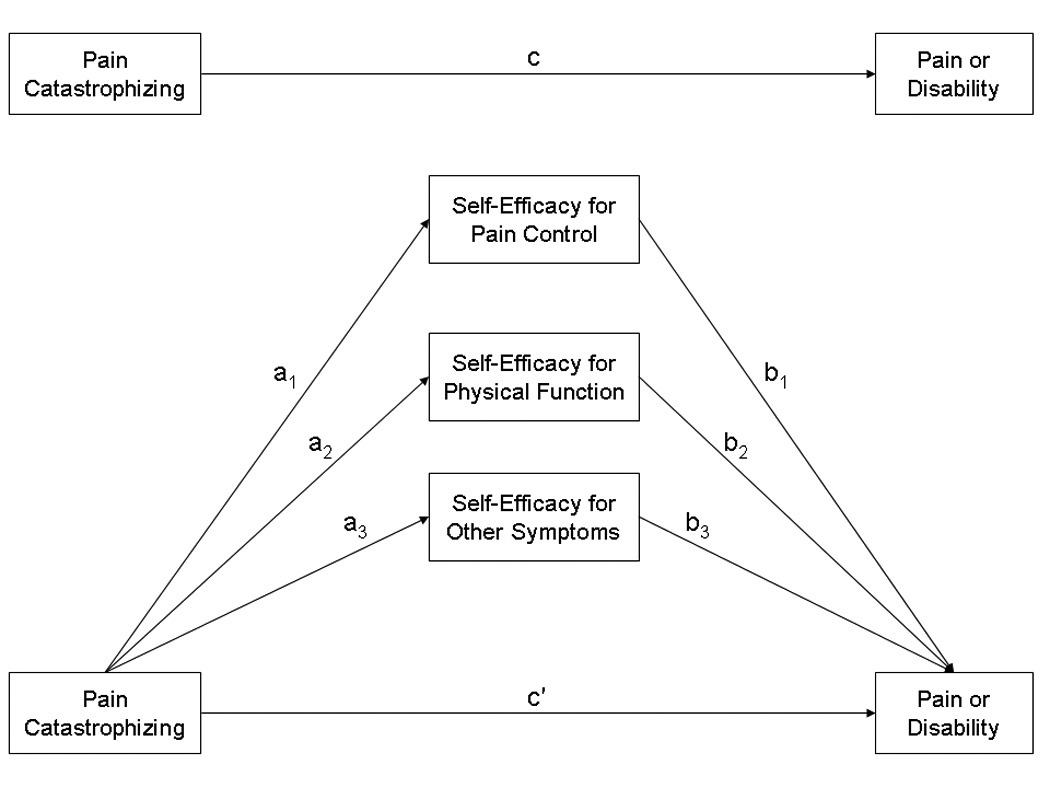
This study examined whether self-efficacy mediated the relationship between pain catastrophizing and pain and disability. Participants were 192 individuals diagnosed with osteoarthritis (OA) of the knees who were overweight or obese. Multiple mediator analyses were conducted to simultaneously test self-efficacy for pain control, physical function, and emotional symptoms as mediators while controlling for demographic and medical status variables. Higher pain catastrophizing was associated with lower self-efficacy in all 3 domains (Ps < .05). Self-efficacy for pain control fully mediated the relationship between pain catastrophizing and pain (beta = .08, Sobel test Z = 1.97, P < .05). The relationship between pain catastrophizing and physical disability was fully mediated by self-efficacy for physical function (beta = .06, Sobel test Z = 1.95, P = .05). Self-efficacy for emotional symptoms partially mediated the relationship between pain catastrophizing and psychological disability (beta = .12, Sobel test Z = 2.92, P < .05). These results indicate that higher pain catastrophizing contributed to greater pain and disability via lower domain-specific self-efficacy. Efforts to reduce pain and improve functioning in OA patients should consider addressing pain catastrophizing and domain specific self-efficacy. Pain catastrophizing may be addressed through cognitive therapy techniques and self-efficacy may be enhanced through practice of relevant skills and personal accomplishments.
Perspective: This study found that higher pain catastrophizing contributed to greater pain and disability via domain specific self-efficacy. These results suggest that treatment efforts to reduce pain and improve functioning in OA patients who are overweight or obese should consider addressing both pain catastrophizing and self-efficacy.
Figures
References
-
- Altman R, Asch E, Bloch D, Bole G, Borenstein D, Brandt K, Christy W, Cooke TD, Greenwald R, Hochberg M, Howell D, Kaplan D, Koopman W, Longley S, Mankin H, McShane DJ, Medsger T, Meenan R, Mikkelsen W, Moskowitz R, Murphy W, Rothschild B, Segal M, Sokoloff L, Wolfe E. Development of criteria for the classification and reporting of osteoarthritis. Classification of osteoarthritis of the knee. Diagnostic and Therapeutic Criteria Committee of the American Rheumatism Association. Arthritis Rheum. 1986;29:1039–1049. - PubMed
-
- Altman RD, Hochberg M, Murphy WA, Jr, Wolfe F, Lequesne M. Atlas of individual radiographic features in osteoarthritis. Osteoarthritis Cartilage. 1995;3 Suppl A:3–70. - PubMed
-
- Bandura A. Self-efficacy: Toward a unifying theory of behavioral change. Psychol Rev. 1977;84:191–215. - PubMed
-
- Bandura A. Social foundations of thought and action: a social cognitive theory. Englewood Cliffs, NJ: Prentice-Hall Inc; 1986.
-
- Baron RM, Kenny DA. The moderator-mediator variable distinction in social psychological research: Conceptual, strategic, and statistical considerations. J Pers Soc Psychol. 1986;51:1173–1182. - PubMed
Publication types
MeSH terms
Grants and funding
LinkOut - more resources
Full Text Sources
Medical
