. 2008 Oct;155(3):343-56.
doi: 10.1038/bjp.2008.273. Epub 2008 Jul 7.

Investigation of the role of 5-HT2 receptor subtypes in the control of the bladder and the urethra in the anaesthetized female rat

Affiliations

Investigation of the role of 5-HT2 receptor subtypes in the control of the bladder and the urethra in the anaesthetized female rat

Y Mbaki et al. Br J Pharmacol. 2008 Oct.

Abstract

Background and purpose: Micturition is controlled by central 5-HT-containing pathways. 5-HT2 receptors have been implicated in this system especially in control of the urethra, which is a drug target for treating urinary incontinence. This study investigates the role of each of the three subtypes of this receptor with emphasis on sphincter regulation.

Experimental approach: Recordings of urethral and bladder pressure, external urethral sphincter (EUS) EMG, as well as the micturition reflex induced by bladder distension along with blood pressure and heart rate were made in anaesthetized rats. The effects of agonists and antagonists for 5-HT2 receptor subtypes were studied on these variables.

Key results: The 5-HT2C agonists Ro 60-0175, WAY 161503 and mCPP, i.v., activated the EUS, increased urethral pressure and inhibited the micturition reflex. The effects of Ro 60-0175 on the EUS were blocked by the 5-HT2C antagonist SB 242084 and the 5-HT2A antagonists, ketanserin and MDL 100907. SB 242084 also blocked the inhibitory action on the reflex, while the 5-HT2B antagonist RS 127445 only blocked the increase in urethral pressure. The 5-HT2A receptor agonist DOI given i.v. or i.t. but not i.c.v. activated the EUS.

Conclusions and implications: 5-HT2A/2C receptors located in the sacral spinal cord activate the EUS, while central 5-HT2C receptors inhibit the micturition reflex and 5-HT2B receptors, probably at the level of the urethra, increase urethral smooth muscle tone. Furthermore, 5-HT2B and 5-HT2C receptors do not seem to play an important role in the physiological regulation of micturition.


Figures
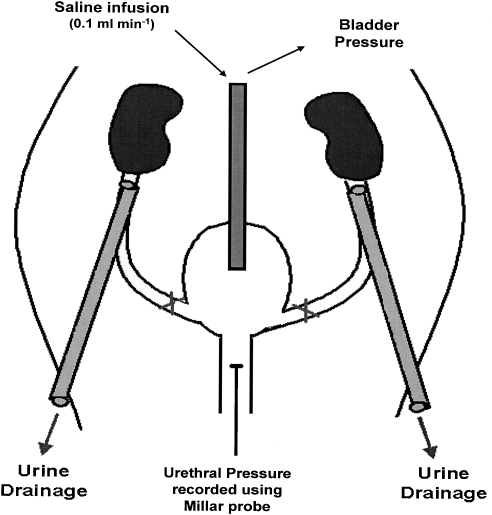
Figure 1
Figure 1
Schematic representation of the experimental method used. The ureters were tied and cut at the level of the bladder and cannulated at the level of the kidneys. A single-cuffed cannula connected through a T-piece to a pressure transducer and a syringe pump was inserted into the bladder dome. Electrodes used to record EUS–EMG activity were inserted on either side of the urethral orifice. The Millar probe was inserted into the urethra from the urethral orifice. Adapted from Wibberley et al. (2002).
Figure 2
Figure 2
Diagram to illustrate the main experimental protocol for the i.v. studies used in the present experiments.
Figure 3
Figure 3
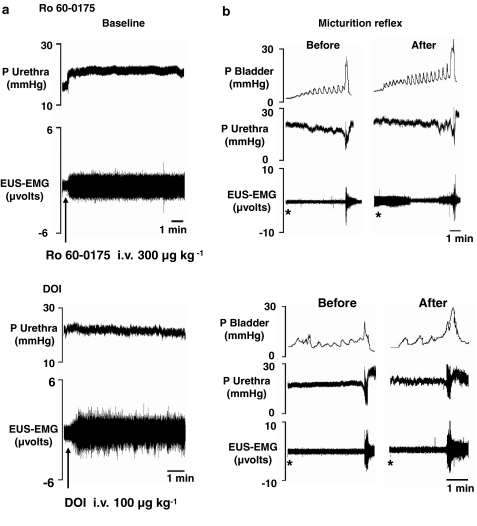
Traces showing the effects of Ro 60-0175 (300 μg kg−1, i.v.) and DOI (100 μg kg−1, i.v.) on (a) baseline urethral pressure and EUS–EMG activity and (b) on bladder-distension (micturition) induced changes in bladder and urethral pressures and EUS–EMG activity. *Denotes onset of saline infusion into the bladder.
Figure 4
Figure 4
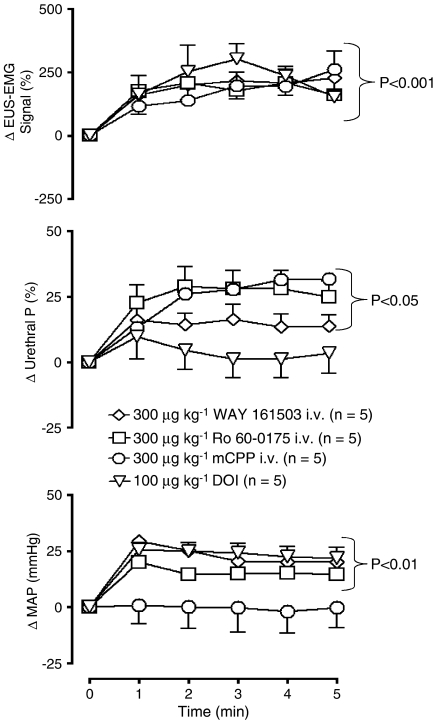
Urethane anaesthetized female rats: a comparison of the effects of 5-HT2 receptor agonists WAY 161503, Ro 60-0175, mCPP and DOI on changes (Δ) in external urethral sphincter (EUS) EMG signal (%), urethral pressure (urethral P; %) and mean arterial blood pressure (MAP; mm Hg). Each point represents the mean value and vertical bars show the s.e.mean. Changes caused by WAY 161503, Ro 60-0175 and DOI were compared with DMSO+saline control, whereas for mCPP the control was saline+saline control (these control data have not been illustrated for the sake of clarity, see Figures 7a and 8a for DMSO+saline control data) using a split-plot analysis.
Figure 5
Figure 5
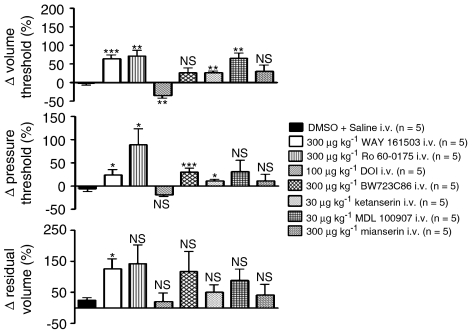
Urethane anaesthetized female rats: a comparison of the effects of the 5-HT2 receptor agonists WAY 161503, Ro 60-0175, DOI and BW723C86 and the antagonists ketanserin, MDL 100907 and mianserin on percentage (%) changes (Δ) in volume threshold, pressure threshold and residual volume. Each bar represents mean value and vertical bars show the s.e.mean. Changes caused by WAY 161503, Ro 60-0175, DOI, BW723C86, ketanserin, MDL 100907 and mianserin were compared with vehicle (DMSO+saline) control using Student's unpaired t-test. *P<0.05, **P<0.01, ***P<0.001, NS, non-significant. NB mCPP was not included as part of the reflex data as the reflex was completely abolished hence it was not possible to measure any of the bladder variables.
Figure 6
Figure 6
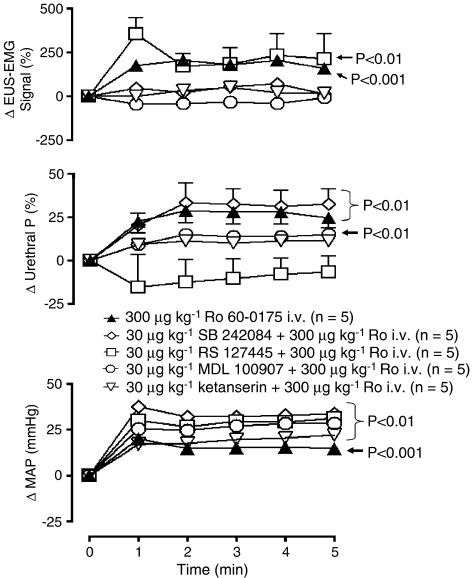
Urethane anaesthetized female rats: a comparison of the effects of Ro 60-0175 alone and Ro 60-0175 in the presence of SB 242084, RS 127445, MDL 100907 or ketanserin on changes (Δ) in external urethral sphincter (EUS) EMG signal (%), urethral pressure (urethral P; %) and mean arterial blood pressure (MAP; mm Hg). Each point represents the mean value and vertical bars show the s.e.mean. Changes in baseline variables were compared with vehicle controls using a split-plot analysis. Vehicle control has not been illustrated for the sake of clarity (see Figures 7a and 8a for DMSO+saline control data). It should be noted that changes caused between antagonist pretreatments were found not to be significant.
Figure 7
Figure 7
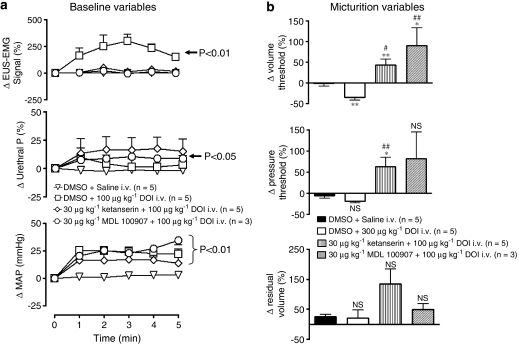
Urethane anaesthetized female rats: Comparison of the effects of vehicle (DMSO+saline) with DOI in the presence of DMSO, ketanserin or MDL 100907 (30 μg kg−1) on changes (Δ) in (a) baseline variables, external urethral sphincter (EUS) EMG signal (%), urethral pressure (urethral P; %) and mean arterial blood pressure (MAP; mm Hg) and (b) on percentage (%) changes (Δ) in volume threshold, pressure threshold and residual volume evoked by infusion of saline into the bladder (micturition reflex). Changes in baseline variables were compared with vehicle controls using a split-plot analysis. Changes in micturition were compared with vehicle control using Student's unpaired t-test. In (b) *compared with vehicle, #compared with DMSO+DOI. *,#P<0.05, **,##P<0.01, ***P<0.001, NS, non-significant. Each point or bar represents mean value and vertical bars show the s.e.mean.
Figure 8
Figure 8
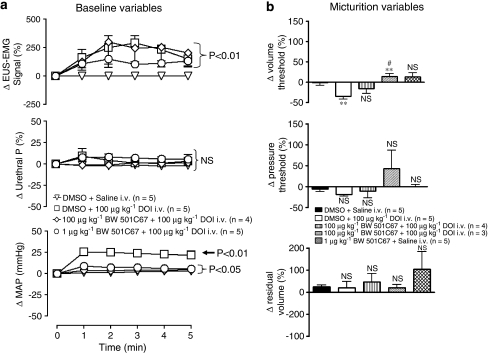
Urethane anaesthetized female rats: Comparison of the effects of vehicle (DMSO+saline) with DOI in the presence of DMSO or BW 501C67 (100 μg kg−1 and 1 mg kg−1) on changes (Δ) in (a) baseline variables, external urethral sphincter (EUS) EMG signal (%), urethral pressure (urethral P, %) and mean arterial blood pressure (MAP; mm Hg) and (b) on percentage (%) changes (Δ) in volume threshold, pressure threshold and residual volume evoked by infusion of saline into the bladder (micturition reflex). Changes in baseline variables were compared with vehicle controls using a split-plot analysis. Changes in micturition were compared with vehicle control using Student's unpaired t-test. *,#P<0.05, **,##P<0.01, NS, non-significant. Each point or bar represents mean value and vertical bars show the s.e.mean.
Figure 9
Figure 9
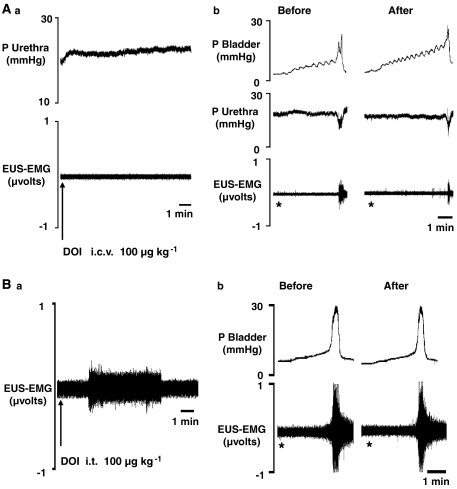
Urethane anaesthetized female rats: Traces showing the effects of (A) i.c.v. DOI (100 μg kg−1) on (a) baseline urethral pressure and EUS–EMG activity and (b) on distention caused by infusion of saline into the bladder (the micturition reflex) in bladder and urethral pressure and raw urethral striated muscle. (B) Traces showing the effects of i.t. DOI (100 μg kg−1) on (a) baseline EUS–EMG activity and (b) on distention caused by infusion of saline into the bladder (the micturition reflex) in bladder and EUS–EMG activity. *Denotes onset of saline infusion into the bladder.

References

    1. Anderson IK, Martin GR, Ramage AG. Evidence that i.c.v. administration of 5-HT causes sympathoexcitation through activation of 5-HT1A receptors and vasopressin release through activation of 5-HT2/1C receptors in anaesthetized rats. Br J Pharmacol. 1992;107:1020–1028. - PMC - PubMed
    1. Alexander SPH, Mathie A, Peters JA. Guide to receptors and channels (GRAC), 2nd edition (2007 revision) Br J Pharmacol. 2007;150 Suppl. 1:S6–S8. - PMC - PubMed
    1. Bancila M, Vergé D, Rampin O, Backstrom JR, Sanders-Bush E, McKenna KE, et al. 5-Hydroxytryptamine2C receptors on spinal neurons controlling penile erection in the rat. Neuroscience. 1999;92:1523–1537. - PubMed
    1. Barnes NM, Sharp T. A review of central 5-HT receptors and their function. Neuropharmacol. 1999;38:1083–1152. - PubMed
    1. Bonhaus DW, Flippin LA, Greenhouse RJ, Jaime S, Rocha C, Dawson M, et al. RS-127445: a selective, high affinity, orally bioavailable 5-HT2B receptor antagonist. Br J Pharmacol. 1999;127:1075–1082. - PMC - PubMed

Publication types

MeSH terms

Substances