Sensory perception of food and insulin-like signals influence seizure susceptibility
- PMID: 18604269
- PMCID: PMC2432499
- DOI: 10.1371/journal.pgen.1000117
Sensory perception of food and insulin-like signals influence seizure susceptibility
Abstract
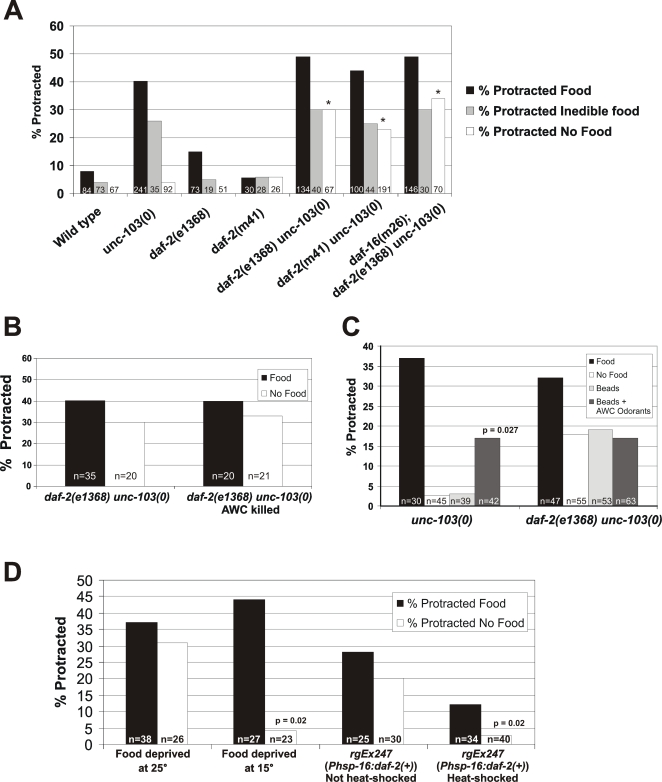
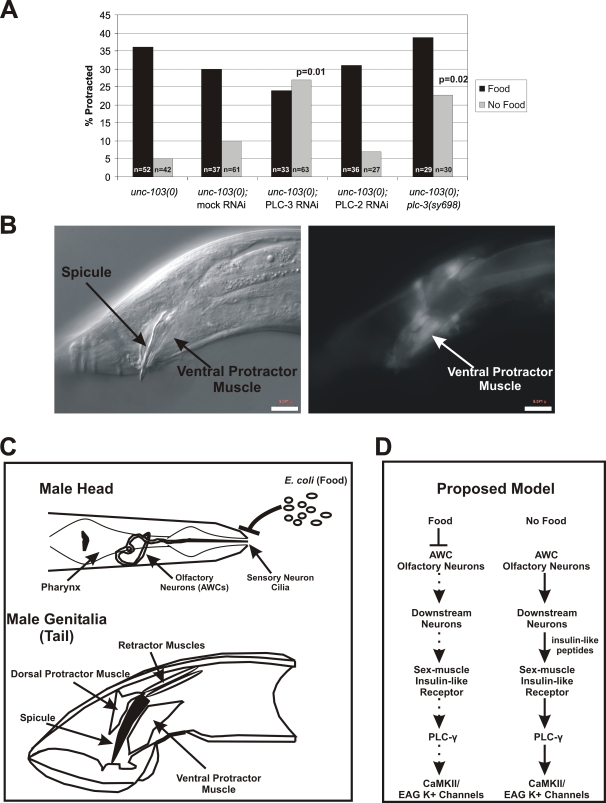
Food deprivation is known to affect physiology and behavior. Changes that occur could be the result of the organism's monitoring of internal and external nutrient availability. In C. elegans, male mating is dependent on food availability; food-deprived males mate with lower efficiency compared to their well-fed counterparts, suggesting that the mating circuit is repressed in low-food environments. This behavioral response could be mediated by sensory neurons exposed to the environment or by internal metabolic cues. We demonstrated that food-deprivation negatively regulates sex-muscle excitability through the activity of chemosensory neurons and insulin-like signaling. Specifically, we found that the repressive effects of food deprivation on the mating circuit can be partially blocked by placing males on inedible food, E. coli that can be sensed but not eaten. We determined that the olfactory AWC neurons actively suppress sex-muscle excitability in response to food deprivation. In addition, we demonstrated that loss of insulin-like receptor (DAF-2) signaling in the sex muscles blocks the ability of food deprivation to suppress the mating circuit. During low-food conditions, we propose that increased activity by specific olfactory neurons (AWCs) leads to the release of neuroendocrine signals, including insulin-like ligands. Insulin-like receptor signaling in the sex muscles then reduces cell excitability via activation of downstream molecules, including PLC-gamma and CaMKII.
Conflict of interest statement
The authors have declared that no competing interests exist.
Figures


References
-
- Kaeberlein TL, Smith ED, Tsuchiya M, Welton KL, Thomas JH, et al. Lifespan extension in Caenorhabditis elegans by complete removal of food. Aging Cell. 2006;5:487–494. - PubMed
-
- Bough KJ, Valiyil R, Han FT, Eagles DA. Seizure resistance is dependent upon age and calorie restriction in rats fed a ketogenic diet. Epilepsy Res. 1999;35:21–28. - PubMed
Publication types
MeSH terms
Substances
Grants and funding
LinkOut - more resources
Full Text Sources
Medical
Miscellaneous