


Executive functions and school readiness intervention: impact, moderation, and mediation in the Head Start REDI program
- PMID: 18606033
- PMCID: PMC3205459
- DOI: 10.1017/S0954579408000394
Executive functions and school readiness intervention: impact, moderation, and mediation in the Head Start REDI program
Abstract
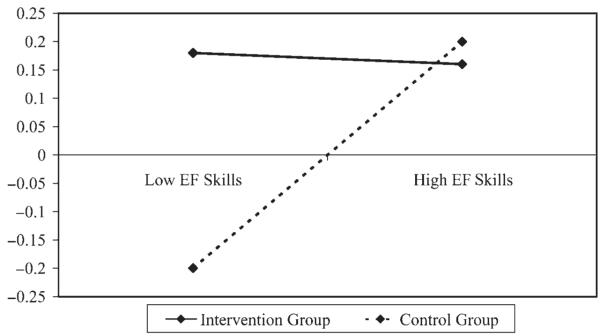
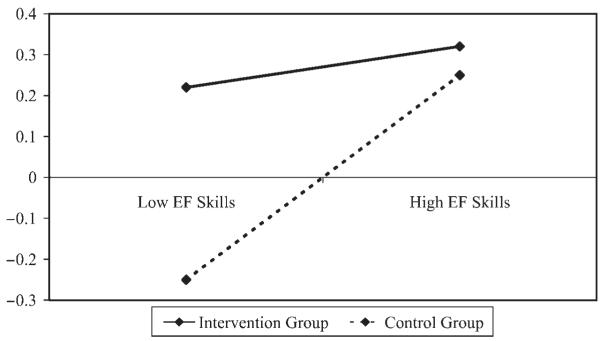
Despite their potentially central role in fostering school readiness, executive function (EF) skills have received little explicit attention in the design and evaluation of school readiness interventions for socioeconomically disadvantaged children. The present study examined a set of five EF measures in the context of a randomized-controlled trial of a research-based intervention integrated into Head Start programs (Head Start REDI). Three hundred fifty-six 4-year-old children (17% Hispanic, 25% African American; 54% girls) were followed over the course of the prekindergarten year. Initial EF predicted gains in cognitive and social-emotional skills and moderated the impact of the Head Start REDI intervention on some outcomes. The REDI intervention promoted gains on two EF measures, which partially mediated intervention effects on school readiness. We discuss the importance of further study of the neurobiological bases of school readiness, the implications for intervention design, and the value of incorporating markers of neurobiological processes into school readiness interventions.
Figures


References
-
- Adams MJ, Foorman BR, Lundberg I, Beeler T. Phonological sensitivity in young children: A classroom curriculum. Paul H. Brookes; Baltimore, MD: 1998.
-
- Barkley RA. The EF and self-regulation: An evolutionary neuropsychological perspective. Neuropsychology Review. 2001;11:1–29. - PubMed
-
- Baron RM, Kenny DA. The moderator–mediator variable distinctionin social psychological research: Conceptual, strategic, and statistical considerations. Journal of Personality and Social Psychology. 1986;51:1173–1182. - PubMed
-
- Blair C. School readiness: Integrating cognition and emotion in a neurobiological conceptualization of children’s functioning at school entry. American Psychologist. 2002;57:111–127. - PubMed
Publication types
MeSH terms
Grants and funding
LinkOut - more resources
Full Text Sources
Medical
