


Comment
doi: 10.1016/j.devcel.2008.06.007.
Dangerous liaisons: the apoptotic engulfment receptor CED-1 links innate immunity to the unfolded protein response
Affiliations
- PMID: 18606133
- PMCID: PMC3359060
- DOI: 10.1016/j.devcel.2008.06.007
Item in Clipboard
Comment
Dangerous liaisons: the apoptotic engulfment receptor CED-1 links innate immunity to the unfolded protein response
Dev Cell.
2008 Jul.
Abstract
In this issue of Developmental Cell, Haskins et al. describe a molecular link between an apoptotic cell receptor, a branch of the unfolded protein response, and innate immunity. The finding that the plasma membrane phagocytic receptor CED-1 promotes the expression of unfolded response genes suggests a novel regulatory mechanism for the control of this primitive immune system that may couple the presence of pathogen with the production of secreted antimicrobial effectors.
Figures
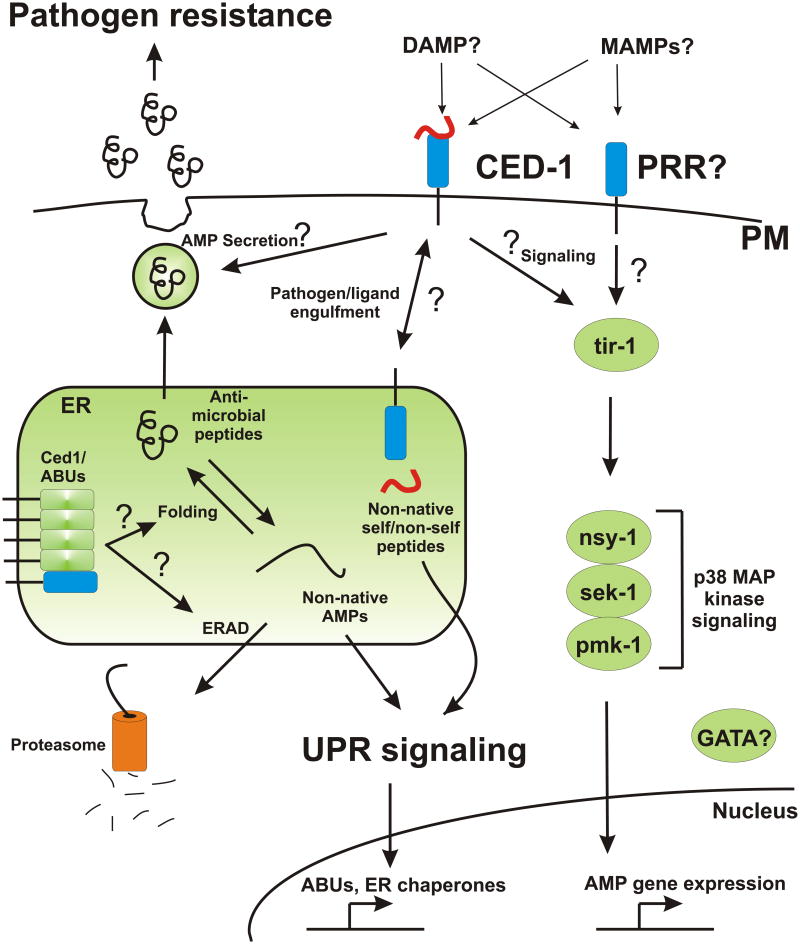
Ced-1 may coordinate multiple mechanisms to link innate immunity to the Unfolded Protein Response. During pathogen infection, Ced-1 mediated-engulfment and ER delivery of self or non-self ‘damage signals’ might trigger the Unfolded Protein Response, possibly through acute elevation of ER protein load. Increased expression of UPR target genes, such as ER chaperones and Abu genes might, in turn, might be required to facilitate the folding and/or maturation of secreted antimicrobial peptides, which are also induced by pathogen infection via a conserved p38 MAP kinase signaling pathway. Ced-1 might also regulate immune responses through interactions with other cellular mechanisms, such as ERAD, secretory pathways, or direct regulation of MAP kinase-controlled AMP production.
Comment on
-
Unfolded protein response genes regulated by CED-1 are required for Caenorhabditis elegans innate immunity.Dev Cell. 2008 Jul;15(1):87-97. doi: 10.1016/j.devcel.2008.05.006. Dev Cell. 2008. PMID: 18606143 Free PMC article.
References
-
- Akira S, Uematsu S, Takeuchi O. Pathogen recognition and innate immunity. Cell. 2006;124:783–801. - PubMed
-
- Kim DH, Ausubel FM. Evolutionary perspectives on innate immunity from the study of Caenorhabditis elegans. Curr Opin Immunol. 2005;17:4–10. - PubMed
-
- Matzinger P. The danger model: a renewed sense of self. Science. 2002;296:301–305. - PubMed
Publication types
MeSH terms
Substances
Grants and funding
LinkOut - more resources
Full Text Sources
Medical
