. 2008 Jul;15(1):87-97.
doi: 10.1016/j.devcel.2008.05.006.

Unfolded protein response genes regulated by CED-1 are required for Caenorhabditis elegans innate immunity

Affiliations

Unfolded protein response genes regulated by CED-1 are required for Caenorhabditis elegans innate immunity

Kylie A Haskins et al. Dev Cell. 2008 Jul.

Abstract

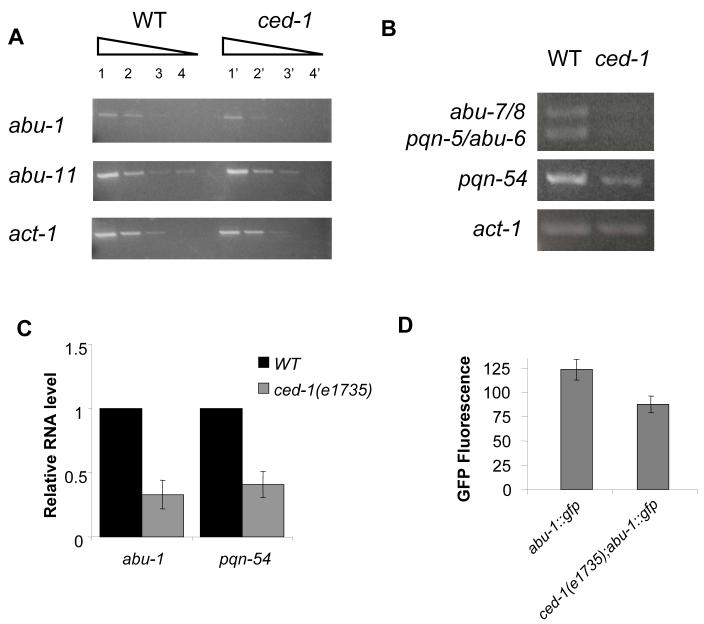
The endoplasmic reticulum stress response, also known as the unfolded protein response (UPR), has been implicated in the normal physiology of immune defense and in several disorders, including diabetes, cancer, and neurodegenerative disease. Here, we show that the apoptotic receptor CED-1 and a network of PQN/ABU proteins involved in a noncanonical UPR response are required for proper defense to pathogen infection in Caenorhabditis elegans. A full-genome microarray analysis indicates that CED-1 functions to activate the expression of pqn/abu genes. We also show that ced-1 and pqn/abu genes are required for the survival of C. elegans exposed to live Salmonella enterica, and that overexpression of pqn/abu genes confers protection against pathogen-mediated killing. The results indicate that unfolded protein response genes, regulated in a CED-1-dependent manner, are involved in the C. elegans immune response to live bacteria.


Figures
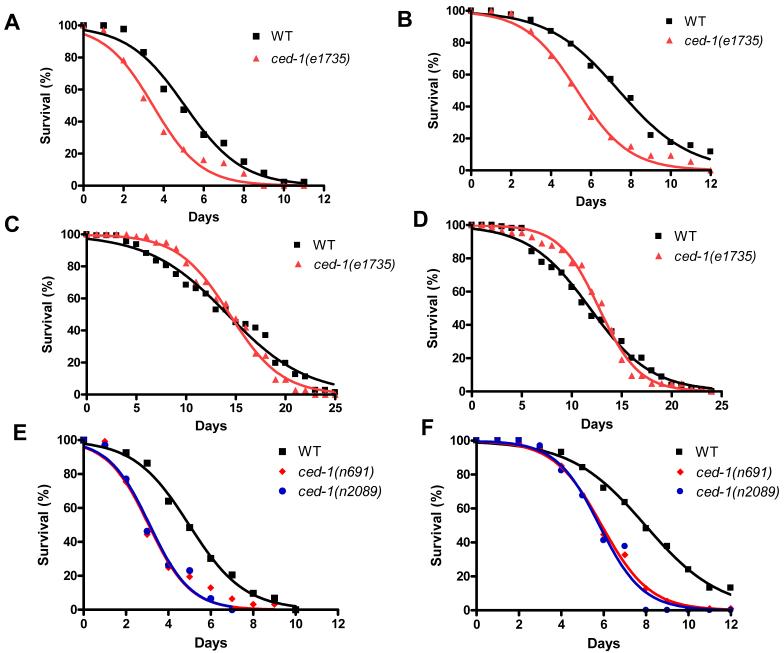
Figure 1
Figure 1
ced-1 Loss-of-function Mutants are Immunocompromised Animals Killed by Live Bacteria (A) Wild-type and ced-1(e1735) animals were exposed to live S. enterica: ced-1(e1735) P < 0.0001. (B) Wild-type and ced-1(e1735) animals were exposed to live E. coli: ced-1(e1735) P < 0.0001. (C) Wild-type and ced-1(e1735) animals were exposed to heat-killed S. enterica: ced-1(e1735) P > 0.1. (D) Wild-type and ced-1(e1735) animals were exposed to heat-killed E. coli: ced-1(e1735) P > 0.1. (E) Wild-type, ced-1(n691) and ced-1(n2089) animals were exposed to live S. enterica: ced-1(n691) P < 0.0001, ced-1(n2089) P < 0.0001. (F) Wild-type, ced-1(n691), and ced-1(n2089) animals were exposed to live E. coli: ced-1(n691) P < 0.0001, ced-1(n2089) P < 0.0001. For each condition 110-140 animals were used, with the exception of ced-1(n2089) where 35 animals were used. P values are relative to wild-type animals.
Figure 2
Figure 2
CED-1 Regulates pqn/abu Unfolded Protein Response Genes (A) Wild-type (lanes 1-4) and ced-1(e1735) (lanes 1′-4′) cDNAs were stepwise 10-fold serially diluted. PCR was performed using gene specific primers and expression levels of act-1, a housekeeping gene, was used to confirm cDNA equalization. (B) Wild-type and ced-1(e1735) cDNAs were 10-fold serially diluted and the 1:1,000 dilutions were used. PCR was performed using gene specific primers and expression levels of act-1, a housekeeping gene, was used to confirm cDNA equalization. abu-7 and abu-8 mRNA are 93.4% identical and abu-6 and abu-7 mRNA are 98.3% identical; although one primer set was used to amplify all four transcripts, the two groups could be differentiated by size. (A-B) L1 stage animals fed E. coli were grown to L4 stage. RNA was then isolated, RT-PCR was performed, and PCR products were run on a gel and stained with ethidium bromide. RT-PCR was performed in duplicate from independent RNA isolations, and similar results were achieved. (C) Quantitative reverse transcription-PCR analysis of abu-1 and pqn-54 expression in ced-1(e1735) relative to wild-type nematodes grown on E. coli to L4 stage. Data were analyzed by relative quantitation using the comparative cycle threshold method and normalization to actin. One sample Student’s exact t-test indicates that differences between wild type and ced-1(e1735) are significantly different (P<0.05); n=3; bars correspond to mean±s.d. (D) GFP expression in a standard defined area encompassing the entire pharynx of L4 stage abu-1::gfp(zcEx8) animals and ced-1(e1735);abu-1::gfp(zcEx8) animals was analyzed using max green channel intensity calculated by ImageJ 1.37v freeware. Student’s exact t-test indicates that differences between abu-1::gfp(zcEx8) and ced-1(e1735);abu-1::gfp(zcEx8) are significantly different (P<0.05); n=15; bars correspond to mean±s.d.
Figure 3
Figure 3
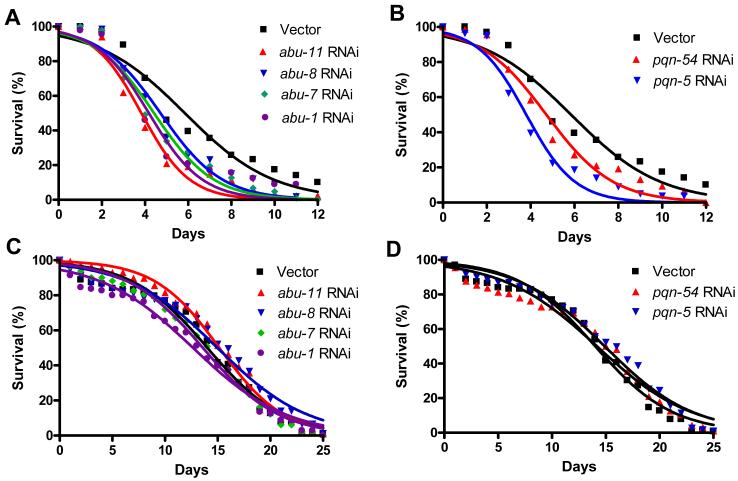
pqn/abu Genes Expressed in a CED-1-dependent Manner are Required for C. elegans Immunity (A) Wild-type animals grown on dsRNA for vector control or dsRNA for abu genes were exposed to live S. enterica: abu-11 RNAi P < 0.0001, abu-8 RNAi P = 0.0032, abu-7 RNAi P < 0.0001, abu-1 RNAi P = 0.0459. (B) Wild-type animals grown on dsRNA for vector control or dsRNA for pqn genes were exposed to live S. enterica: pqn-54 RNAi P = 0.0056, pqn-5 RNAi P < 0.0001. (C) Wild-type animals grown on dsRNA for vector control or dsRNA for abu genes were exposed to heat-killed S. enterica: abu-11 RNAi P > 0.1, abu-8 RNAi P > 0.1, abu-7 RNAi P > 0.1, abu-1 RNAi P > 0.1. (D) Wild-type animals grown on dsRNA for vector control or dsRNA for pqn candidate genes were exposed to heat-killed S. enterica: pqn-54 RNAi P > 0.1, pqn-5 RNAi P > 0.1. For each condition, 90-140 animals were used. P values are relative to wild-type animals fed dsRNA for vector control.
Figure 4
Figure 4
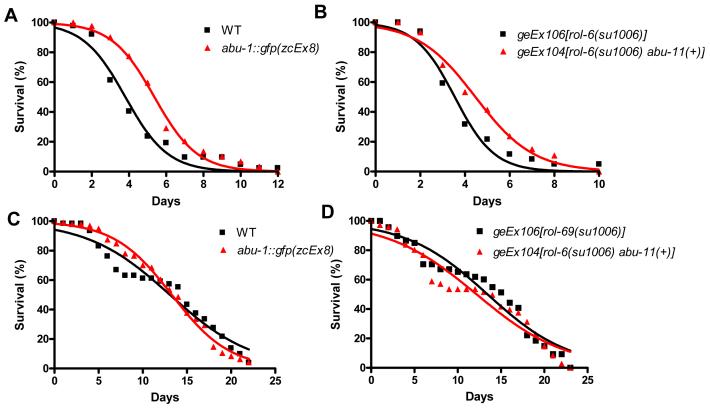
Overexpression of abu-1 or abu-11 Extends C. elegans Lifespan on Live Bacteria (A) Wild-type and abu-1::gfp(zcEx8) animals were exposed to live S. enterica: abu-1::gfp(zcEx8) P = 0.0005. (B) geEx106[rol-6(su1006)] and geEx104[rol-6(su1006) abu-11(+)] animals were exposed to live S. enterica: geEx104[rol-6(su1006) abu-11(+)] P = 0.0373. (C) Wild-type and abu-1::gfp(zcEx8) animals were exposed to heat-killed S. enterica: abu-1::gfp(zcEx8) P > 0.1. (D) geEx106[rol-6(su1006)] and geEx104[rol-6(su1006) abu-11(+)] animals were exposed to heat-killed S. enterica: geEx104[rol-6(su1006) abu-11(+)] P > 0.1. For each condition, 60-105 animals were used. P values are relative to control animals.
Figure 5
Figure 5
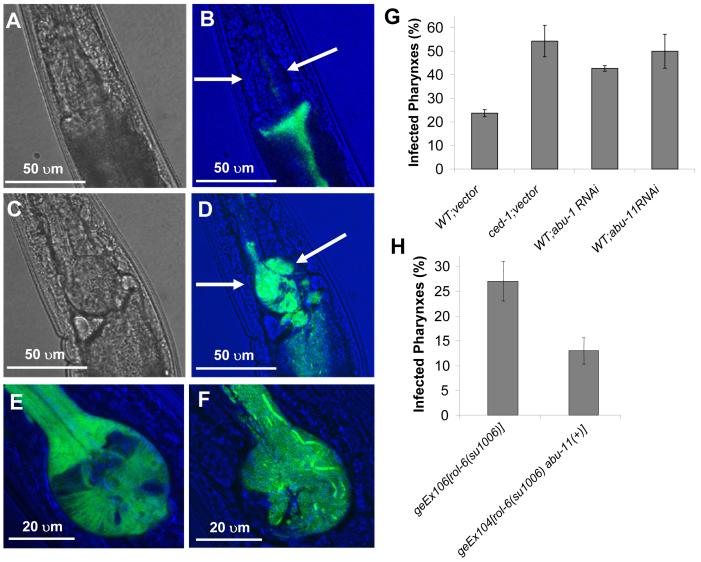
pqn/abu Genes Expressed in a CED-1-dependent Manner are Required for C. elegans Defense to Pharyngeal Invasion by S. enterica (A-D) Confocal images show the pharynx of wild-type (A-B) and ced-1(e1735) (C-D) animals infected for 48 hours with S. enterica expressing GFP. In the merged images (B and D), the terminal bulb of the pharynx is indicated with arrows. (E) Confocal image of the terminal bulb of an abu-1::gfp(zcEx8) animal showing pharyngeal expression of ABU-1::GFP. (F) Confocal image of the infected terminal bulb of a ced-1(e1735) animal fed S. enterica expressing GFP for 48 hours. (G) The percentage of nematodes with infected pharynxes when fed S. enterica expressing GFP for 48 hours was determined for wild-type and ced-1(e1735) animals exposed to dsRNA for vector control and wild-type animals exposed to dsRNA targeting abu-1 and abu-11. (H) The percentage of nematodes with infected pharynxes when fed S. enterica expressing GFP for 48 hours was determined for geEx106[rol-6(su1006)] and geEx104[rol-6(su1006) abu-11(+)] animals. Bars correspond to mean±s.d.
Figure 6
Figure 6
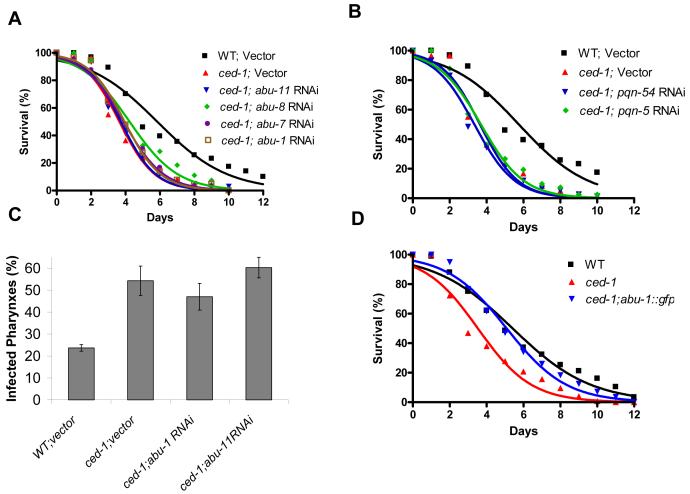
CED-1 and PQN/ABU Unfolded Protein Response Proteins are Part of a Pathway Required for Innate Immunity to S. enterica (A) Wild-type animals grown on dsRNA for vector control and ced-1(e1735) animals grown on dsRNA for vector control or dsRNA for abu genes were exposed to live S. enterica: wild type;vector P < 0.0001, ced-1;abu-11 RNAi P > 0.1, ced-1;abu-8 RNAi P > 0.1, ced-1;abu-7 RNAi P > 0.1, ced-1;abu-1 RNAi P > 0.1. 74-140 animals were used. P values are relative to ced-1(e1735) animals fed dsRNA for vector control. (B) Wild-type animals grown on dsRNA for vector control and ced-1(e1735) animals grown on dsRNA for vector control or dsRNA for pqn genes were exposed to live S. enterica: wild-type; vector P < 0.0001, ced-1;pqn-54 RNAi P > 0.1, ced-1;pqn-5 RNAi P > 0.1. 74-140 animals were used. P values are relative to ced-1(e1735) animals fed dsRNA for vector control. (C) The percentage of nematodes with infected pharynxes when fed S. enterica expressing GFP for 48 hours was determined for wild-type and ced-1(e1735) animals grown on dsRNA for control and ced-1(e1735) animals grown dsRNA targeting abu-1 and abu-11 candidate genes. Bars correspond to mean ± standard deviation. (D) Wild-type, ced-1(e1735), and ced-1(e1735);abu-1::gfp(zcEx8) animals were exposed to live S. enterica: wild-type P < 0.0001, ced-1(e1735);abu-1::gfp(zcEx8) P > 0.1. 174-179 animals were used. P values are relative to ced-1(e1735) animals.

Comment in

References

    1. Aballay A, Ausubel FM. Programmed cell death mediated by ced-3 and ced-4 protects Caenorhabditis elegans from Salmonella typhimurium-mediated killing. Proc Natl Acad Sci U S A. 2001;98:2735–2739. - PMC - PubMed
    1. Aballay A, Drenkard E, Hilbun LR, Ausubel FM. Caenorhabditis elegans innate immune response triggered by Salmonella enterica requires intact LPS and is mediated by a MAPK signaling pathway. Curr Biol. 2003;13:47–52. - PubMed
    1. Aballay A, Yorgey P, Ausubel FM. Salmonella typhimurium proliferates and establishes a persistent infection in the intestine of Caenorhabditis elegans. Curr Biol. 2000;10:1539–1542. - PubMed
    1. Akira S, Uematsu S, Takeuchi O. Pathogen recognition and innate immunity. Cell. 2006;124:783–801. - PubMed
    1. Alper S, McBride SJ, Lackford B, Freedman JH, Schwartz DA. Specificity and complexity of the C. elegans innate immune response. Mol Cell Biol. 2007 - PMC - PubMed

Publication types

MeSH terms

Substances

LinkOut - more resources