


Characterization of Ig gene somatic hypermutation in the absence of activation-induced cytidine deaminase
- PMID: 18606684
- PMCID: PMC2587332
- DOI: 10.4049/jimmunol.181.2.1299
Characterization of Ig gene somatic hypermutation in the absence of activation-induced cytidine deaminase
Abstract
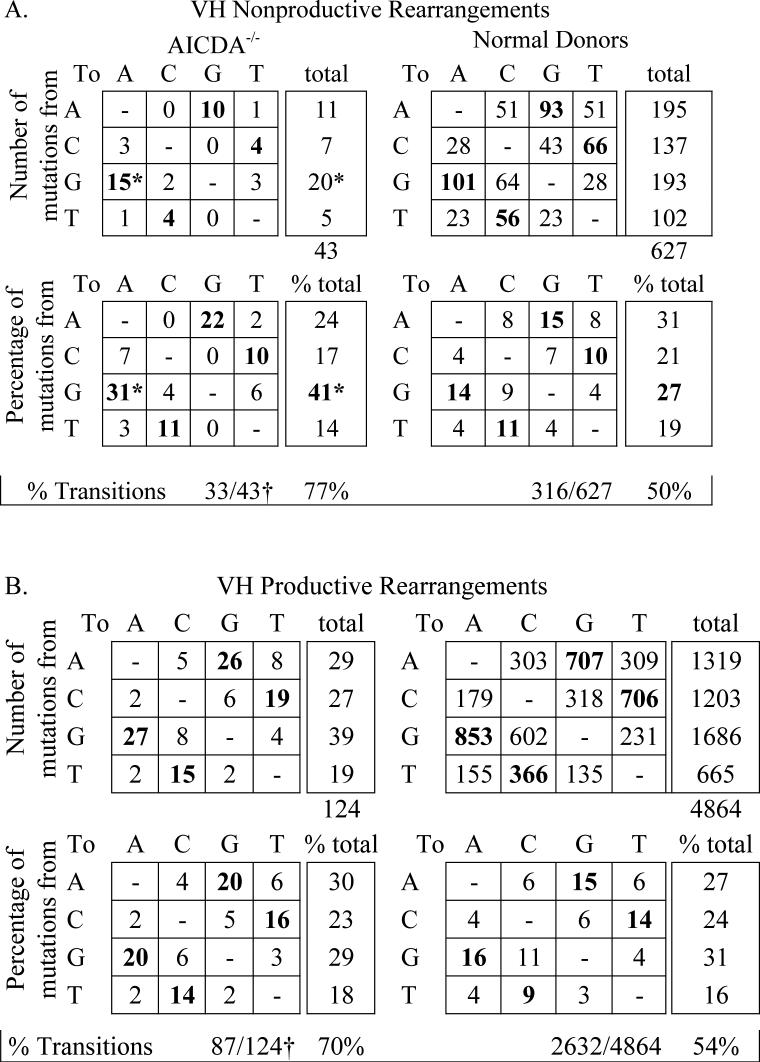
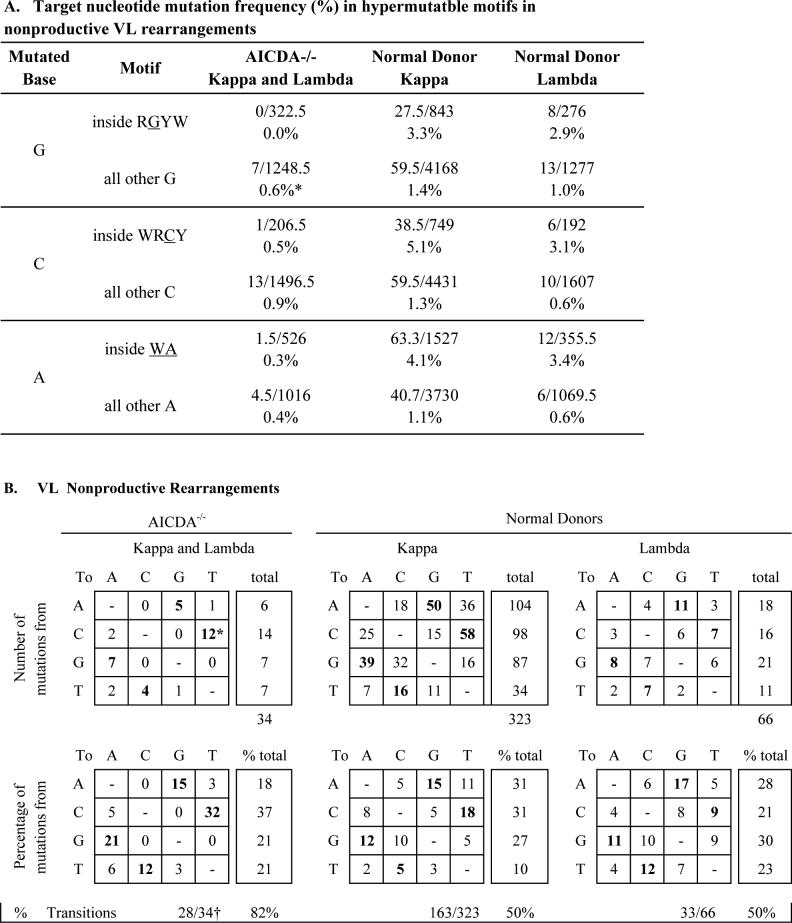
Somatic hypermutation (SHM) of Ig genes depends upon the deamination of C nucleotides in WRCY (W = A/T, R = A/G, Y = C/T) motifs by activation-induced cytidine deaminase (AICDA). Despite this, a large number of mutations occur in WA motifs that can be accounted for by the activity of polymerase eta (POL eta). To determine whether there are AICDA-independent mutations and to characterize the relationship between AICDA- and POL eta-mediated mutations, 1470 H chain and 1313 kappa- and lambda-chain rearrangements from three AICDA(-/-) patients were analyzed. The Ig mutation frequency of all V(H) genes from AICDA(-/-) patients was 40-fold less than that of normal donors, whereas the mutation frequency of mutated V(H) sequences from AICDA(-/-) patients was 6.8-fold less than that of normal donors. AICDA(-/-) B cells lack mutations in WRCY/RGYW motifs as well as replacement mutations and mutational targeting in complementarity-determining regions. A significantly reduced mutation frequency in WA motifs compared with normal donors and an increased percentage of transitions, which may relate to reduced uracil DNA-glycosylase activity, suggest a role for AICDA in regulating POL eta and uracil DNA-glycosylase activity. Similar results were observed in V(L) rearrangements. The residual mutations were predominantly G:C substitutions, indicating that AICDA-independent cytidine deamination was a likely, yet inefficient, mechanism for mutating Ig genes.
Figures
References
-
- Muramatsu M, Kinoshita K, Fagarasan S, Yamada S, Shinkai Y, Honjo T. Class switch recombination and hypermutation require activation-induced cytidine deaminase (AID), a potential RNA editing enzyme. Cell. 2000;102:553–563. - PubMed
-
- Milstein C. Diversity and the genesis of high affinity antibodies. Biochem. Soc. Trans. 1987;15:779–787. - PubMed
-
- Revy P, Muto T, Levy Y, Geissmann F, Plebani A, Sanal O, Catalan N, Forveille M, Dufourcq-Labelouse R, Gennery A, Tezcan I, Ersoy F, Kayserili H, Ugazio AG, Brousse N, Muramatsu M, Notarangelo LD, Kinoshita K, Honjo T, Fischer A, Durandy A. Activation-induced cytidine deaminase (AID) deficiency causes the autosomal recessive form of the Hyper-IgM syndrome (HIGM2). Cell. 2000;102:565–575. - PubMed
-
- Barreto VM, Ramiro AR, Nussenzweig MC. Activation-induced deaminase: controversies and open questions. Trends Immunol. 2005;26:90–96. - PubMed
Publication types
MeSH terms
Substances
Grants and funding
LinkOut - more resources
Full Text Sources
Other Literature Sources
