


Secular trends in cardiovascular risk factors with a 36-year perspective: observations from 38- and 50-year-olds in the Population Study of Women in Gothenburg
- PMID: 18609256
- PMCID: PMC3409601
- DOI: 10.1080/02813430802088403
Secular trends in cardiovascular risk factors with a 36-year perspective: observations from 38- and 50-year-olds in the Population Study of Women in Gothenburg
Abstract
Objectives: To study secular trends in cardiovascular risk factors in four different cohorts of women examined in 1968-1969, 1980-1981, 1992-1993 and 2004-2005.
Design: Comparison of four representative cohorts of 38- and 50-year-old women over a period of 36 years.
Setting: Gothenburg, Sweden with approximately 450,000 inhabitants.
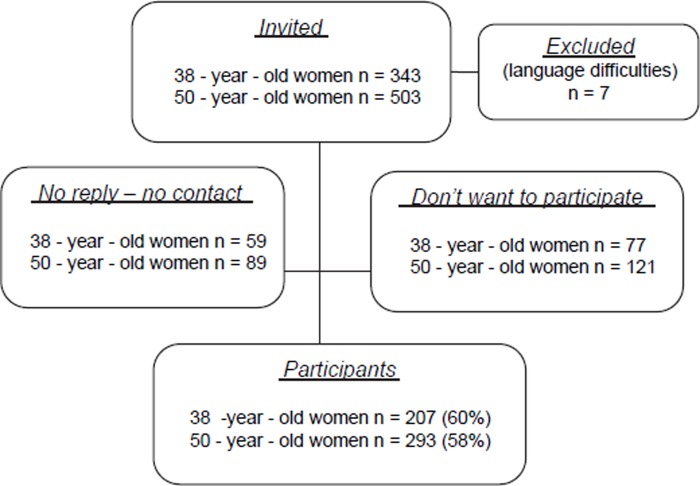
Subjects: Four representative samples of 38- and 50-year-old women were invited to free health examinations (participation rate 59-90%, n =1901).
Main outcome measures: Body mass index (BMI), systolic and diastolic blood pressure (SBP, DBP), leisure time exercise, use of antihypertensive medication, smoking, levels of haemoglobin, b-glucose, s-cholesterol, s-triglycerides and HDL-cholesterol.
Results: There was no significant difference in mean BMI from 1968-1969 versus 2004-2005. Mean leisure time exercise was significantly higher in later born cohorts; in 1968, around 15% were physically active compared with 40% in 2004. SBP and DBP, mean s-cholesterol and s-triglyceride levels were significantly lower in both 38- and 50-year-old cohorts in 2004-2005 versus 1968-1969. HDL-cholesterol (not measured until 1992-1993), showed a significantly higher mean level in 2004-2005. Reduction of risk factors was apparent in women with a high as well as low level of physical activity. Smoking declined most in women with high levels of physical activity.
Conclusions: Several cardiovascular risk factors related to lifestyle have improved in middle-aged women from the 1960s until today. Most of the positive trends are observed in women with both low and high physical activity.
Figures
References
-
- Posner BM, Franz MM, Quatromoni PA, Gagnong DR, Sytowskai PA, D'Agostino RB, Cupples LA. Secular trends in diet and risk factors for cardiovascular disease: The Framingham Study. J Am Diet Assoc. 1995;95:171–9. - PubMed
-
- Bengtsson C, Ahlqwist M, Andersson K, Björkelund C, Lissner L, Söderström M. The Prospective Population Study of Women in Gothenburg, Sweden, 1968–1969 to 1992–93. A 24-year follow-up study with special reference to participation, representativeness, and mortality. Scand J Prim Health Care. 1997;15:214–19. - PubMed
-
- Anderson GL, Limacher M, Assaf AR, Bassford T, Beresford SA, Black H, et al. Women's Health Initiative Steering Committee. Effects of conjugated equine estrogen in postmenopausal women with hysterectomy: The Women's Health Initiative randomized controlled trial. JAMA. 2004;291:1701–12. - PubMed
-
- Nyberg A. In Familj, makt och jämställdhet [Family, power, and equality] Stockholm: SOU; 1997. Makt, Kön och BNP (Power, gender and state incomes) p. 138.
-
- Socialstyrelsen. Stockholm; 2005. Folkhälsorapport 2005. (The National Board of Health and Welfare. Health in Sweden. The National Health Report 2005)
Publication types
MeSH terms
LinkOut - more resources
Full Text Sources
Medical
