


Transcriptome analysis for Caenorhabditis elegans based on novel expressed sequence tags
- PMID: 18611272
- PMCID: PMC2474577
- DOI: 10.1186/1741-7007-6-30
Transcriptome analysis for Caenorhabditis elegans based on novel expressed sequence tags
Abstract
Background: We have applied a high-throughput pyrosequencing technology for transcriptome profiling of Caenorhabditis elegans in its first larval stage. Using this approach, we have generated a large amount of data for expressed sequence tags, which provides an opportunity for the discovery of putative novel transcripts and alternative splice variants that could be developmentally specific to the first larval stage. This work also demonstrates the successful and efficient application of a next generation sequencing methodology.
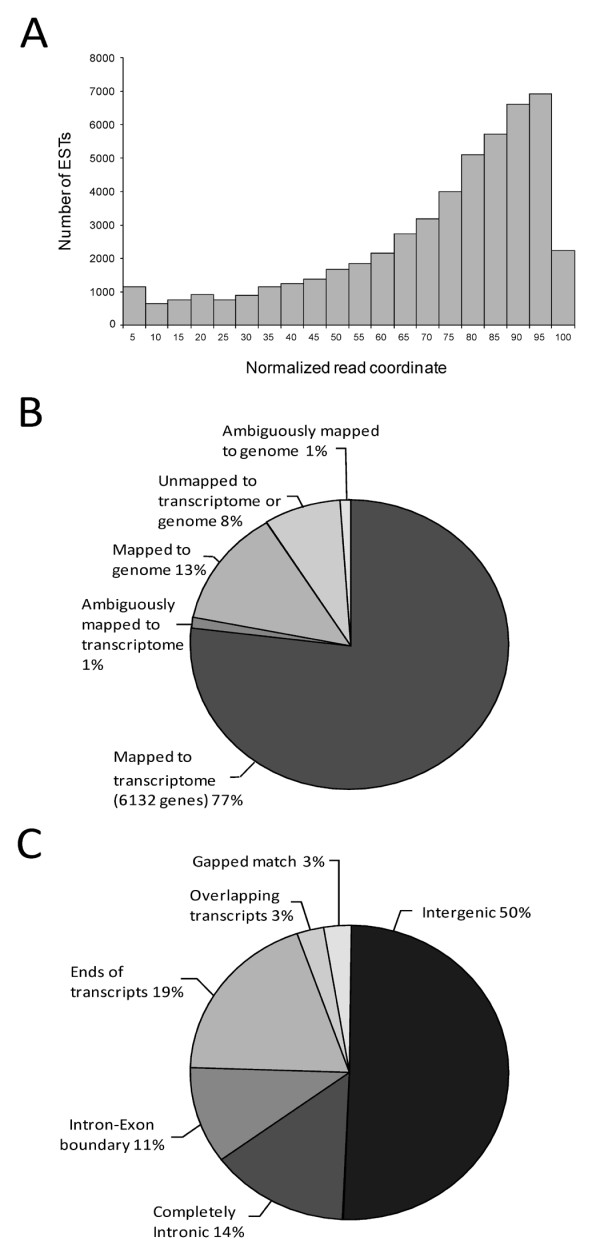
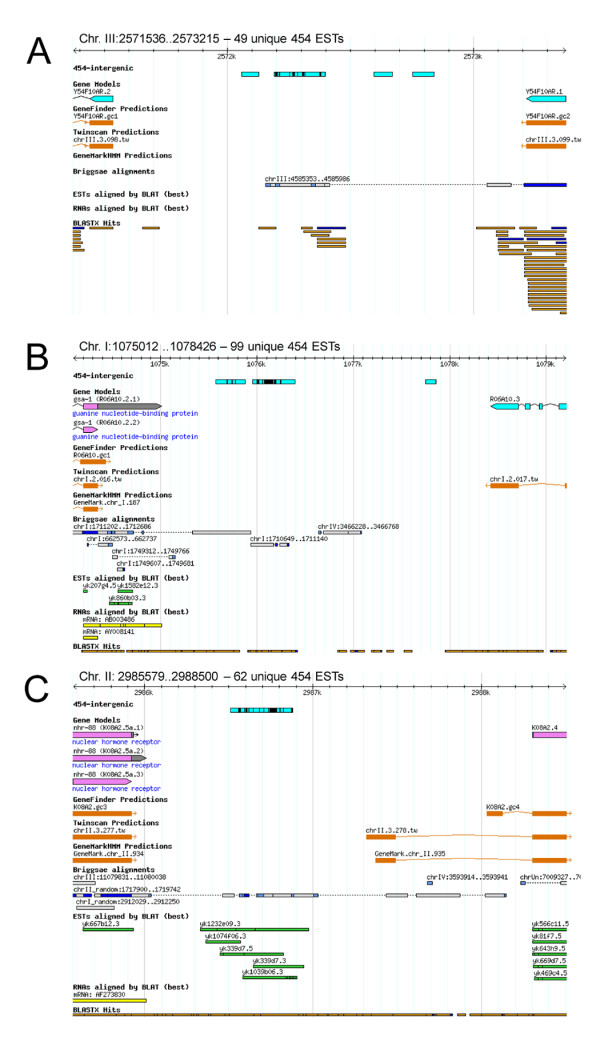
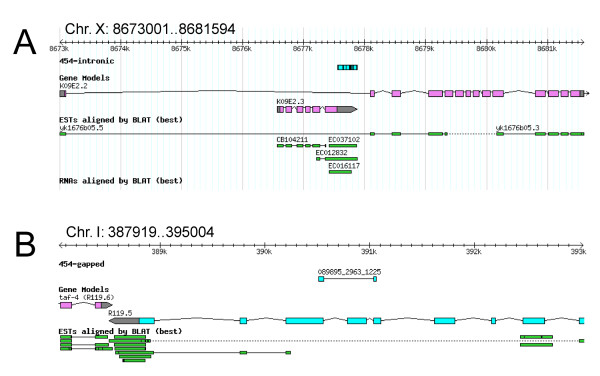
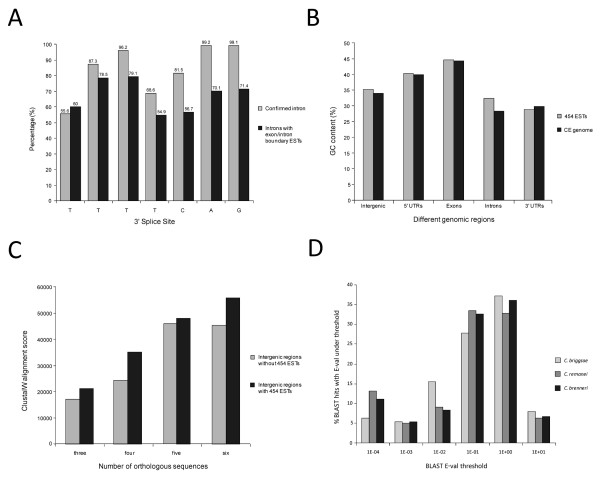
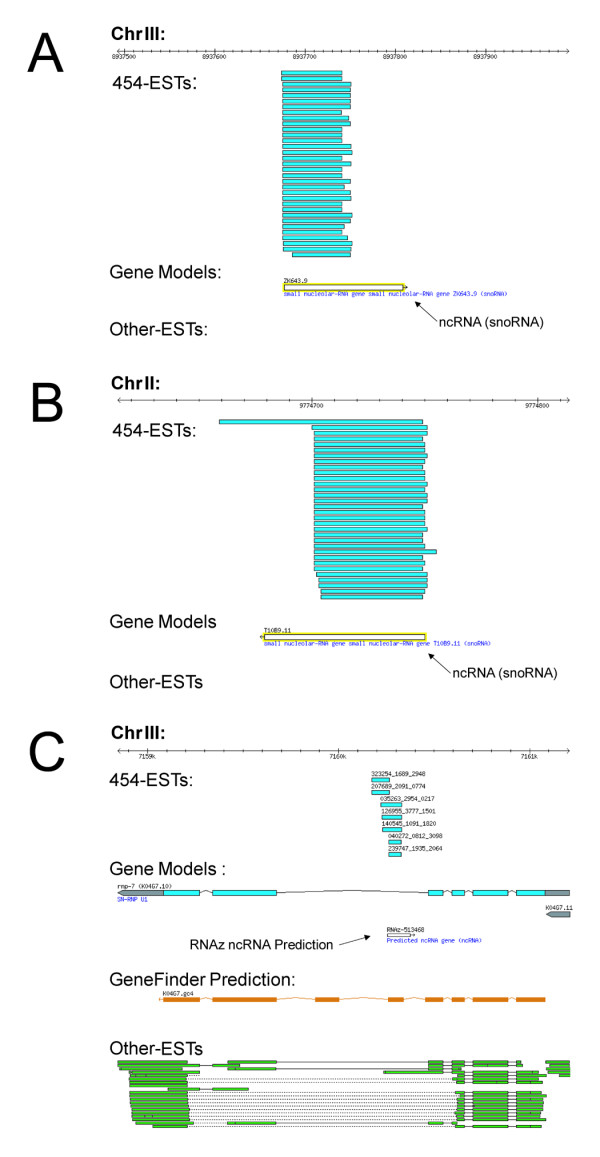
Results: We have generated over 30 million bases of novel expressed sequence tags from first larval stage worms utilizing high-throughput sequencing technology. We have shown that approximately 14% of the newly sequenced expressed sequence tags map completely or partially to genomic regions where there are no annotated genes or splice variants and therefore, imply that these are novel genetic structures. Expressed sequence tags, which map to intergenic (around 1000) and intronic regions (around 580), may represent novel transcribed regions, such as unannotated or unrecognized small protein-coding or non-protein-coding genes or splice variants. Expressed sequence tags, which map across intron-exon boundaries (around 300), indicate possible alternative splice sites, while expressed sequence tags, which map near the ends of known transcripts (around 600), suggest extension of the coding or untranslated regions. We have also discovered that intergenic and intronic expressed sequence tags, which are well conserved across different nematode species, are likely to represent non-coding RNAs. Lastly, we have incorporated available serial analysis of gene expression data generated from first larval stage worms, in order to predict novel transcripts that might be specifically or predominantly expressed in the first larval stage.
Conclusion: We have demonstrated the use of a high-throughput sequencing methodology to efficiently produce a snap-shot of transcriptional activities occurring in the first larval stage of C. elegans development. Such application of this new sequencing technique allows for high-throughput, genome-wide experimental verification of known and novel transcripts. This study provides a more complete C. elegans transcriptome profile and, furthermore, gives insight into the evolutionary and biological complexity of this organism.
Figures
References
-
- Bainbridge MN, Warren RL, Hirst M, Romanuik T, Zeng T, Go A, Delaney A, Griffith M, Hickenbotham M, Magrini V, Mardis ER, Sadar MD, Siddiqui AS, Marra MA, Jones SJM. Analysis of the prostate cancer cell line LNCaP transcriptome using a sequencing-by-synthesis approach. BMC Genomics. 2006;7:246. doi: 10.1186/1471-2164-7-246. - DOI - PMC - PubMed
-
- McKay SJ, Johnsen R, Khattra J, Asano J, Baillie DL, Chan S, Dube N, Fang L, Goszczynski B, Ha E, Halfnight E, Hollebakken R, Huang P, Hung K, Jensen V, Jones SJ, Kai H, Li D, Mah A, Marra M, McGhee J, Newbury R, Pouzyrev A, Riddle DL, Sonnhammer E, Tian H, Tu D, Tyson JR, Vatcher G, Warner A, Wong K, Zhao Z, Moerman DG. Gene expression profiling of cells, tissues, and developmental stages of the nematode C. elegans. Cold Spring Harb Symp Quant Biol. 2003;68:159–169. doi: 10.1101/sqb.2003.68.159. - DOI - PubMed
Publication types
MeSH terms
Substances
LinkOut - more resources
Full Text Sources
