


The glucocorticoid receptor and FOXO1 synergistically activate the skeletal muscle atrophy-associated MuRF1 gene
- PMID: 18612045
- PMCID: PMC2652500
- DOI: 10.1152/ajpendo.00646.2007
The glucocorticoid receptor and FOXO1 synergistically activate the skeletal muscle atrophy-associated MuRF1 gene
Abstract
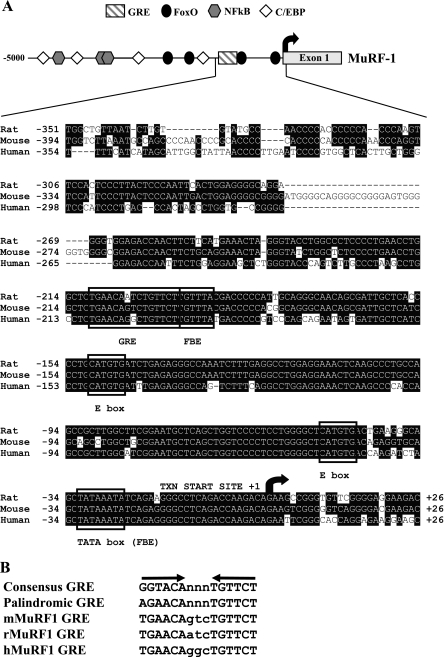
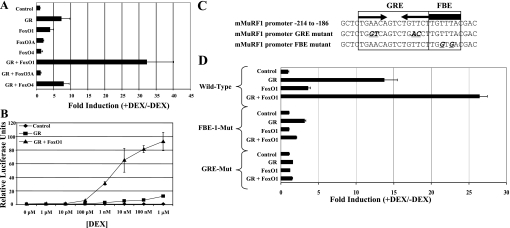
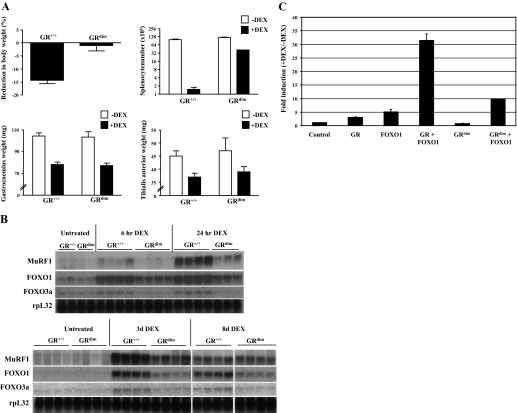
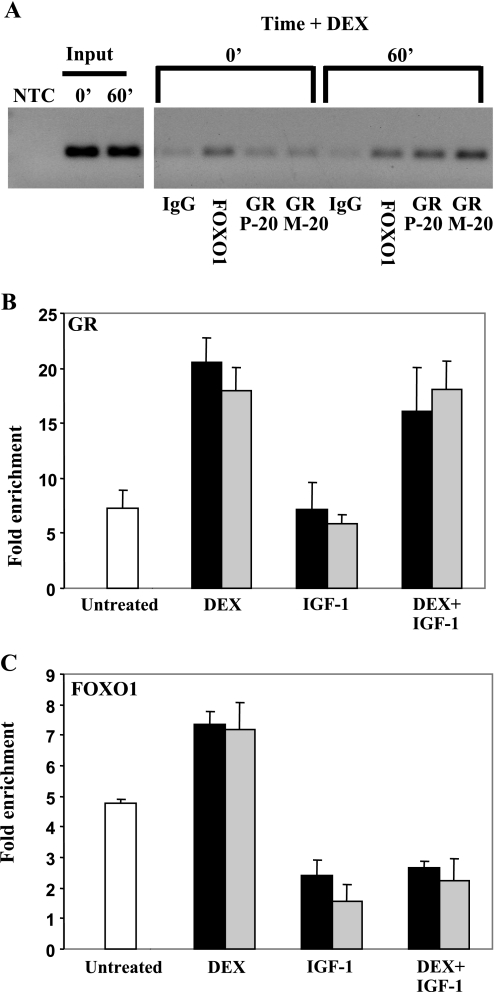
The muscle specific ubiquitin E3 ligase MuRF1 has been implicated as a key regulator of muscle atrophy under a variety of conditions, such as during synthetic glucocorticoid treatment. FOXO class transcription factors have been proposed as important regulators of MuRF1 expression, but its regulation by glucocorticoids is not well understood. The MuRF1 promoter contains a near-perfect palindromic glucocorticoid response element (GRE) 200 base pairs upstream of the transcription start site. The GRE is highly conserved in the mouse, rat, and human genes along with a directly adjacent FOXO binding element (FBE). Transient transfection assays in HepG2 cells and C(2)C(12) myotubes demonstrate that the MuRF1 promoter is responsive to both the dexamethasone (DEX)-activated glucocorticoid receptor (GR) and FOXO1, whereas coexpression of GR and FOXO1 leads to a dramatic synergistic increase in reporter gene activity. Mutation of either the GRE or the FBE significantly impairs activation of the MuRF1 promoter. Consistent with these findings, DEX-induced upregulation of MuRF1 is significantly attenuated in mice expressing a homodimerization-deficient GR despite no effect on the degree of muscle loss in these mice vs. their wild-type counterparts. Finally, chromatin immunoprecipitation analysis reveals that both GR and FOXO1 bind to the endogenous MuRF1 promoter in C(2)C(12) myotubes, and IGF-I inhibition of DEX-induced MuRF1 expression correlates with the loss of FOXO1 binding. These findings present new insights into the role of the GR and FOXO family of transcription factors in the transcriptional regulation of the MuRF1 gene, a direct target of the GR in skeletal muscle.
Figures



References
-
- Beato M, Chalepakis G, Schauer M, Slater EP. DNA regulatory elements for steroid hormones. J Steroid Biochem 32: 737–747, 1989. - PubMed
-
- Bodine SC, Latres E, Baumhueter S, Lai VK, Nunez L, Clarke BA, Poueymirou WT, Panaro FJ, Na E, Dharmarajan K, Pan ZQ, Valenzuela DM, DeChiara TM, Stitt TN, Yancopoulos GD, Glass DJ. Identification of ubiquitin ligases required for skeletal muscle atrophy. Science 294: 1704–1708, 2001. - PubMed
-
- Cai D, Frantz JD, Tawa NE Jr, Melendez PA, Oh BC, Lidov HG, Hasselgren PO, Frontera WR, Lee J, Glass DJ, Shoelson SE. IKKbeta/NF-kappaB activation causes severe muscle wasting in mice. Cell 119: 285–298, 2004. - PubMed
-
- Clarke BA, Drujan D, Willis MS, Murphy LO, Corpina RA, Burova E, Rakhilin SV, Stitt TN, Patterson C, Latres E, Glass DJ. The E3 Ligase MuRF1 degrades myosin heavy chain protein in dexamethasone-treated skeletal muscle. Cell Metab 6: 376–385, 2007. - PubMed
Publication types
MeSH terms
Substances
Grants and funding
LinkOut - more resources
Full Text Sources
Other Literature Sources
Molecular Biology Databases
Research Materials
Miscellaneous
