


Review
doi: 10.1104/pp.108.118232.
Molecular plant breeding as the foundation for 21st century crop improvement
Affiliations
- PMID: 18612074
- PMCID: PMC2442525
- DOI: 10.1104/pp.108.118232
Item in Clipboard
Review
Molecular plant breeding as the foundation for 21st century crop improvement
Plant Physiol.
2008 Jul.
No abstract available
Figures
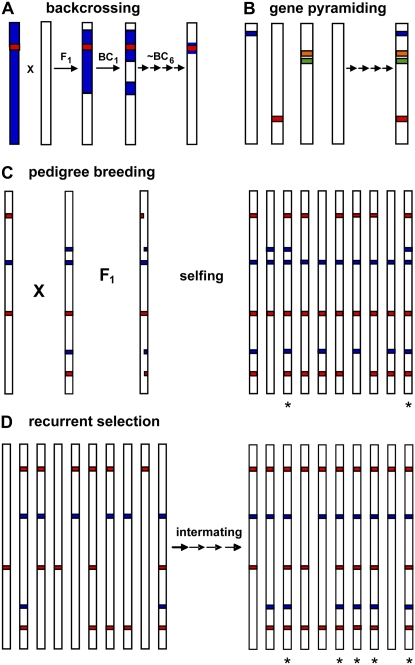
Common breeding and selection schemes. Each vertical bar is a graphical representation of the genome for an individual within a breeding population, with colored segments indicating genes and/or QTLs that influence traits under selection. Genes associated with different traits are shown in different colors (e.g. red, blue). “X” indicates a cross between parents, and arrows depict successive crosses of the same type. Asterisk below an individual signifies a desirable genotype. A, Backcrossing. A donor line (blue bar) featuring a specific gene of interest (red) is crossed to an elite line targeted for improvement (white bar), with progeny repeatedly backcrossed to the elite line. Each backcross cycle involves selection for the gene of interest and recovery of increased proportion of elite line genome. B, Gene pyramiding. Genes/QTLs associated with different beneficial traits (blue, red, orange, green) are combined into the same genotype via crossing and selection. C, Pedigree breeding. Two individuals with desirable and complementary phenotypes are crossed; F1 progeny are self-pollinated to fix new, improved genotype combinations. D, Recurrent selection. A population of individuals (10 in this example) segregate for two traits (red, blue), each of which is influenced by two major favorable QTLs. Intermating among individuals and selection for desirable phenotypes/genotypes increases the frequencies of favorable alleles at each locus. For this example, no individual in the initial population had all of the favorable alleles, but after recurrent selection half of the population possesses the desired genotype. For hybridized crops, recurrent selection can be performed in parallel within two complementary populations to derive lines that are then crossed to form hybrids; this method is called reciprocal recurrent selection.
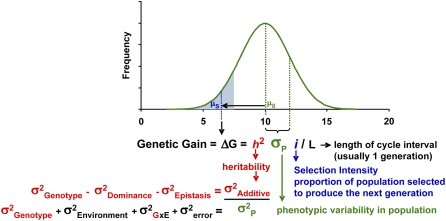
The genetic gain equation and its component variables. The top portion illustrates an idealized distribution showing the frequency of individuals within a breeding population (y axis) that exhibit various classes of phenotypic values (x axis). Mean phenotypic value (μ0) of the original population (shown as entire area under the normal curve) and mean (μS) for the group of selected individuals (shaded in blue) are indicated. In this generalized example, trait improvement is achieved by selecting for a lower phenotypic value, e.g. grain moisture at harvest in maize. Components of variation (σ2) that contribute to the sd of the phenotypic distribution (σP) are indicated below the histogram.
References
-
- Baenziger PS, Russell WK, Graef GL, Campbell BT (2006) Improving lives: 50 years of crop breeding, genetics, and cytology (C-1). Crop Sci 46 2230–2244
-
- Behr CF, Heck GR, Hironaka CH, You J, inventors (2004) Corn plants comprising event PV-ZMGT32 (NK603). U.S. Patent No. 6,825,400
-
- Beló A, Zhen P, Luck S, Shen B, Meyer DJ, Li B, Tingey S, Rafalski A (2008) Whole genome scan detects an allelic variant of fad2 associated with increased oleic acid levels in maize. Mol Genet Genomics 279 1–10 - PubMed
-
- Bevan MW, Flavell RB, Chilton MD (1983) A chimaeric antibiotic resistance gene as a selectable marker for plant cell transformation. Nature 304 184–187 - PubMed
-
- Bliss FA (2007) Education and preparation of plant breeders for careers in global crop improvement. Crop Sci 47 S250–S261
Publication types
MeSH terms
LinkOut - more resources
Full Text Sources
Other Literature Sources
