. 2008 Jul 9:5:59.
doi: 10.1186/1742-4690-5-59.

Implication of TRIM alpha and TRIMCyp in interferon-induced anti-retroviral restriction activities

Affiliations

Implication of TRIM alpha and TRIMCyp in interferon-induced anti-retroviral restriction activities

Laetitia Carthagena et al. Retrovirology. .

Abstract

Background: TRIM5 alpha is a restriction factor that interferes with retroviral infections in a species-specific manner in primate cells. Although TRIM5 alpha is constitutively expressed, its expression has been shown to be up-regulated by type I interferon (IFN). Among primates, a particular case exists in owl monkey cells, which express a fusion protein between TRIM5 and cyclophilin A, TRIMCyp, specifically interfering with HIV-1 infection. No studies have been conducted so far concerning the possible induction of TRIMCyp by IFN. We investigated the consequences of IFN treatment on retroviral restriction in diverse primate cells and evaluated the implication of TRIM5 alpha or TRIMCyp in IFN-induced anti-retroviral activities.

Results: First, we show that human type I IFN can enhance TRIM5 alpha expression in human, African green monkey and macaque cells, as well as TRIMCyp expression in owl monkey cells. In TRIM5 alpha-expressing primate cell lines, type I IFN has little or no effect on HIV-1 infection, whereas it potentiates restriction activity against N-MLV in human and African green monkey cells. In contrast, type I IFN treatment of owl monkey cells induces a great enhancement of HIV-1 restriction, as well as a strain-tropism independent restriction of MLV. We were able to demonstrate that TRIM5 alpha is the main mediator of the IFN-induced activity against N-MLV in human and African green monkey cells, whereas TRIMCyp mediates the IFN-induced HIV-1 restriction enhancement in owl monkey cells. In contrast, the type I IFN-induced anti-MLV restriction in owl monkey cells is independent of TRIMCyp expression.

Conclusion: Together, our observations indicate that both TRIM5 alpha and TRIMCyp are implicated in IFN-induced anti-retroviral response in primate cells. Furthermore, we found that type I IFN also induces a TRIMCyp-independent restriction activity specific to MLV in owl monkey cells.


Figures
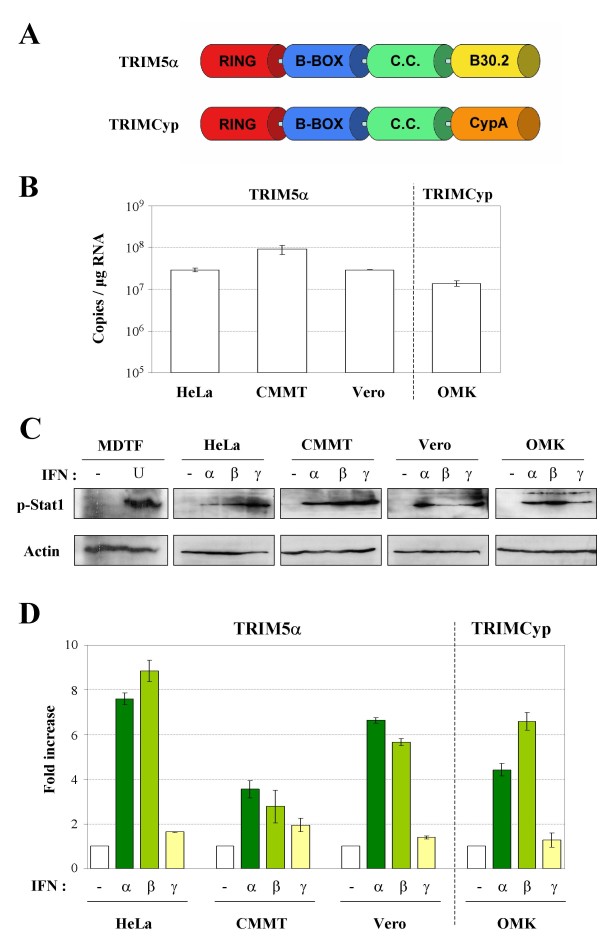
Figure 1
Figure 1
Up-regulation of TRIM5 expression in primate cells. A. Schematic representation of the domain structure of TRIM5α and TRIMCyp proteins. C.C.: Coiled-Coil. B. Comparison of TRIM5α or TRIMCyp constitutive expression in HeLa, CMMT, Vero and OMK cells by quantitative RT-PCR. C. MDTF, HeLa, CMMT, Vero or OMK cells were stimulated with universal type I IFN (U), IFN-α, β or γ for 20 min or left untreated (-) and assessed for phosphorylated Stat1 (Tyr 701) and actin by western blot. D. Total RNA was extracted after 8 h of treatment with IFN-α, β or γ. TRIM5α (in HeLa, CMMT and Vero cells) or TRIMCyp (in OMK cells) mRNA expression levels were measured by quantitative RT-PCR and normalized to GAPDH mRNA. Results are expressed as fold increase, defined as the ratio of TRIM5 expression in IFN treated/untreated cells. Error bars reflect the SD of duplicate values in a representative experiment.
Figure 2
Figure 2
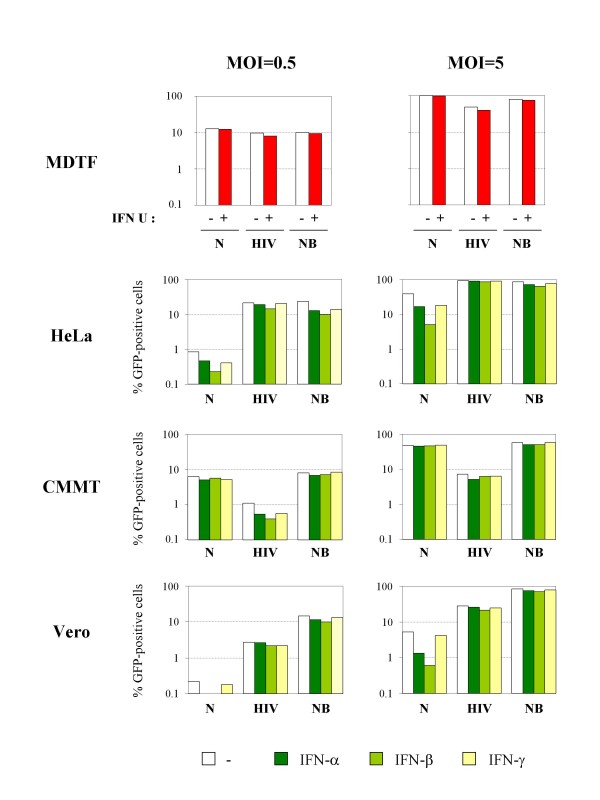
Modulation of anti-retroviral activity in primate cells by IFNs. MDTF, HeLa, CMMT, Vero or OMK cells were stimulated with universal type I IFN (U), IFN-α, β or γ or left untreated (-), and transduced 24 h later with VSV-pseudotyped GFP-expressing N-MLV (N), HIV-1 (HIV) or NB-MLV (NB) at low (MOI = 0.5) or high (MOI = 5) multiplicity of infection (as determined on MDTF cells). The percentage of transduced (GFP-positive) cells was determined by FACS 48 h post-transduction.
Figure 3
Figure 3
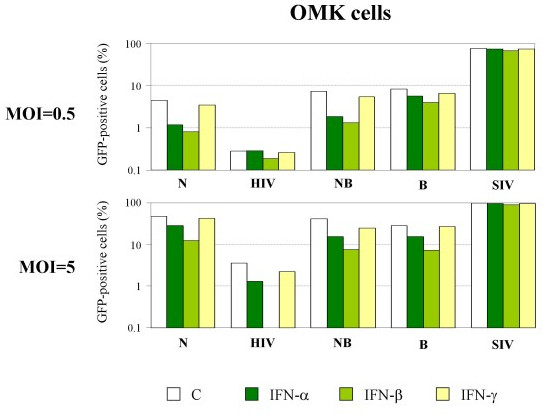
IFN-induced anti-retroviral activities in primate cells. OMK cells were treated with human IFN-α, β or γ and transduced 24 h later with VSV-pseudotyped GFP-expressing N-MLV (N), HIV-1 (HIV), NB-MLV (NB), B-MLV (B) or SIVmac (SIV) at low (MOI = 0.5) or high (MOI = 5) multiplicity of infection. The percentage of transduced cells was determined by FACS 48 h post-transduction.
Figure 4
Figure 4
TRIM5α is the main mediator of the IFN-induced N-MLV restriction. A. HeLa and Vero cells were transfected with a siRNA targeting luciferase (Luc) or TRIM5α (siRNA H1, HA2 or A3), as indicated, and stimulated 24 h later with 1000 U/ml of IFN-β for 8 h. Total RNA was extracted and the levels of TRIM5α mRNA were determined by quantitative RT-PCR and normalized to GAPDH. The mean ± SD of duplicates is shown. B. HeLa or Vero cells were transfected with siRNA targeting luciferase (Luc), TRIM5αhu (H1 or HA2) or TRIM5αagm (HA2 or A3), as indicated. The next day, cells were stimulated with 1000 U/ml of IFN-β for 8 h and challenged with a GFP-expressing N-MLV vector. The percentage of GFP-positive cells was determined by FACS 48 h post-transduction. Data are from a typical experiment representative of three independent experiments.
Figure 5
Figure 5
The IFN-induced MLV restriction activity in OMK cells is independent of TRIMCyp. A. OMK cells were transfected with a siRNA targeting luciferase (Luc) or TRIMCyp (as well as CypA), as indicated, and stimulated 24 h later with 1000 U/ml of IFN-β for 8 h. Total RNA was extracted and the levels of TRIMCyp mRNA were determined by quantitative RT-PCR and normalized to GAPDH. The mean ± SD of duplicates is shown. B. OMK cells were transfected with anti-Luc (diamonds) or anti-TRIMCyp (triangles) siRNA and transduced 48 h later with increasing doses of HIV-1. The percentage of GFP-positive cells was determined by FACS 48 h post-transduction. C. Same experiment as in panel B, except that cells were challenged with HIV-1, N-MLV, B-MLV or NB-MLV (at a MOI of 5), following siRNA and IFN-β treatments. The percentage of GFP-positive cells was determined by FACS 48 h post-transduction. Data are from a typical experiment representative of three independent experiments.
Figure 6
Figure 6
The IFN-induced enhancement of anti-HIV-1 restriction in OMK cells is due to TRIMCyp. A. OMK cells were induced with IFN-β and challenged 24 h later with GFP-expressing HIV-1, N-MLV, B-MLV or NB-MLV at a MOI of 5. CsA (5 μM) was added 2 h before transduction. Percentage of transduced cells was determined by FACS 48 h post-transduction. Fold restriction represents the ratio of untreated to IFN-β-treated cells to be transduced by the GFP-encoding retroviral vectors. Results are representative of two independent experiments with comparable results. A significant enhancement of retroviral restriction is defined as a ratio > 2. B. OMK cells were stimulated with IFN-β and transduced 24 h later with VSV-pseudotyped GFP-expressing HIV-1, SIVmac or HIV-1 SCA vectors at a MOI of 1. The percentage of transduced cells was determined by FACS 48 h post-transduction. Fold restriction represents the ratio of untreated/IFN-β-treated cells to be transduced. As in panel A, a significant enhancement of retroviral restriction is defined as a ratio > 2.
Figure 7
Figure 7
The IFN-induced block occurs early in the MLV replication cycle. OMK cells were treated or not with 1000 U/ml of IFN-β and challenged 24 h later with DNase-treated GFP-expressing SIVmac (SIV), HIV-1 (HIV), N-, B-, or NB-tropic MLV vectors. The same experiment was performed in parallel in the presence of AZT at 5 μM during infections. Total DNA was extracted 6 h post-transduction and the amount of reverse transcripts was estimated by PCR using GFP primers. A PCR on CypA was also performed as a control.
Figure 8
Figure 8
Effects of IFNs on TRIM5 expression and retroviral restriction in primate cells. Left: Effect of IFNs on TRIM5α (HeLa, CMMT and Vero) and TRIMCyp (OMK) mRNA expression, expressed as fold increase (IFN-treated/untreated cells). Right: Effect of IFN-β treatment on retroviral restriction, expressed as fold restriction (untreated/IFN-treated cells).

References

    1. Bieniasz PD. Intrinsic immunity: a front-line defense against viral attack. Nat Immunol. 2004;5:1109–1115. doi: 10.1038/ni1125. - DOI - PubMed
    1. Baumann JG. Intracellular restriction factors in mammalian cells--An ancient defense system finds a modern foe. Curr HIV Res. 2006;4:141–168. doi: 10.2174/157016206776055093. - DOI - PubMed
    1. Perez O, Hope TJ. Cellular restriction factors affecting the early stages of HIV replication. Curr HIV/AIDS Rep. 2006;3:20–25. doi: 10.1007/s11904-006-0004-3. - DOI - PubMed
    1. Hatziioannou T, Perez-Caballero D, Yang A, Cowan S, Bieniasz PD. Retrovirus resistance factors Ref1 and Lv1 are species-specific variants of TRIM5alpha. Proc Natl Acad Sci U S A. 2004;101:10774–10779. doi: 10.1073/pnas.0402361101. - DOI - PMC - PubMed
    1. Keckesova Z, Ylinen LM, Towers GJ. The human and African green monkey TRIM5alpha genes encode Ref1 and Lv1 retroviral restriction factor activities. Proc Natl Acad Sci U S A. 2004;101:10780–10785. doi: 10.1073/pnas.0402474101. - DOI - PMC - PubMed

Publication types

MeSH terms

LinkOut - more resources