


Keep them in school: the importance of education as a protective factor against HIV infection among young South African women
- PMID: 18614609
- PMCID: PMC2734068
- DOI: 10.1093/ije/dyn131
Keep them in school: the importance of education as a protective factor against HIV infection among young South African women
Abstract
Objective: To identify risk factors for HIV infection among young women aged 15-24 years reporting one lifetime partner in South Africa. Design In 2003, we conducted a nationally representative household survey of sexual behaviour and HIV testing among 11 904 young people aged 15-24 years in South Africa. This analysis focuses on the subset of sexually experienced young women with only one reported lifetime sex partner (n = 1708).
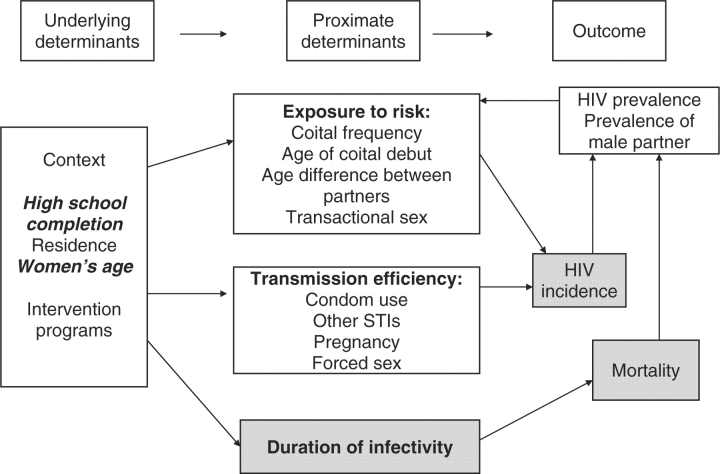
Methods: Using the proximate determinants framework and the published literature we identified factors associated with HIV in young women. The associations between these factors and HIV infection were explored in multivariable logistic regression models.
Results: Of the young women, 15% reporting one lifetime partner were HIV positive. In multivariable analyses, young women who had not completed high school were more likely to be infected with HIV compared with those that had completed high school (AOR 3.75; 95% CI 1.34-10.46).
Conclusions: Young South African women in this population were at high risk of HIV infection despite reporting only having one lifetime partner. Few individual level factors were associated with HIV infection, emphasizing the importance of developing HIV prevention interventions that address structural and partner level risk factors.
Figures
References
-
- Pettifor A, Rees H, Kleinschmidt I, et al. Young people's sexual health in South Africa: HIV prevalence and sexual behaviours from a nationally representative household survey. AIDS. 2005;19:1525–34. - PubMed
-
- UNAIDS. Report on the Global AIDS Epidemic 2006. Geneva: UNAIDS; 2006.
-
- Santelli JS, Lindberg LD, Abma J, McNeely CS, Resnick M. Adolescent sexual behavior: estimates and trends from four nationally representative surveys. Fam Plann Perspect. 2000;32:156–65, 194. - PubMed
-
- Glynn J, Carael M, Auvert B, et al. Why do young women have a much higher prevalence of HIV than young men? A study in Kisumu, Kenya and Ndola, Zambia. AIDS. 2001;15(Suppl 4):S51–60. - PubMed
Publication types
MeSH terms
Grants and funding
LinkOut - more resources
Full Text Sources
Medical
