


Health-related quality of life of long-term high-grade glioma survivors
- PMID: 18617599
- PMCID: PMC2718959
- DOI: 10.1215/15228517-2008-049
Health-related quality of life of long-term high-grade glioma survivors
Abstract
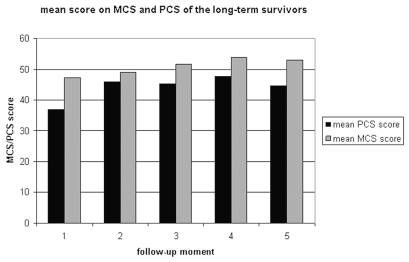
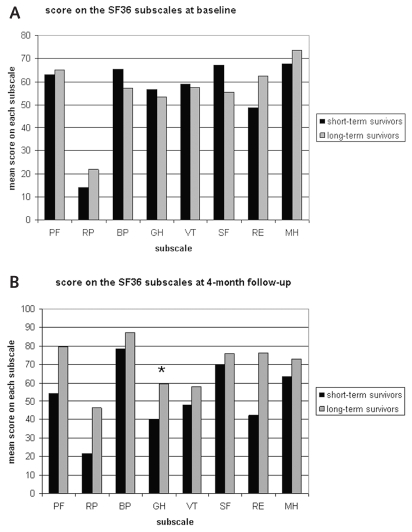
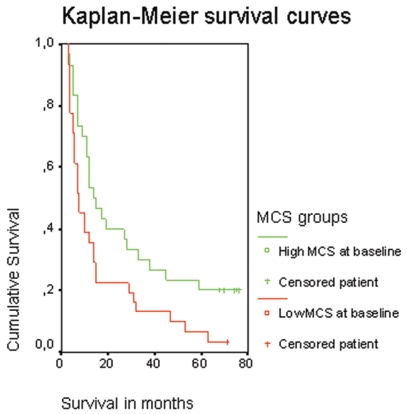
The objective of this study was to compare the health-related quality of life (HRQOL) of long-term to short-term high-grade glioma (HGG) survivors, determine the prognostic value of HRQOL for overall survival, and determine the effect of tumor recurrence on HRQOL for long-term survivors. Following baseline assessment (after surgery, before radiotherapy), self-perceived HRQOL (using the Medical Outcomes Study Short Form 36 [SF-36]) and brain tumor-specific symptoms (using the 20-item Brain Cancer Module) were assessed every 4 months until 16 months after histological diagnosis. Kaplan-Meier survival analysis and the Cox proportional hazards model were performed to estimate overall survival of patients with impaired scores on the aggregated SF-36 higher-order summary scores measuring physical functioning on a physical component scale and on a mental component scale (MCS). Sixteen patients with a short-term survival (baseline and 4-month follow-up) and 16 with a long-term survival (follow-up until 16 months after diagnosis) were selected out of 68 initially recruited HGG patients. At baseline, the short-term and long-term survivors did not differ in their HRQOL. Between baseline and the 4-month follow-up, HRQOL of short-term survivors deteriorated, whereas the long-term survivors improved to a level comparable to healthy controls. Patients with impaired mental functioning (MCS) at baseline had a shorter median survival than patients with normal functioning. After accounting for differences in patient and tumor characteristics, however, mental functioning was not independently related to poorer overall survival. Not surprisingly, in the group of long-term survivors, the five patients with recurrence had a more compromised HRQOL at the 16-month follow-up compared to the 11 patients without recurrence. We concluded that baseline HRQOL is not related to duration of survival and that long-term survivors show improvement of HRQOL to a level comparable to that of the healthy.
Figures
References
-
- Radhakrishnan K, Mokri B, Parisi JE, et al. The trends in incidence of primary brain tumors in the population of Rochester, Minnesota. Ann Neurol. 1995;37:67–73. - PubMed
-
- Stupp R, Mason WP, van den Bent MJ, et al. Radiotherapy plus concomitant and adjuvant temozolomide for glioblastoma. N Engl J Med. 2005;352:987–996. - PubMed
-
- Aiken RD. Quality-of-life issues in patients with malignant gliomas. Semin Oncol. 1994;21:273–275. - PubMed
-
- Taylor BV, Buckner JC, Cascino TL, et al. Effects of radiation and chemotherapy on cognitive function in patients with high-grade glioma. J Clin Oncol. 1998;16:2195–2201. - PubMed
-
- Meyers CA, Hess KR, Yung WK, et al. Cognitive function as a predictor of survival in patients with recurrent malignant glioma. J Clin Oncol. 2000;18:646–650. - PubMed
Publication types
MeSH terms
LinkOut - more resources
Full Text Sources
Medical
