. 2008 Nov;149(11):5518-26.
doi: 10.1210/en.2008-0713. Epub 2008 Jul 10.

Nonclassical mechanisms of progesterone action in the brain: II. Role of calmodulin-dependent protein kinase II in progesterone-mediated signaling in the hypothalamus of female rats

Affiliations

Nonclassical mechanisms of progesterone action in the brain: II. Role of calmodulin-dependent protein kinase II in progesterone-mediated signaling in the hypothalamus of female rats

Bhuvana Balasubramanian et al. Endocrinology. 2008 Nov.

Abstract

In addition to the activation of classical progestin receptor-dependent genomic pathway, progesterone (P) can activate nonclassical, membrane-initiated signaling pathways in the brain. We recently demonstrated rapid P activation of second-messenger kinases, protein kinase A, and protein kinase C in the ventromedial nucleus (VMN) and preoptic area (POA) of rat brain. To determine whether P can activate yet another Ca+2 dependent kinase, we examined the rapid P modulation of calcium and calmodulin-dependent protein kinase II (CaMKII) in the VMN and POA in female rats. A rapid P-initiated activation of CaMKII basal activity was observed in the VMN but not the POA at 30 min. Estradiol benzoate (EB) priming enhanced this CaMKII basal activity in both the VMN and POA. CaMKII protein levels and phosphorylation of Thr-286 moiety on CaMKII, however, remained unchanged with EB and/or P treatments, suggesting that the changes in the CaMKII kinase activity are due to rapid P modulation of the kinase activity and not its synthesis or autoactivation. Furthermore, intracerebroventricular (icv) administration of a CaMKII-specific inhibitor, KN-93, 30 min prior to the P infusion, in EB-primed, ovariectomized female rats inhibited CaMKII activation but not protein kinase A and protein kinase C activities. Interestingly, icv administration of KN-93 30 min prior to P infusion (icv) resulted in a reduction but not total inhibition of P-facilitated lordosis response in EB-primed female rats. These observations suggest a redundancy or, alternately, a hierarchy in the P-regulated activation of kinase signaling cascades in female reproductive behavior.


Figures
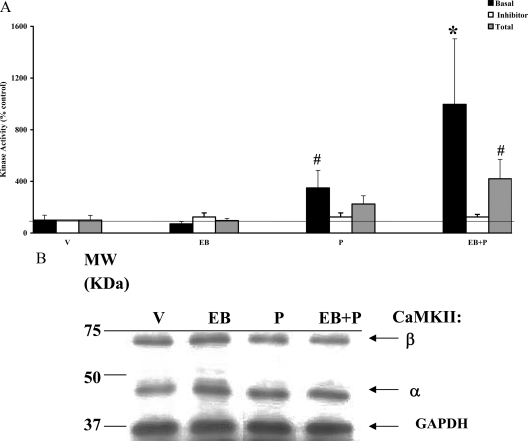
Figure 1
Figure 1
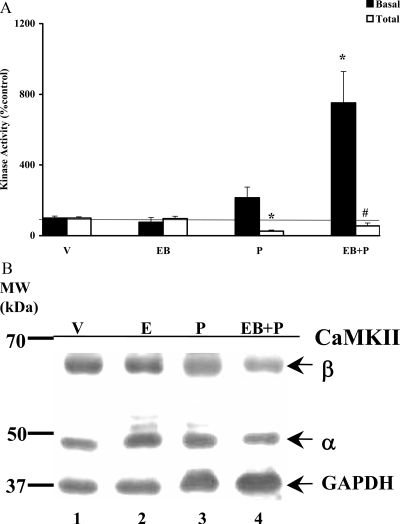
P modulation of CaMKII basal and total activities in the presence and absence of CaMKII inhibitor KN-93 (A) and Western immunoblotting for CaMKII protein (B) in the VMN. Ovariectomized rats with chronic in-dwelling stainless steel cannulae in the third cerebral ventricle were primed with EB or vehicle (V) sc. Forty-eight hours later, P was administered icv and killed 30 min later. A, The VMN tissue homogenates were assayed for CaMKII basal and total activities in the absence and presence of CaMKII inhibitor KN-93 (inhibitor) infused (icv) 30 min before P or V treatment. The CaMKII basal and total activities are expressed as percentage of vehicle control (mean ± sem; 100%). The CaMKII activity was normalized to the vehicle in the presence of KN-93 and expressed as percentage of the respective control (mean ± sem; 100%). The specific activity of V control in the presence of KN-93 was 0.2 pmol/min·mg and in the absence of KN-93 was 12.4 pmol/min·mg. Statistical analysis using ANOVA followed by Dunnett’s or Newman-Keuls post hoc multiple comparisons indicated statistically significant differences between V and P treatment (#, P < 0.05) and between V and EB+P (*, P < 0.01). The CaMKII total activity due to EB+P, compared with vehicle, was significant (#, P < 0.05) (n = 6 for each group). B, The homogenates were subjected to Western immunoblot analysis as described. Each lane represents the sample from one animal per treatment group. A representative autoradiograph is shown. The GAPDH band at 37 kDa was used as a normalizing control. Lane 1 corresponds to vehicle control (V); lane 2, EB; lane 3, P; and lane 4, EB+P treatments. Magic marker molecular weight (MW) standards were run alongside the protein samples and the MWs are noted adjacent to lane 1.
Figure 2
Figure 2
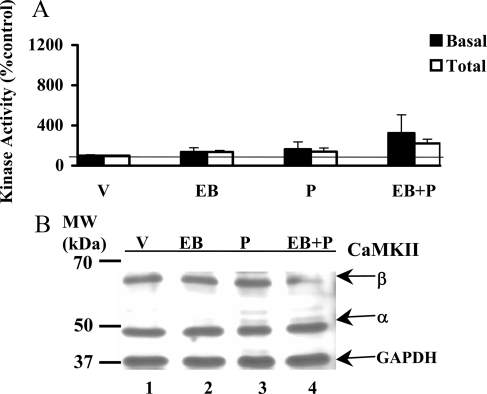
P modulation of CaMKII basal and total activities (A) and Western analysis of CaMKII protein (B) in the POA. A, POA homogenates from the experimental animals were analyzed for their CaMKII basal and total activities as described above. The CaMKII activity is expressed as percentage of vehicle control (mean ± sem; 100%). Statistical analysis using ANOVA followed by Dunnett’s post hoc multiple comparisons indicated statistically significant increase in CaMKII basal activity for EB+P treatment (*, P < 0.01), compared with vehicle control (V). The CaMKII total activities for P and EB+P treatments were also significantly different from V (*, P < 0.01 and #, P < 0.05, respectively) (n = 6 for each treatment group). B, The POA homogenates were subjected to Western immunoblot analysis. Each lane represents the sample from one animal per treatment group. A representative autoradiograph is shown. The GAPDH band at 37 kDa was used as a normalizing control. Lane 1 corresponds to vehicle control (V); lane 2, EB; lane 3, P; and lane 4, EB+P treatments. Magic marker molecular weight (MW) standards were run alongside the protein samples and the MWs are noted adjacent to lane 1.
Figure 3
Figure 3
P modulation of CaMKII basal and total activities (A) and protein (B) in the CTX. A, Cortical tissue homogenates were analyzed for basal and total CaMKII. The CaMKII activity is expressed as percentage of vehicle control (V; mean ± sem; 100%). ANOVA followed by post hoc analyses using Dunnett’s or Newman-Keuls multiple comparison tests indicated no significant differences between the treatment groups and the vehicle (P > 0.05). B, The homogenates were subjected to Western immunoblot analysis a representative autoradiograph is shown. The GAPDH band at 37 kDa was used as a normalizing control. Lane 1 corresponds to vehicle control (V); lane 2, EB; lane 3, P; lane 4, EB+P treatments. Magic marker molecular weight (MW) standards were run alongside the protein samples and the MWs are noted adjacent to lane 1.
Figure 4
Figure 4
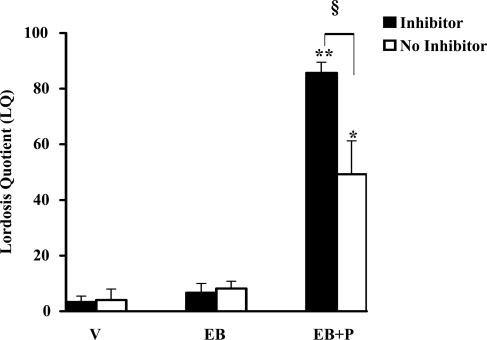
KN-93 was capable of inhibiting CaMKII basal activity in the VMN but not the lordosis response in female rats. Ovariectomized rats with stereotaxically implanted stainless steel cannula into the third cerebral ventricle were primed with 2 μg EB or vehicle (V) (sc). Forty-eight hours later, the rats were infused with vehicle (aCSF) or CaMKII inhibitor KN-93 in aCSF, followed by icv P or vehicle 30 min later. The animals were examined for their lordosis response in the presence of a male (proven breeder) 30 min after P administration (icv). The results were expressed as LQ. ANOVA followed by Newman-Keul’s multiple comparison tests indicated significant differences in the lordosis response between EB+P and V in the absence of KN-93 (**, P < 0.001) and in its presence (*, P < 0.01). Statistically significant differences were observed in the LQ in the absence and presence of KN-93 (§, P < 0.001) (n = 6 for each treatment group).
Figure 5
Figure 5
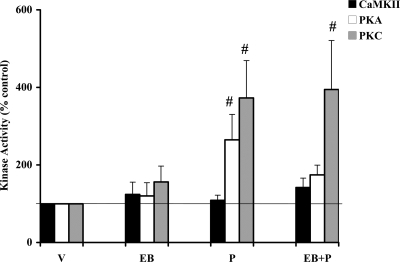
P regulation of PKA and PKC basal activities remained unaltered by CaMKII inhibitor KN-93 in the VMN. VMN tissue sample homogenates from the treatments groups administered KN-93 in Fig. 4 were processed for kinase assays as described in Materials and Methods. The homogenates were assayed for basal PKA, PKC, and CaMKII activities. The CaMKII activity was normalized to the vehicle (V) in the presence of KN-93 and expressed as percentage of the respective control (mean ± sem; 100%). ANOVA followed by Dunnett’s post hoc multiple comparisons demonstrated significant differences between P-stimulated PKA (#, P < 0.05) and PKC (#, P < 0.05) basal activities, compared with the vehicle control, in the presence of KN-93. Significant difference in the PKC basal activity was also observed between EB+P and vehicle control (#, P < 0.05) in the presence of KN-93 (n = 6 in each treatment group).

References

    1. Schumacher M, Coirini H, Pfaff DW, McEwen BS 1990 Behavioral effects of progesterone associated with rapid modulation of oxytocin receptors. Science 250:691–694 - PubMed
    1. Beyer C, Gonzalez-Mariscal G 1986 Elevation in hypothalamic cAMP as a common factor in the facilitation of lordosis in rodents: a working hypothesis. Ann NY Acad Sci 474:270–281 - PubMed
    1. Kow LM, Mobbs CV, Pfaff DW 1994 Role of second-messenger systems and neuronal activity in the regulation of lordosis by neurotransmitters neuropeptides and estrogen: a review. Neurosci Bio Behav Rev 18:251–268 - PubMed
    1. Pettiti N, Etgen AM 1989 Progesterone depression of norepinephrine-stimulated cAMP accumulation in hypothalamic slices. Brain Res Mol Brain Res 5:109–119 - PubMed
    1. Pettiti N, Etgen AM 1990 β1-Adrenoreceptor augmentation of β-stimulated cAMP formation is enhanced by estrogen and reduced by progesterone in rat hypothalamic slices. J Neurosci 10:2842–2849 - PMC - PubMed

Publication types

MeSH terms