Review
. 2008 Aug;9(8):748-53.
doi: 10.1038/embor.2008.129. Epub 2008 Jul 11.

The O-linked N-acetylglucosamine modification in cellular signalling and the immune system. 'Protein modifications: beyond the usual suspects' review series

Affiliations
Review

The O-linked N-acetylglucosamine modification in cellular signalling and the immune system. 'Protein modifications: beyond the usual suspects' review series

Alexander Golks et al. EMBO Rep. 2008 Aug.

Abstract

The intracellular modification of proteins by the addition of a single O-linked N-acetylglucosamine (O-GlcNAc) molecule is a ubiquitous post-translational modification in eukaryotic cells. It is catalysed by O-linked N-acetylglucosaminyltransferase, which attaches O-GlcNAc to serine/threonine residues, and it is counter-regulated by beta-N-acetylglucosaminidase, which is the antagonistic glycosidase that removes the O-GlcNAc group. O-GlcNAc modification competes with phosphorylation by protein kinases at similar sites, thereby affecting important signalling nodes. Accumulating evidence supports a central role for O-GlcNAc modifications and the corresponding enzymes in the regulation of immune cells, particularly in the activation processes of T and B lymphocytes. Here, we discuss recent advances in the field of O-GlcNAc modifications, focusing on the cells of the immune system.


Figures
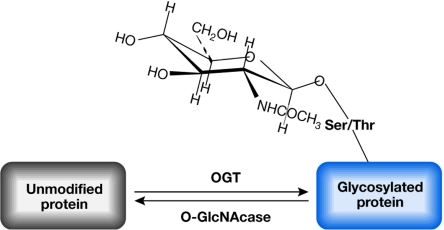
Figure 1
Figure 1
General scheme of O-linked N-acetylglucosamine modification. N-acetylglucosamine is added to serine/threonine (Ser/Thr) residues of target proteins by the enzyme O-linked N-acetylglucosaminyltransferase (OGT) using UDP-GlcNAc as substrate. The N-acetylglucosamine group is removed by the antagonistic activity of β-N-acetylglucosaminidase. O-GlcNAc, O-linked N-acetylglucosamine.
Figure 2
Figure 2
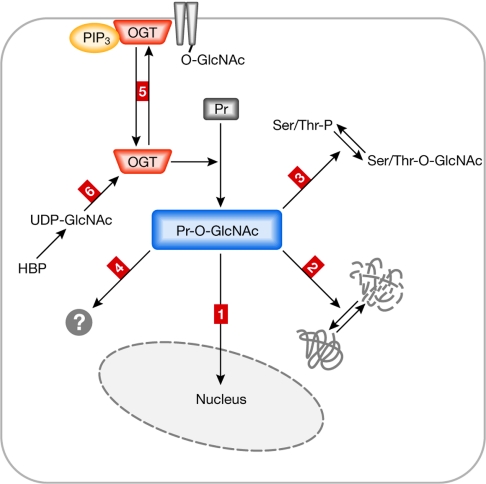
Possible mechanisms controlling O-linked N-acetylglucosaminyl-transferase activity and the consequences of O-linked N-acetylglucosamine modifications. O-GlcNAc protein modifications mediated by OGT have different outcomes, some of which are summarized in this figure. OGT itself is under the control of different regulatory mechanisms. On O-GlcNAc modification, proteins (for example, transcription factors) translocate into the nucleus (outcome 1). O-GlcNAc modification can affect protein stability (outcome 2). O-GlcNAc modification occurs on serine/threonine (Ser/Thr) residues that are also targets of protein phosphorylation (outcome 3); this can result in competitive regulation of target proteins with different outcomes. O-GlcNAc modification might have additional (not yet well-characterized) effects on target proteins such as structural consequences, effects on catalytic activity and hetero-homodimer formation (outcome 4). OGT function can be regulated by cellular re-localization, such as recruitment to the plasma membrane (outcome 5). OGT activity depends on the concentration of its substrate UDP-GlcNAc, which is strongly coupled to the metabolic state of the cells (outcome 6). HBP, hexosamine biosynthetic pathway; O-GlcNAc, O-linked N-acetylglucosamine; OGT, O-linked N-acetylglucosaminyltransferase; PIP3, phosphatidylinositol (3,4,5)-trisphosphate; Pr, protein; Pr-GlcNAc, O-GlcNAc-modified protein.
Figure 3
Figure 3
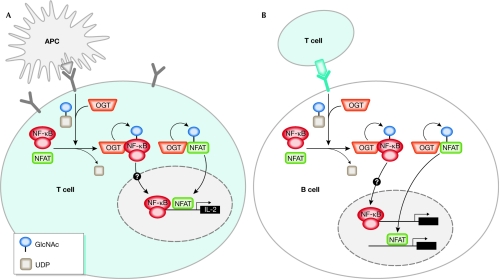
Model of O-linked N-acetylglucosamine modification during lymphocyte activation. (A) Activation of T lymphocytes through the T-cell receptor (TCR) leads to the association of the transcription factors known as nuclear factor of activated T cells (NFAT) and nuclear factor-κB (NF-κB) to O-linked N-acetylglucosaminyltransferase (OGT) and their O-GlcNAc modification. The transient O-GlcNAc modification enhances the nuclear translocation of NFAT (and probably also that of NF-κB). Nuclear localization and activation of NFAT and NF-κB is needed for the transcriptional activation of many genes, such as interleukin-2 (IL-2). (B) Activation of B lymphocytes through the B-cell receptor (BCR) leads to the association of the transcription factors NFAT and NF-κB to OGT, and their O-GlcNAc modification. The transient O-GlcNAc modification enhances the nuclear translocation of NFAT (and probably also that of NF-κB). Nuclear localization of NFAT and NF-κB is crucial to the reprogramming of B cells. APC, antigen-presenting cell; O-GlcNAc, O-linked N-acetylglucosamine.
None
Alexander Golks
None
Danilo Guerini

References

    1. Cheng X, Hart GW (2001) Alternative O-glycosylation/O-phosphorylation of serine-16 in murine estrogen receptor beta: post-translational regulation of turnover and transactivation activity. J Biol Chem 276: 10570–10575 - PubMed
    1. Cheng X, Cole RN, Zaia J, Hart GW (2000) Alternative O-glycosylation/O-phosphorylation of the murine estrogen receptor beta. Biochemistry 39: 11609–11620 - PubMed
    1. Chou TY, Hart GW (2001) O-linked N-acetylglucosamine and cancer: messages from the glycosylation of c-Myc. Adv Exp Med Biol 491: 413–418 - PubMed
    1. Chou TY, Hart GW, Dang CV (1995) c-Myc is glycosylated at threonine 58, a known phosphorylation site and a mutational hot spot in lymphomas. J Biol Chem 270: 18961–18965 - PubMed
    1. Comtesse N, Maldener E, Meese E (2001) Identification of a nuclear variant of MGEA5, a cytoplasmic hyaluronidase and a beta-N-acetylglucosaminidase. Biochem Biophys Res Commun 283: 634–640 - PubMed

MeSH terms

Substances