Randomized Controlled Trial
. 2008 Jul 11;4(7):e1000125.
doi: 10.1371/journal.pgen.1000125.

A candidate gene approach identifies the CHRNA5-A3-B4 region as a risk factor for age-dependent nicotine addiction

Affiliations
Randomized Controlled Trial

A candidate gene approach identifies the CHRNA5-A3-B4 region as a risk factor for age-dependent nicotine addiction

Robert B Weiss et al. PLoS Genet. .

Abstract

People who begin daily smoking at an early age are at greater risk of long-term nicotine addiction. We tested the hypothesis that associations between nicotinic acetylcholine receptor (nAChR) genetic variants and nicotine dependence assessed in adulthood will be stronger among smokers who began daily nicotine exposure during adolescence. We compared nicotine addiction-measured by the Fagerstrom Test of Nicotine Dependence-in three cohorts of long-term smokers recruited in Utah, Wisconsin, and by the NHLBI Lung Health Study, using a candidate-gene approach with the neuronal nAChR subunit genes. This SNP panel included common coding variants and haplotypes detected in eight alpha and three beta nAChR subunit genes found in European American populations. In the 2,827 long-term smokers examined, common susceptibility and protective haplotypes at the CHRNA5-A3-B4 locus were associated with nicotine dependence severity (p = 2.0x10(-5); odds ratio = 1.82; 95% confidence interval 1.39-2.39) in subjects who began daily smoking at or before the age of 16, an exposure period that results in a more severe form of adult nicotine dependence. A substantial shift in susceptibility versus protective diplotype frequency (AA versus BC = 17%, AA versus CC = 27%) was observed in the group that began smoking by age 16. This genetic effect was not observed in subjects who began daily nicotine use after the age of 16. These results establish a strong mechanistic link among early nicotine exposure, common CHRNA5-A3-B4 haplotypes, and adult nicotine addiction in three independent populations of European origins. The identification of an age-dependent susceptibility haplotype reinforces the importance of preventing early exposure to tobacco through public health policies.


Conflict of interest statement

The authors have declared that no competing interests exist.

Figures
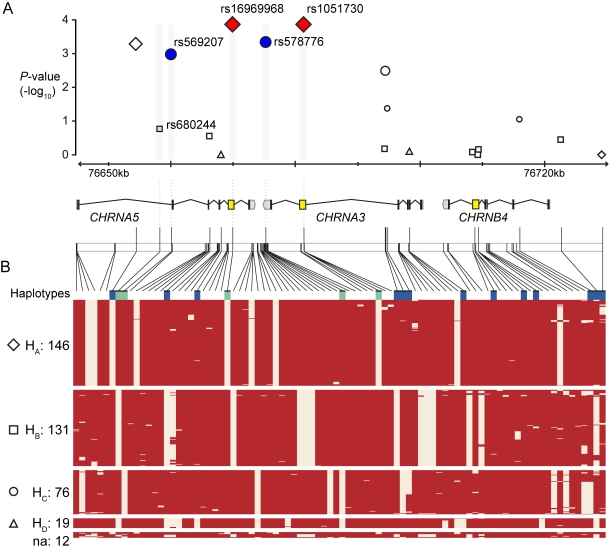
Figure 1
Figure 1. Haplotype Structure and Association Results in the Nicotinic α5, α3 and β4 Receptor Subunit Genes on Chromosome 15q24.
(A) Genomic region of CHRNA5-A3-B4 transcription units on chr. 15 between 76,644,000 to 76,732,000 base pairs (NCBI Build 36). −log10(P value) plot of SNPs as a function of genomic position, with their P values (allele association values from chi square tests) observed in the early onset condition. The symbols indicate haplotype assignment (HA, HB, HC and HD) of the individual markers; open symbols indicate P values in the UT-WI cohorts and shaded symbols indicate P values in the combined UT-WI-LHS cohorts. The five SNPs used to assign haplotype status in the UT-WI-LHS cohorts are colored by haplotype affiliation: red (HA), (blue (HC) or beige (HB). (B) fastPHASE inferred haplotype structure of the region from unphased resequencing and genotypic data from 384 chromosomes (resequencing sample cohort). Haplotypes were assigned to groups using the 5 SNPs genotyped in the UT-WI-LHS cohorts (rs680244, rs569207, rs16969968, rs578776, and rs1051730). Haplotype counts for HA, HB, HC, HD and not assigned (na) are shown on the left, and the positions of SNPs genotyped in the UT-WI cohorts are indicated above the haplotypes by blue and in the UT-WI-LHS cohorts by green indicators.
Figure 2
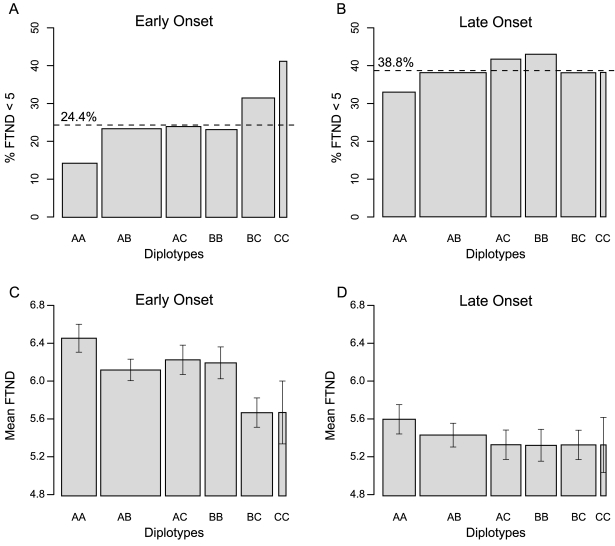
Figure 2. Low Nicotine Dependence (%) and Mean FTND Scores by Diplotype and Age of Onset of Daily Smoking in the Combined UT-WI-LHS Cohorts.
(A), (B) partitioning of diplotypes between FTND<5 and FTND>5 categories in early and late onset groups. The percentage of individuals in the FTND<5 category is shown by the dichotomous ‘FTND cut’ value (dashed line). (C), (D) mean FTND score of diplotypes by early and late onset; error bars indicate the S.E.M. Sample size by diplotype within the early onset condition was: AA, 161; AB, 276; AC, 162; BB, 146; BC, 153; and CC, 34. Within the late onset condition, diplotype sample sizes were: AA, 203; AB, 384; AC, 186; BB, 160; BC, 190; and CC, 34. Diplotype counts are indicated by the width of each associated column within the plots.
Figure 3
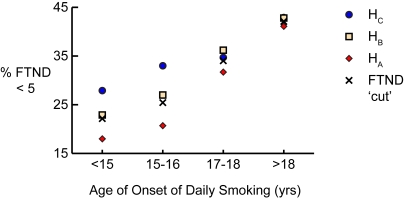
Figure 3. Low Nicotine Dependence (%) as a Function of Haplotypes A and C versus Age of Onset of Daily Smoking Quartiles in the UT-WI-LHS Cohorts.
(A) Percentage of each haplotype in the FTND score<5 category as a function of age of onset quartiles. The percentage of individuals in the FTND<5 category for each quartile is shown by the dichotomous ‘FTND cut’ value. The age range for each quartile, with percentage of total subjects in parentheses, is as follows: <15 years (19%), 15–16 years (27%), 17–18 years (26%), and >18 years (29%).

References

    1. Breslau N, Johnson EO. Predicting smoking cessation and major depression in nicotine-dependent smokers. Am J Public Health. 2000;90:1122–1127. - PMC - PubMed
    1. Piper ME, McCarthy DE, Baker TB. Assessing tobacco dependence: a guide to measure evaluation and selection. Nicotine Tob Res. 2006;8:339–351. - PubMed
    1. U.S. Department of Health and Human Services. The health consequences of smoking: A report of the Surgeon General. Atlanta, GA: U.S. Department of Health and Human Services, Centers for Disease Control and Prevention, National Center for Chronic Disease Prevention and Health Promotion, Office on Smoking and Health; 2004.
    1. Li MD, Cheng R, Ma JZ, Swan GE. A meta-analysis of estimated genetic and environmental effects on smoking behavior in male and female adult twins. Addiction. 2003;98:23–31. - PubMed
    1. Feng Y, Niu T, Xing H, Xu X, Chen C, et al. A common haplotype of the nicotine acetylcholine receptor alpha 4 subunit gene is associated with vulnerability to nicotine addiction in men. Am J Hum Genet. 2004;75:112–121. - PMC - PubMed

Publication types