


Dermatomal scratching after intramedullary quisqualate injection: correlation with cutaneous denervation
- PMID: 18619906
- PMCID: PMC3128346
- DOI: 10.1016/j.jpain.2008.05.010
Dermatomal scratching after intramedullary quisqualate injection: correlation with cutaneous denervation
Abstract
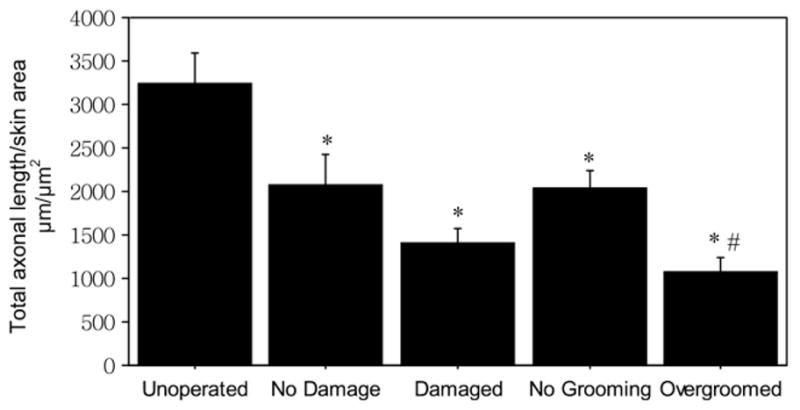
Central nervous system lesions cause peripheral dysfunctions currently attributed to central cell death that compromises function of intact peripheral nerves. Injecting quisqualate (QUIS) into the rat spinal cord models spinal cord injury (SCI) and causes at-level scratching and self-injury. Such overgrooming was interpreted to model pain until patients with self-injurious scratching after SCI reported itch motivated scratching that was painless because of sensory loss. Because self-injurious scratching is difficult to explain by central mechanisms alone, we hypothesized that QUIS injections damage peripheral axons of at-level afferents. QUIS was injected into thoracic spinal cords of 18 Long-Evans rats. Animals were killed 3 days after overgrooming began or 14 days after injection. Spinal cord lesions were localized and DRG-immunolabeled for ATF-3. At-level and control skin samples were PGP9.5-immunabeled to quantify axons. Eighty-four percent of QUIS rats overgroomed. Skin in these regions had lost two-thirds of epidermal innervation as compared with controls (P < .001). Rats that overgroomed had 47% less axon-length than nongrooming rats (P = .006). The presence of ATF-3 immunolabeled neurons within diagnosis-related groups of QUIS rats indicated death of afferent cell bodies. Overgrooming after QUIS injections may not be due entirely to central changes. As in humans, self-injurious neuropathic scratching appeared to require loss of protective pain sensations in addition to peripheral denervation.
Perspective: This study suggests that intramedullary injection of quisqualic acid in rats causes death of at-level peripheral as well as central neurons. Self-injurious dermatomal scratching that develops in spinal-injured rats may reflect neuropathic itch and loss of protective pain sensations.
Figures


Comment in
-
Scratching the brain to understand neuropathic itch.J Pain. 2008 Nov;9(11):973-4. doi: 10.1016/j.jpain.2008.08.002. J Pain. 2008. PMID: 18984500 No abstract available.
References
-
- Abraham KE, McGinty JF, Brewer KL. Opioid peptide mRNA expression is related to the onset of pain-related behaviors following excitotoxic spinal cord injury. Pain. 2001;90:181–190. - PubMed
-
- Andrew D, Craig AD. Spinothalamic lamina I neurons selectively sensitive to histamine: A central neural pathway for itch. Nat Neurosci. 2001;4:72–77. - PubMed
-
- Bernhard JD. Itch and pruritus: What are they and how should itches be classified? Dermatol Ther. 2005;18:288–291. - PubMed
-
- Blight AR. Morphometric analysis of a model of spinal cord injury in guinea pigs, with behavioral evidence of delayed secondary pathology. J Neurol Sci. 1991;103:156–71. - PubMed
-
- Brewer KL, Nolan T. Spinal and supraspinal expression of tumor necrosis factor-alpha (TNF-α) following excitotoxic spinal cord injury. J Mol Neurosci. 2007;31:13–22. - PubMed
Publication types
MeSH terms
Substances
Grants and funding
LinkOut - more resources
Full Text Sources
Medical
Research Materials
Miscellaneous
