


doi: 10.1126/science.1160033.
Genetic determinants of self identity and social recognition in bacteria
Affiliations
- PMID: 18621670
- PMCID: PMC2567286
- DOI: 10.1126/science.1160033
Item in Clipboard
Genetic determinants of self identity and social recognition in bacteria
Science.
.
Abstract
The bacterium Proteus mirabilis is capable of movement on solid surfaces by a type of motility called swarming. Boundaries form between swarming colonies of different P. mirabilis strains but not between colonies of a single strain. A fundamental requirement for boundary formation is the ability to discriminate between self and nonself. We have isolated mutants that form boundaries with their parent. The mutations map within a six-gene locus that we term ids for identification of self. Five of the genes in the ids locus are required for recognition of the parent strain as self. Three of the ids genes are interchangeable between strains, and two encode specific molecular identifiers.
Figures
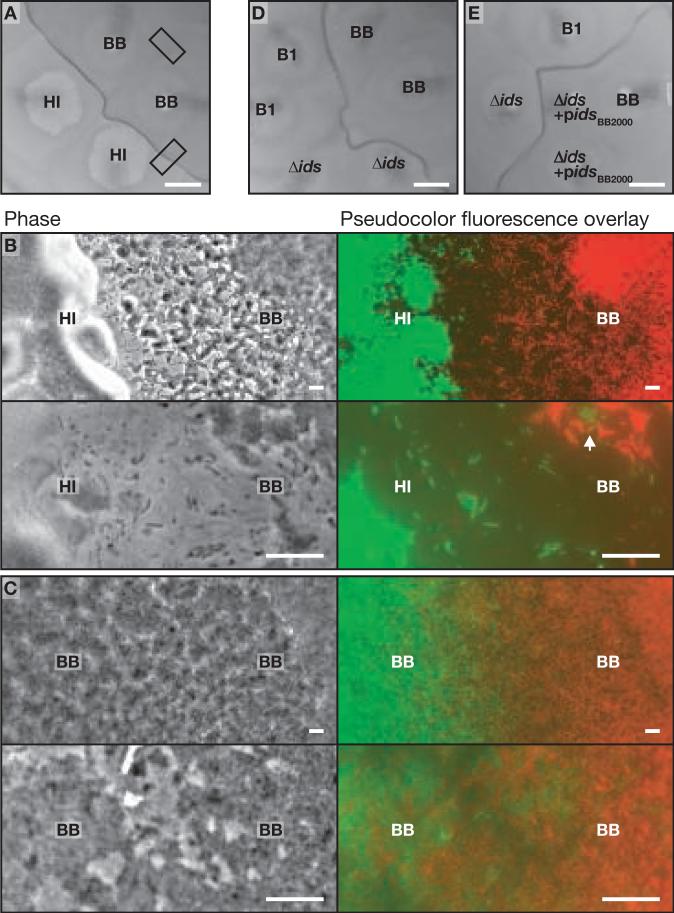
(A) Section of an agar plate with swarms of P. mirabilis strains HI4320 (HI) and BB2000 (BB). The boxes indicate intersections visualized in panels B and C. (B) Microscopy showing (top) the boundary between a GFP-labeled HI swarm (green) and a dsRed-labeled BB swarm (red), and (bottom) a higher magnification of the boundary. The arrow indicates HI cells among BB cells in the boundary. (C) Microscopy showing (top) the merger of two BB swarms, and (bottom) a higher magnification of the merger. The left BB swarm (green) expressed GFP and the right BB swarm (red) expressed dsRed (2). (D) Section of an agar plate with swarms of BB, the Ids transposon mutant (B1) and the idsA-F deletion mutant (Δids). (E) Section of an agar plate with swarms of B1, Δids, BB, and two swarms of the idsA-F deletion mutant carrying an idsA-F expression vector (Δids+pidsBB2000). The bars are 1 cm (A, D and E) and 10 μm (B and C).
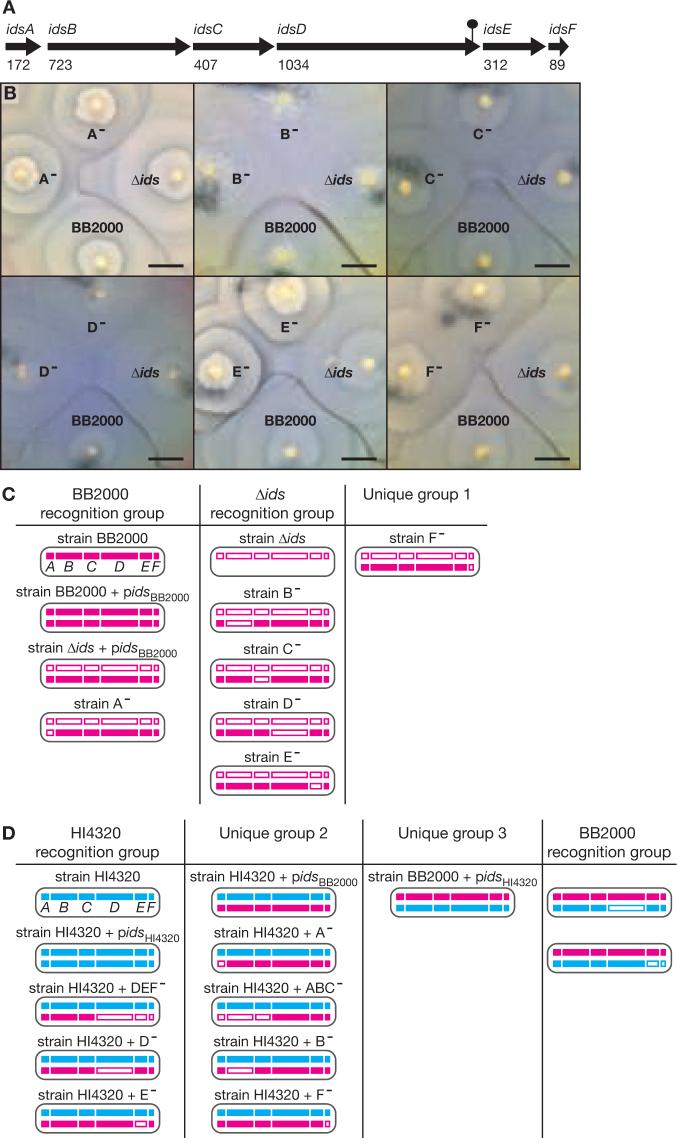
(A) The length of the encoded polypeptides in the six-gene ids cluster of strain BB2000 is shown underneath each gene. The lollipop demarks the site of the transposon insertion in the Ids transposon mutant. (B) Sections of agar plates with the BB2000 parent, the idsA-F deletion mutant (Δids) and the idsA-F deletion mutant carrying a plasmid-borne BB2000 idsA-F gene cluster with single-gene disruptions in idsA (A−), idsB (B−), idsC (C−), idsD (D−), idsE (E−) or idsF (F−). The bars are 1 cm. (C) Recognition groups of strains constructed in the BB2000 and Δids backgrounds. A subset of the strains is shown in panel B. (D) Recognition groups of transgenic diploid derivatives of wildtype HI4320 and wildtype BB2000. Agar plates with swarms of representative strains are shown in Figure S3. For panels C and D, a cell of each strain is represented by an oval in which the chromosomal and plasmid-borne ids gene clusters are on the top and bottom, respectively. A white box denotes a gene disruption. The BB2000 and HI4320 ids gene clusters are in red and blue, respectively. Each strain was tested against every other strain to determine the recognition groups (2). Each recognition group was comprised of strains whose swarms merged; boundaries formed between swarms of strains in different recognition groups.
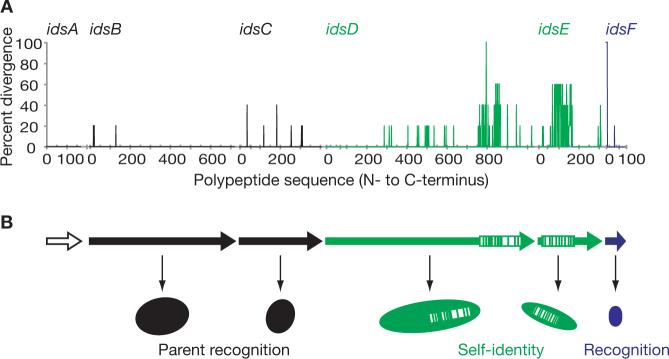
(A) A plot showing the percent divergence of the encoded polypeptides in the idsABCDEF gene cluster amongst P. mirabilis strains BB2000, HI4320, CW977, G151 and S4/3. (B) A model for self-recognition. The idsB, idsC, idsD, idsE and idsF genes are required for recognition of the BB2000 parent as self. IdsA is not required for self-recognition. IdsF has a function in self-non-self recognition that is distinct from that of IdsB and IdsC. The idsD and idsE genes encode specific molecular identifiers of self.
References
Publication types
MeSH terms
Substances
Associated data
- Actions
- Actions
- Actions
- Actions
- Actions
- Actions
Grants and funding
LinkOut - more resources
Full Text Sources
Other Literature Sources
