. 2008 Jul 22;105(29):10215-20.
doi: 10.1073/pnas.0803565105. Epub 2008 Jul 11.

Amide bonds assemble pili on the surface of bacilli

Affiliations

Amide bonds assemble pili on the surface of bacilli

Jonathan M Budzik et al. Proc Natl Acad Sci U S A. .

Abstract

Pilin precursors are the building blocks of pili on the surface of Gram-positive bacteria; however, the assembly mechanisms of these adhesive fibers are unknown. Here, we describe the chemical bonds that assemble BcpA pilin subunits on the surface of Bacillus cereus. Sortase D cleaves BcpA precursor between the threonine (T) and the glycine (G) residues of its LPXTG sorting signal and catalyzes formation of an amide bond between threonine (T) of the sorting signal and lysine (K) in the YPKN motif of another BcpA subunit. Three CNA B domains of BcpA generate intramolecular amide bonds, and one of these contributes also to pilus formation. Conservation of catalysts and structural elements in pilin precursors in Gram-positive bacteria suggests a universal mechanism of fiber assembly.


Conflict of interest statement

The authors declare no conflict of interest.

Figures
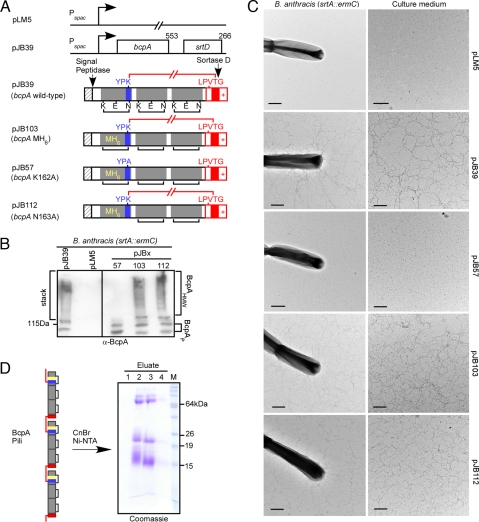
Fig. 1.
Fig. 1.
Purification of BcpA pili. (A) Graphic representation of pLM5 and plasmid derivatives with bcpA-srtD under control of the IPTG inducible Pspac promoter. pJB39 expresses wild-type bcpA-srtD. Plasmid pJB103 contains the MH6 peptide (yellow) 10 residues upstream from the YPKN motif. pJB57 carries an alanine substitution of the pilin motif lysine to alanine (bcpAMH6 K162A-srtD). pJB112 contains a substitution of the asparagine (N) residue of YPKN to alanine. Dashed shading indicates the signal peptide. The YPKN motif is printed in blue, the sorting signal (LPVTG, hydrophobic region, and positively charged tail) and the amide linkage between lysine 162 within the YPKN pilin motif and threonine 522 in red. bcpA encodes three CNA B domains (gray) with conserved lysine (K), glutamic acid (E), and asparagine (N) residues. (B) B. anthracis srtA::ermC cultures were centrifuged and supernatant analyzed by immunoblotting with BcpA antisera (α-BcpA). Electrophoretic mobilities of marker (115 kDa), BcpA precursor (BcpAP), and BcpA fibers (BcpAHMW) are indicated. (C) Bacilli or culture medium were analyzed by ImmunoGold labeling with α-BcpA serum and viewed by transmission electron microscopy. (Scale bars, 1 μm.) (D) Graphic representation of inter- and intramolecular amide bonds in MH6 tagged BcpA pili. Each major pilin protein monomer contains three intramolecular amide bonds (black) and three CNA B domains (gray); intermolecular amide linkages between pilin subunits are drawn in red. Pili were digested with cyanogen bromide (CNBr) and MH6 tagged YPKN peptides purified on NI-NTA, separated by SDS/PAGE and stained with Coomassie. Four 500-μl eluate aliquots were collected (E1–4).
Fig. 2.
Fig. 2.
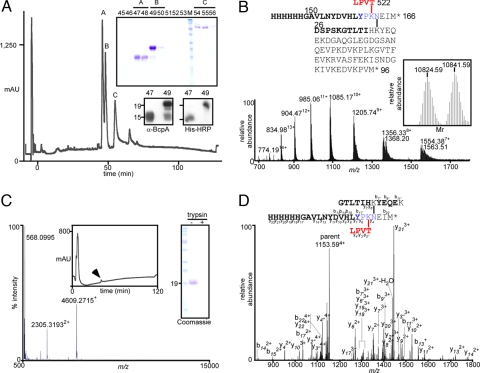
Inter- and intramolecular amide bonds in BcpA pili. (A) RP-HPLC of CNBr cleaved and Ni-NTA purified BcpA pili. Compounds A-C were analyzed by SDS/PAGE (Coomassie), by immunoblotting with α-BcpA and by binding to His-HRP. (B) The molecular mass of compound A was determined by ESI-FTMS. Insets display the deduced structure of compound A and the Mr values calculated by XtractAll for Qual Browser. Intra- (Asn163-Lys37, black), intermolecular amide (Lys162-Thr522, red), YPKN motif (blue) and LPXTG sorting signal (red) are indicated. M* denotes homoserine lactone residues. Residues in bold were identified by Edman degradation. (C) Compound A was incubated with trypsin and analyzed by SDS/PAGE (Coomassie). Compound A1, a tryptic peptide of compound A, was purified by Ni-NTA affinity chromatography, separated by RP-HPLC (arrowhead) and mass measured by MALDI-MS. (D) CAD fragmentation spectra (m/z) of the parent ion 1,153.594+. Fragment ions are labeled,‘ refers to fragment ions that arose from fragmentation of the GTLTIHKYEQEK branch of the peptide, “ refers to fragment ions that arose from the LPVT branch of the peptide. Unmarked fragment ions were derived from fragmentation of the HHHGAVLNYDVHLYPKNEIM*. M* denotes a homoseryl residue.
Fig. 3.
Fig. 3.
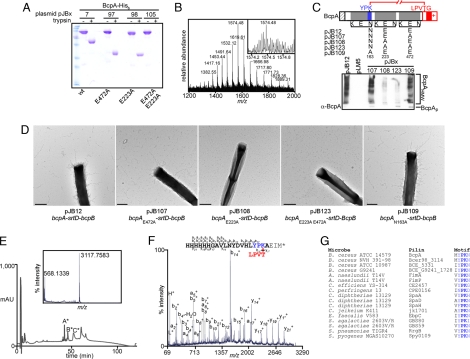
Contribution of intramolecular amide bonds toward pilus assembly. (A) Recombinant BcpAHis-6 (pJB7), BcpAHis-6 E472A (pJB97), BcpAHis-6 E223A (pJB98), and BcpAHis-6 E472A E223A (pJB105) were purified from E. coli by Ni-NTA chromatography. Purified proteins were digested with trypsin and analyzed by SDS/PAGE and Coomassie staining. (B) Mass spectra (m/z) for BcpAHis-6 were determined by ESI-FTMS with isotopic resolution. Inset displays the peak at 1,574.48. (C) Graphic representation of intra- and intermolecular amide bonds in MH6 tagged BcpA pili and their plasmid encoded variants. Pilus formation was measured by immunoblotting with α-BcpA. (D) Bacilli were analyzed by ImmunoGold labeling with α-BcpA serum and viewed by transmission electron microscopy. Bars indicate 1 μm. (E) Pili derived from B. anthracis srtA::ermC were digested with CNBr, Ni-NTA affinity-purified and eluate analyzed by RP-HPLC. The monoisotopic ion mass spectra of compound A* was determined by MALDI-MS in reflectron mode. (F) MALDI-MS/MS with CAD of compound A1. Fragment ion types are indicated: “ refers to daughter ions that arose from the LPVT. Other fragment ions were derived from fragmentation of the HHHHHHGAVLNYDVHLYPKAEIM* branch of the peptide. M* denotes a homoserine lactone residue. Residues determined by Edman degradation are printed in bold. (G) Sequence alignment of the YPKN motif in major pilin proteins of Gram-positive bacteria.
Fig. 4.
Fig. 4.
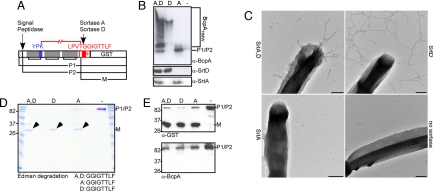
Cleavage sites of sortases and their contribution to pilus assembly. (A) Diagram displays the precursor (P1) of BcpA-GST, and the signal peptidase (P2) and sortase cleaved products (M). (B) Pilus formation from BcpA-GST substrate was examined by immunoblotting with α-BcpA in cells harboring both sortase D (SrtD) and sortase A (SrtA), only one of the two sortases or none at all. (C) Bacilli were analyzed by ImmunoGold labeling with α-BcpA serum and viewed by transmission electron microscopy. (Scale bars, 1 μm.) (D) The cell wall of bacilli was removed with PlyL, protoplast lysed by sonication, and sortase cleavage products purified by affinity chromatography on glutathione-Sepharose. Electrophoretic mobility of the molecular weight marker, pilin precursors (P1/P2), and mature cleavage products (M) on SDS/PAGE is indicated. Edman degradation revealed the N-terminal sequences of mature products. (E) Purified cleavage products were subjected to immunoblotting with specific antisera (α-GST or α-BcpA).

References

    1. Barocchi MA, et al. A pneumococcal pilus influences virulence and host inflammatory responses. Proc Natl Acad Sci USA. 2006;103:2857–2862. - PMC - PubMed
    1. Lauer P, et al. Genome analysis reveals pili in Group B streptococcus. Science. 2005;309:105. - PubMed
    1. Mora M, et al. Group A Streptococcus produce pilus-like structures containing protective antigens and Lancefield T antigens. Proc Natl Acad Sci USA. 2005;102:15641–15646. - PMC - PubMed
    1. Nelson AL, et al. RrgA is a pilus-associated adhesin in Streptococcus pneumoniae. Mol Microbiol. 2007;66:329–340. - PMC - PubMed
    1. Yeung MK, Cisar JO. Cloning and nucleotide sequence of a gene for Actinomyces naeslundii WVU45 type 2 fimbriae. J Bacteriol. 1988;170:3803–3809. - PMC - PubMed

Publication types

MeSH terms