. 2008 Oct;95(8):3892-905.
doi: 10.1529/biophysj.108.134346. Epub 2008 Jul 11.

Monovalent and divalent promoted GAAA tetraloop-receptor tertiary interactions from freely diffusing single-molecule studies

Affiliations

Monovalent and divalent promoted GAAA tetraloop-receptor tertiary interactions from freely diffusing single-molecule studies

Julie L Fiore et al. Biophys J. 2008 Oct.

Abstract

Proper assembly of RNA into catalytically active three-dimensional structures requires multiple tertiary binding interactions, individual characterization of which is crucial to a detailed understanding of global RNA folding. This work focuses on single-molecule fluorescence studies of freely diffusing RNA constructs that isolate the GAAA tetraloop-receptor tertiary interaction. Freely diffusing conformational dynamics are explored as a function of Mg(2+) and Na(+) concentration, both of which promote facile docking, but with 500-fold different affinities. Systematic shifts in mean fluorescence resonance energy transfer efficiency values and line widths with increasing [Na(+)] are observed for the undocked species and can be interpreted with a Debye model in terms of electrostatic relaxation and increased flexibility in the RNA. Furthermore, we identify a 34 +/- 2% fraction of freely diffusing RNA constructs remaining undocked even at saturating [Mg(2+)] levels, which agrees quantitatively with the 32 +/- 1% fraction previously reported for immobilized constructs. This verifies that the kinetic heterogeneity observed in the docking rates is not the result of surface tethering. Finally, the K(D) value and Hill coefficient for [Mg(2+)]-dependent docking decrease significantly for [Na(+)] = 25 mM vs. 125 mM, indicating Mg(2+) and Na(+) synergy in the RNA folding process.


Figures
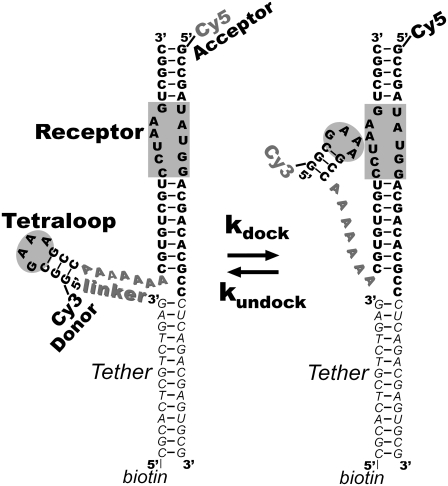
FIGURE 1
FIGURE 1
RNA construct for Cy3-Cy5 FRET-monitoring of GAAA tetraloop-receptor docking/undocking. The GAAA tetraloop and receptor are connected by a flexible A7 linker (shadowed gray text) and highlighted in the undocked (left) and docked (right) states. A biotinylated region (italicized) is also retained for quantitative comparison with previous tethered results.
FIGURE 2
FIGURE 2
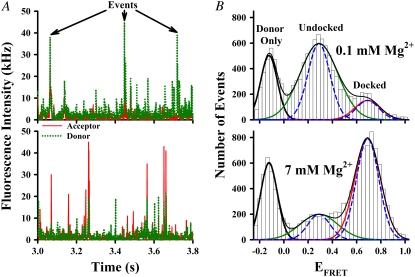
Sample smFRET data analysis of freely diffusing tetraloop-receptor RNA. (A) Sample time traces of donor (dotted green lines) and acceptor (solid red lines) intensities at 0.1 mM Mg2+ (top) and 7 mM Mg2+ (bottom) indicate photon burst events as a molecule traverses the laser focal volume. (B) EFRET histograms generated from events that exceed a 25 kHz threshold at 0.1 mM Mg2+ (top) and 7 mM Mg2+ (bottom) fit to a sum of three Gaussian distributions (black line). The individual Gaussian components reveal distinct populations of donor-only (EFRET < 0, thick black), undocked (green) and docked (red) constructs. Dashed blue lines represent shot-noise limited line-shape predictions.
FIGURE 3
FIGURE 3
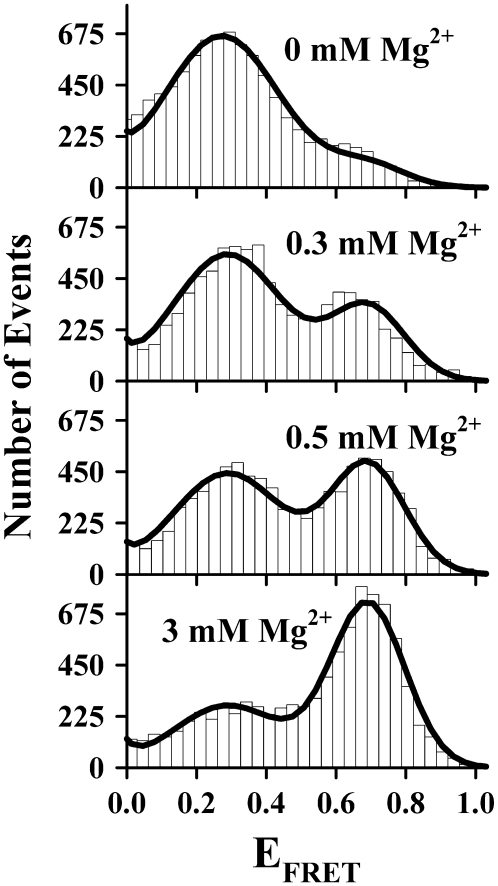
EFRET population histograms as a function of [Mg2+] with Gaussian fits superimposed. The tetraloop-receptor interaction is promoted by Mg2+, as evidenced by the shift in the relative populations from undocked (low EFRET) to docked (high EFRET) states.
FIGURE 4
FIGURE 4
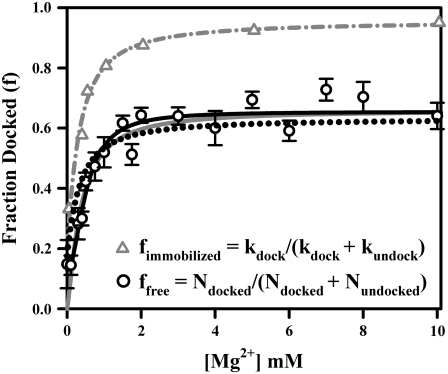
Comparison of Mg2+-dependent fractional docked population for freely diffusing (black circles) and immobilized tetraloop-receptor constructs (gray triangles and dash-dotted line). fimmobilized is calculated from the kinetic rate constants observed in tethered actively docking/undocking constructs, where a nondocking population (32 ± 1%) was previously observed (48). ffree is fit to Eq. 7 (solid gray line), where n = 1.3 ± 0.3, KD = 0.36 ± 0.6 mM, and fmax = 0.66 ± 0.03. Linear scaling of fimmobilized to ffree (Eq. 9) yields 66 ± 2% constructs are actively docking under freely diffusing conditions (dotted black line). ffree is also fit to Eq. 10 (solid black line) derived from the model in Fig. 5 C, which allows for a nonzero docked fraction at 0 mM Mg2+ due to 125 mM Na+.
FIGURE 5
FIGURE 5
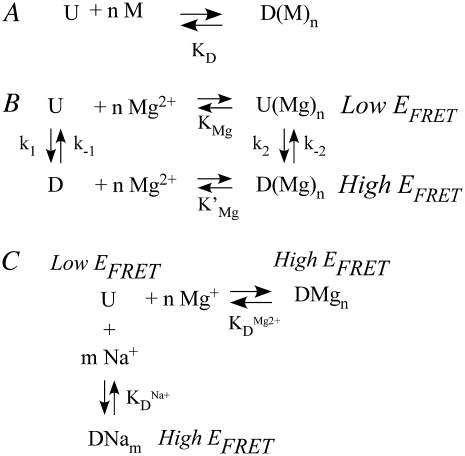
(A) Nominal two-state picture for cooperative binding of metal ions (M) to an undocked state (U), enabling progression to a docked state (D(M)n) with metal ion dissociation constant, KD. (B) Mechanism adapted from Kim et al. (36) to describe docking of the GAAA tetraloop and receptor with and without Mg2+, where KMg and KMg are Mg2+ -dissociation constants and the rate constants reflect docking and undocking resolved by FRET. (C) Simplified parallel model to describe [Na+]- and [Mg2+]-dependence for the observed fraction of docked molecules with Mg2+ and Na+ dissociation constants.
FIGURE 6
FIGURE 6
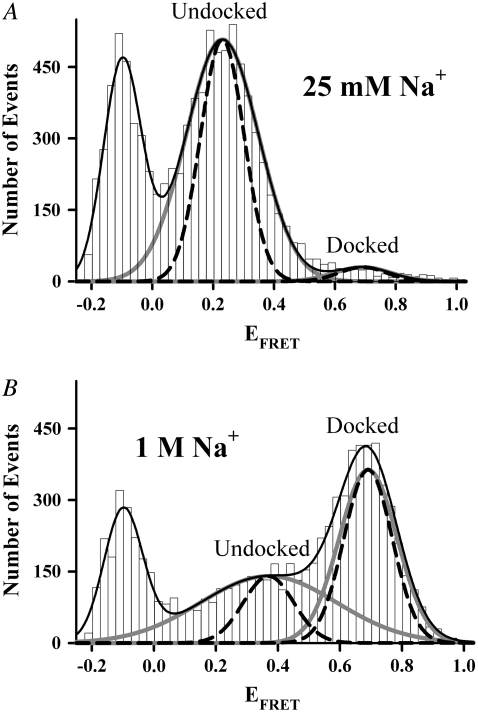
EFRET distributions and Gaussian fits (black lines) showing the donor-only (leftmost peak) population and the individual Gaussian components (gray) and shot-noise predictions (dashed lines) of undocked and docked states at (A) 25 mM Na+ and (B) 1.0 M Na+. Note that the undocked peak shifts to higher center EFRET value and broadens with increasing [Na+] (see text for details).
FIGURE 7
FIGURE 7
(A) Least-squares fits of fractional docked population (Ndocked/(Ndocked + Nundocked)) versus [Na+] to Eq. 7, resulting in fmax = 0.55 ± 0.05, a Hill coefficient 1.3 ± 0.3, and KD = 180 ± 30 mM. The asymptotic value (fmax) is consistent with Mg2+ studies in Fig. 5, suggesting a ≈32–34% nondocking RNA subpopulation. (B) ffree as a function of [Mg2+] at low [Na+] (25 mM) with a fit to Eq. 10 that also allows for a [Na+] docking pathway (Fig. 5 C), yielding fmax = 0.55 ± 0.04, n = 8 ± 2, and formula image and demonstrating high cooperativity with respect to Mg2+ observed in the presence of minimal Na+.
FIGURE 8
FIGURE 8
Evidence for a cation-induced increase in electrostatic compaction and conformational sampling of the undocked state tetraloop-receptor construct. (A and B) Systematic shift in mean EFRET of the undocked peak with increasing [Na+] and [Mg2+], respectively, fit by a Hill-type model (Eq. 11) with formula image 0.227 ± 0.003; formula image 0.07 ± 0.02, n(Na+, Mg2+) = 2.1 ± 0.4, 2.6 ± 0.8, and KD(Na+, Mg2+) = 180 ± 20 mM, 0.9 ± 0.2 mM. (C and D) Systematic shifts in undocked EFRET peak widths as function of [Na+] and [Mg2+], respectively, yielding KD(Na+, Mg2+) = 0.23 M ± 0.02, 1.2 ± 0.4 mM; n(Na+, Mg2+) = 3.6 ± 0.8, 2.7 ± 1.2; and Δσ(Na+, Mg2+) = 0.10 ± 0.01, 0.07 ± 0.03, respectively.
FIGURE 9
FIGURE 9
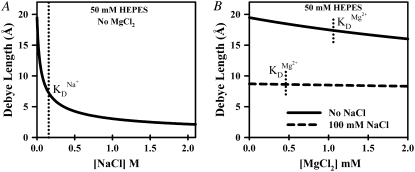
Calculated Debye shielding lengths in the presence of 50 mM hemisodium HEPES buffer with the addition of (A) [NaCl] in the absence MgCl2 and (B) [MgCl2] without and with 100 mM NaCl. Also shown (dotted vertical lines) are the observed KD values for (A) Na+- and (B) Mg2+-facilitated docking.
FIGURE 10
FIGURE 10
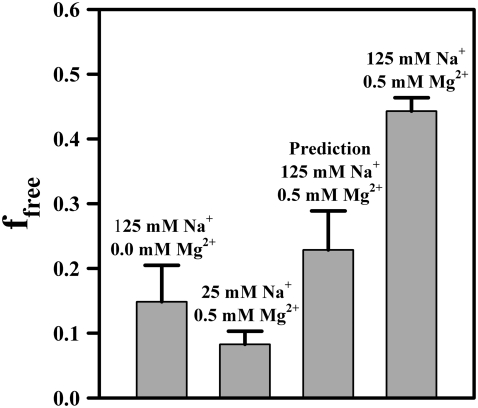
Evidence for positive Na+ and Mg2+-synergy in promoting tetraloop-receptor docking; ffree for combined Mg2+ and Na+ (rightmost bar) is significantly greater than the prediction (third bar) based on a simple additive model of individual Na+ and Mg2+ results (left two bars).

References

    1. Gesteland, R. F., T. R. Cech, and J. F. Atkins. 2006. The RNA World: The Nature of Modern RNA Suggests a Prebiotic RNA. Cold Spring Harbor Laboratory Press, Cold Spring Harbor, NY.
    1. Tinoco, I., and C. Bustamante. 1999. How RNA folds. J. Mol. Biol. 293:271–281. - PubMed
    1. Batey, R. T., R. P. Rambo, and J. A. Doudna. 1999. Tertiary motifs in RNA structure and folding. Angew. Chem. Int. Ed. 38:2327–2343. - PubMed
    1. Young, B. T., and S. K. Silverman. 2002. The GAAA tetraloop-receptor interaction contributes differentially to folding thermodynamics and kinetics for the P4-P6 RNA domain. Biochemistry. 41:12271–12276. - PubMed
    1. Bartley, L. E., X. W. Zhuang, R. Das, S. Chu, and D. Herschlag. 2003. Exploration of the transition state for tertiary structure formation between an RNA helix and a large structured RNA. J. Mol. Biol. 328:1011–1026. - PubMed

Publication types

LinkOut - more resources