


Phosphorylation of endothelial nitric-oxide synthase regulates superoxide generation from the enzyme
- PMID: 18622039
- PMCID: PMC2556006
- DOI: 10.1074/jbc.M802269200
Phosphorylation of endothelial nitric-oxide synthase regulates superoxide generation from the enzyme
Abstract
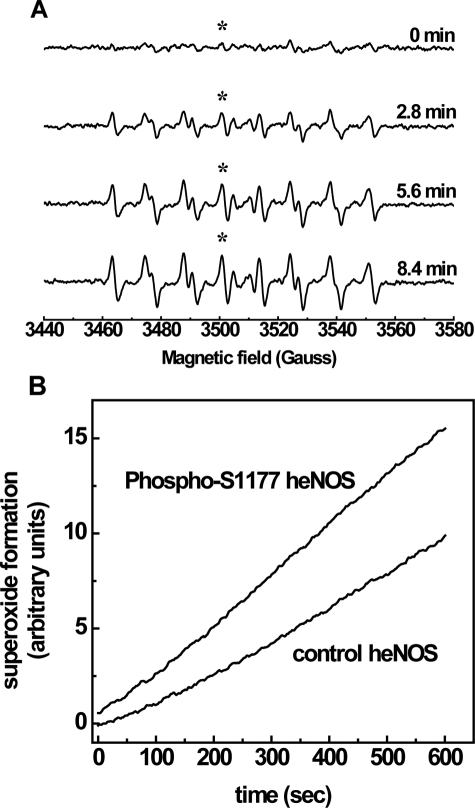
In the vasculature, nitric oxide (NO) is generated by endothelial NO synthase (eNOS) in a calcium/calmodulin-dependent reaction. With oxidative stress, the critical cofactor BH(4) is depleted, and NADPH oxidation is uncoupled from NO generation, leading to production of (O(2)*). Although phosphorylation of eNOS regulates in vivo NO generation, the effects of phosphorylation on eNOS coupling and O(2)* generation are unknown. Therefore, we phosphorylated recombinant BH(4)-free eNOS in vitro using native kinases and determined O(2)* generation using EPR spin trapping. Phosphorylation of Ser-1177 by Akt led to an increase (>50%) in maximal O(2)* generation from eNOS. Moreover, Ser-1177 phosphorylation greatly altered the Ca(2+) sensitivity of eNOS, such that O(2)* generation became largely Ca(2+)-independent. In contrast, phosphorylation of eNOS at Thr-495 by protein kinase Calpha (PKCalpha) had no effect on maximum activity or calcium sensitivity but decreased calmodulin binding and increased association with caveolin. In endothelial cells, eNOS-dependent O(2)* generation was stimulated by vascular endothelial growth factor that induced phosphorylation of Ser-1177. With PKC activation that led to phosphorylation of Thr-495, no inhibition of O(2)* generation occurred. As such, phosphorylation of eNOS at Ser-1177 is pivotal in the direct regulation of O(2)* and NO generation, altering both the Ca(2+) sensitivity of the enzyme and rate of product formation, whereas phosphorylation of Thr-495 indirectly affects this process through regulation of the calmodulin and caveolin interaction. Thus, Akt-mediated phosphorylation modulates eNOS uncoupling and greatly increases O(2)* generation from the enzyme at low Ca(2+) concentrations, and PKCalpha-mediated phosphorylation alters the sensitivity of the enzyme to other negative regulatory signals.
Figures



References
Publication types
MeSH terms
Substances
Grants and funding
LinkOut - more resources
Full Text Sources
Other Literature Sources
Molecular Biology Databases
Research Materials
Miscellaneous
