Understanding healing relationships in primary care
- PMID: 18626031
- PMCID: PMC2478496
- DOI: 10.1370/afm.860
Understanding healing relationships in primary care
Abstract
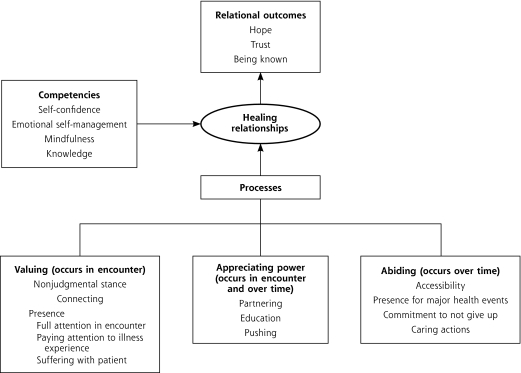
Purpose: Clinicians often have an intuitive understanding of how their relationships with patients foster healing. Yet we know little empirically about the experience of healing and how it occurs between clinicians and patients. Our purpose was to create a model that identifies how healing relationships are developed and maintained.
Methods: Primary care clinicians were purposefully selected as exemplar healers. Patients were selected by these clinicians as having experienced healing relationships. In-depth interviews, designed to elicit stories of healing relationships, were conducted with patients and clinicians separately. A multidisciplinary team analyzed the interviews using an iterative process, leading to the development of case studies for each clinician-patient dyad. A comparative analysis across dyads was conducted to identify common components of healing relationships
Results: Three key processes emerged as fostering healing relationships: (1) valuing/creating a nonjudgmental emotional bond; (2) appreciating power/consciously managing clinician power in ways that would most benefit the patient; and (3) abiding/displaying a commitment to caring for patients over time. Three relational outcomes result from these processes: trust, hope, and a sense of being known. Clinician competencies that facilitate these processes are self-confidence, emotional self-management, mindfulness, and knowledge.
Conclusions: Healing relationships have an underlying structure and lead to important patient-centered outcomes. This conceptual model of clinician-patient healing relationships may be generalizable to other kinds of healing relationships.
References
-
- Miller WL, Crabtree BF, Duffy MB, Epstein RM, Stange KC. Research guidelines for assessing the impact of healing relationships in clinical medicine. Altern Ther Health Med. 2003;9(3)(Suppl):A80–A95. - PubMed
-
- Csordas TJ, Kleinman A. The therapeutic process. In: Johnson TM, Sargent CF, eds. Medical Anthropology: Contemporary Theory and Method. New York, NY: Praeger Publishers; 1990.
-
- Lambert MJ. Implications of outcome research for psychotherapy integration. In: Norcross JC, Goldstein MR, eds. Handbook of Psychotherapy Integration. New York, NY: Basic Book; 1992:94–129.
-
- Jackson C. Healing ourselves, healing others: first in a series. Holist Nurs Pract. 2004;18(2):67–81. - PubMed
-
- Swanson K. What is known about caring in nursing science: a literary meta-analysis. In: Hinshaw AS, Feetham S, Shaver JLF, eds. Handbook of Clinical Nursing Research. Thousand Oaks, CA: Sage Publications; 1999:31–60.
Publication types
MeSH terms
LinkOut - more resources
Full Text Sources
Medical