


The ubiquitin-like molecule interferon-stimulated gene 15 (ISG15) is a potential prognostic marker in human breast cancer
- PMID: 18627608
- PMCID: PMC2575531
- DOI: 10.1186/bcr2117
The ubiquitin-like molecule interferon-stimulated gene 15 (ISG15) is a potential prognostic marker in human breast cancer
Abstract
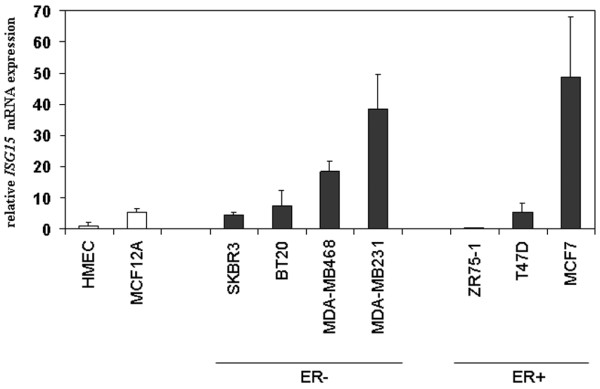
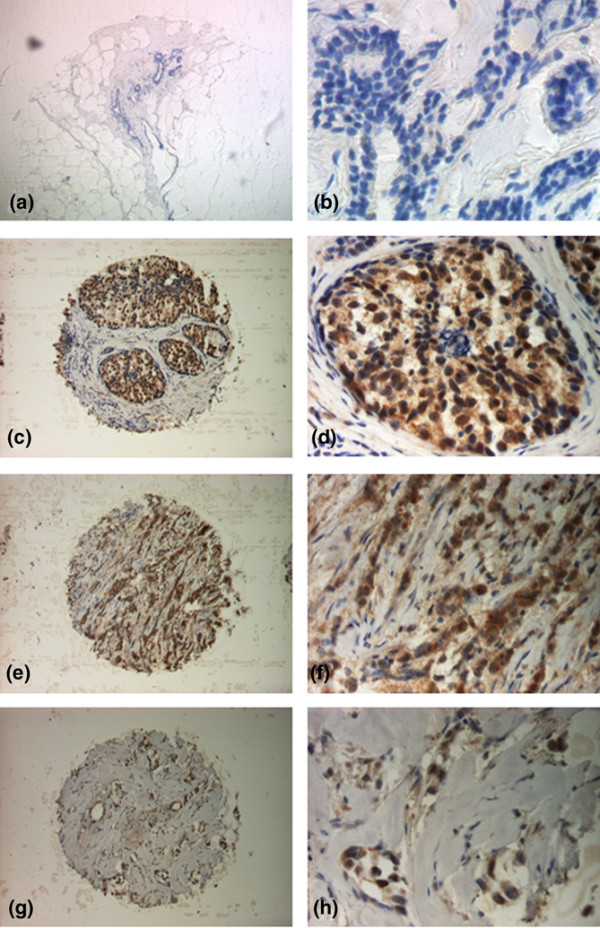
Introduction: ISG15 is an ubiquitin-like molecule that is strongly upregulated by type I interferons as a primary response to diverse microbial and cellular stress stimuli. However, alterations in the ISG15 signalling pathway have also been found in several human tumour entities. To the best of our knowledge, in the current study we present for the first time a systematic characterisation of ISG15 expression in human breast cancer and normal breast tissue both at the mRNA and protein level.
Method: Using semiquantitative real-time PCR, cDNA dot-blot hybridisation and immunohistochemistry, we systematically analysed ISG15 expression in invasive breast carcinomas (n = 910) and normal breast tissues (n = 135). ISG15 protein expression was analysed in two independent cohorts on tissue microarrays; in an initial evaluation set of 179 breast carcinomas and 51 normal breast tissues; and in a second large validation set of 646 breast carcinomas and 10 normal breast tissues. In addition, a collection of benign and malignant mammary cell lines (n = 9) were investigated for ISG15 expression.
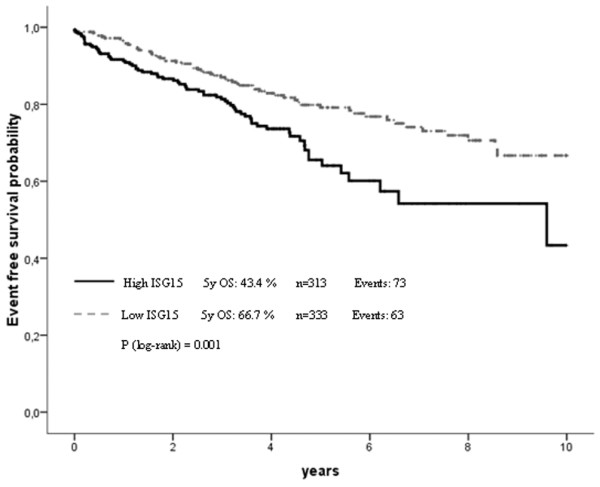
Results: ISG15 was overexpressed in breast carcinoma cells compared with normal breast tissue, both at the RNA and protein level. Recurrence-free (p = 0.030), event-free (p = 0.001) and overall (p = 0.001) survival analyses showed a significant correlation between ISG15 overexpression and unfavourable prognosis.
Conclusion: Therefore, ISG15 may represent a novel breast tumour marker with prognostic significance and may be helpful in selecting patients for and predicting response to the treatment of human breast cancer.
Figures




References
-
- Loeb KR, Haas AL. The interferon-inducible 15-kDa ubiquitin homolog conjugates to intracellular proteins. J Biol Chem. 1992;267:7806–7813. - PubMed
-
- Haas AL, Ahrens P, Bright PM, Ankel H. Interferon induces a 15-kilodalton protein exhibiting marked homology to ubiquitin. J Biol Chem. 1987;262:11315–11323. - PubMed
-
- Hamerman JA, Hayashi F, Schroeder LA, Gygi SP, Haas AL, Hampson L, Coughlin P, Aebersold R, Aderem A. Serpin 2a is induced in activated macrophages and conjugates to a ubiquitin homolog. J Immunol. 2002;168:2415–2423. - PubMed
Publication types
MeSH terms
Substances
LinkOut - more resources
Full Text Sources
Other Literature Sources
Medical
Miscellaneous
