


Frequency-dependent behavior of the intervertebral disc in response to each of six degree of freedom dynamic loading: solid phase and fluid phase contributions
- PMID: 18628705
- PMCID: PMC2758072
- DOI: 10.1097/BRS.0b013e31817bb116
Frequency-dependent behavior of the intervertebral disc in response to each of six degree of freedom dynamic loading: solid phase and fluid phase contributions
Abstract
Study design: Nondestructive displacement-controlled dynamic testing of cadaver material, with repeated measures design and randomized sequence of tests.
Objective: To determine whether the frequency-dependent changes in disc stiffness and phase angle between load and displacement differ between the 6 principal directions of displacement, and whether these differences are greater in deformation directions associated with greater intradiscal fluid flow.
Summary of background data: Prior studies of time-dependent behavior of discs have focused on compression. Comparing different deformation directions allows effects of fluid flow to be distinguished from effects of the solid phase viscoelasticity.
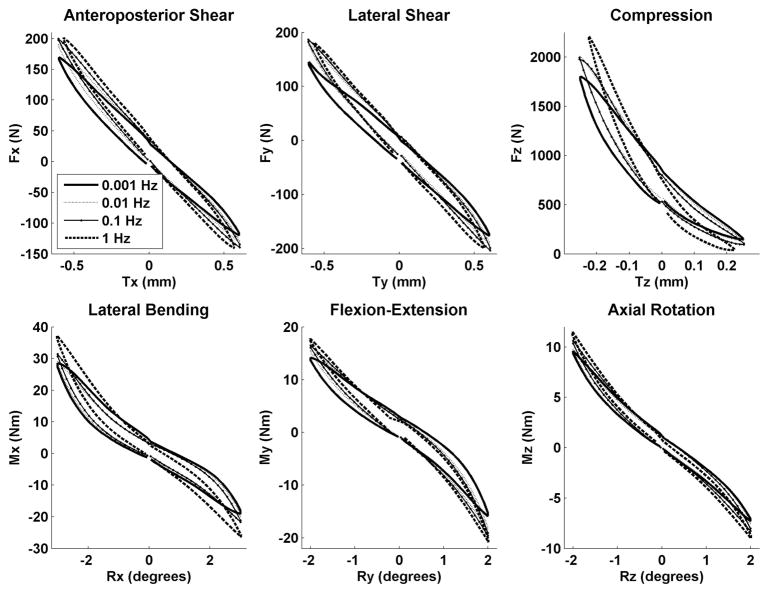
Methods: Vertebra-disc-vertebra preparations (N = 9) from human lumbar spines were subjected to each of 3 displacements and 3 rotations (6 degree of freedom) at each of 4 frequencies (0.001, 0.01, 0.1, and 1 Hz) after equilibration overnight under a 0.4 MPa preload in a bath of phosphate buffered saline at 37 degrees C with protease inhibitors. The forces and torques were recorded along with the applied translation or rotation. The stiffness (force/displacement or torque/rotation) and the phase angle (between each force and displacement) were calculated for each degree of freedom from recorded data.
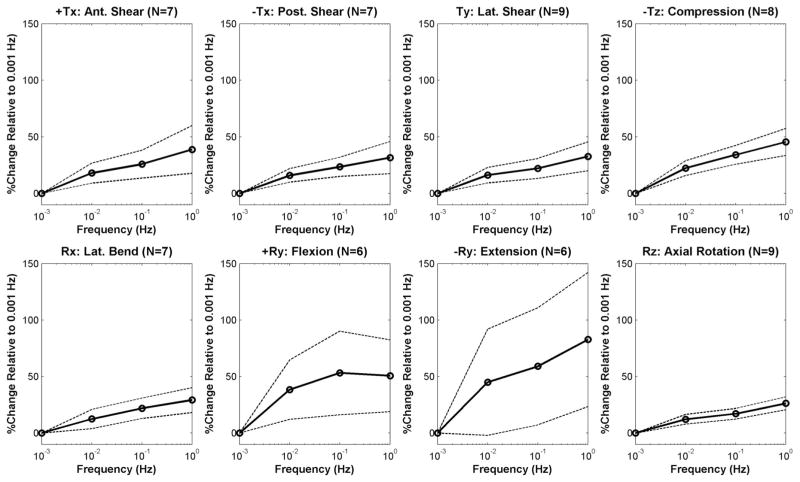
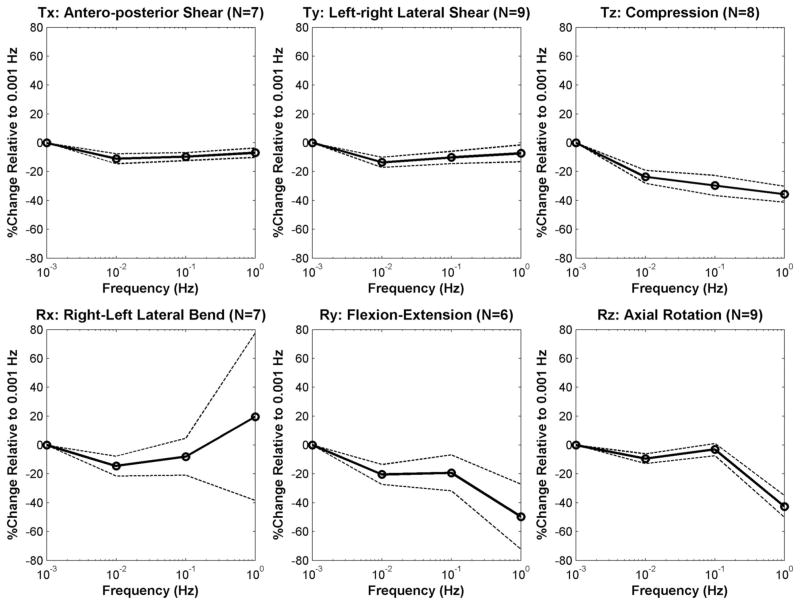
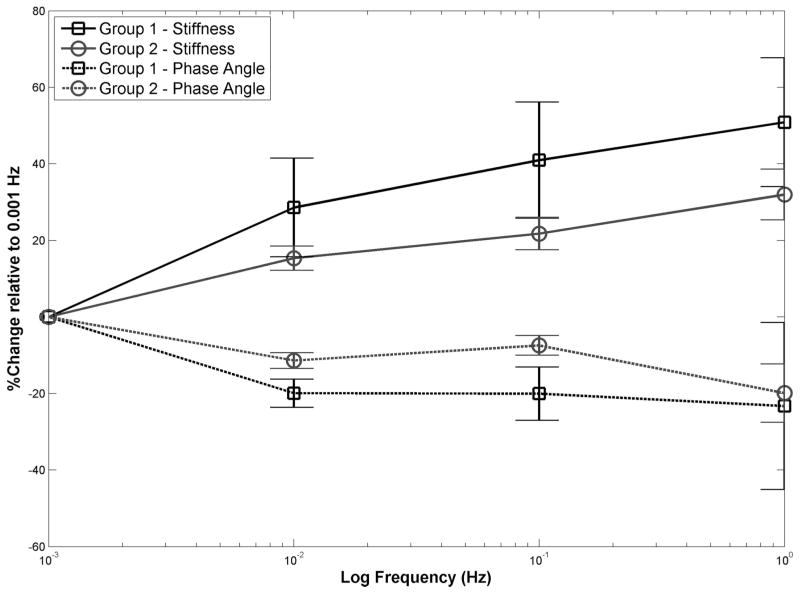
Results: Disc stiffness increased linearly with the log-frequency. The increases over the four decades of frequency were 35%, 33%, and 26% for AP shear, lateral shear, and torsion respectively, and were 45%, 29%, 51%, and 83% for compression, lateral bending, flexion, and extension. The phase angle (a measure of energy absorption) averaged 6.2, 5.1, and 5.1 degrees in AP shear, lateral shear, and torsion, respectively, and 7.0, 7.0, and 8.6 degrees for compression, lateral bending, and flexion-extension. There were no consistent variations of phase angle with frequency.
Conclusion: The stiffness increase and phase angle decrease with frequency were greater for deformation modes in which fluid flow effects are thought to be greater.
Figures
References
-
- Huyghe JM, Houben GB, Drost MR, et al. An ionised/non-ionised dual porosity model of intervertebral disc tissue. Biomech Model Mechanobiol. 2003;2:3–19. - PubMed
-
- Iatridis JC, Laible JP, Krag MH. Influence of fixed charge density magnitude and distribution on the intervertebral disc: applications of a poroelastic and chemical electric (PEACE) model. J Biomech Eng. 2003;125:12–24. - PubMed
-
- Hayes WC, Bodine AJ. Flow-independent viscoelastic properties of articular cartilage matrix. J Biomech. 1978;11:407–19. - PubMed
-
- Mow VC, Huiskes R, editors. Basic Orthopaedic Biomechanics and Mechano-Biology. 3. Philadelphia: Lippincott Williams & Wilkins; 2005.
-
- Mow VC, Kuei SC, Lai WM, et al. Biphasic creep and stress relaxation of articular cartilage in compression? Theory and experiments. J Biomech Eng. 1980;102:73–84. - PubMed
Publication types
MeSH terms
Grants and funding
LinkOut - more resources
Full Text Sources
Research Materials
