


Region-specific growth effects in the developing rat prostate following fetal exposure to estrogenic ultraviolet filters
- PMID: 18629307
- PMCID: PMC2453153
- DOI: 10.1289/ehp.10983
Region-specific growth effects in the developing rat prostate following fetal exposure to estrogenic ultraviolet filters
Abstract
Background and objectives: Exposure to environmental endocrine disruptors is a potential risk factor for humans. Many of these chemicals have been shown to exhibit disruption of normal cellular and developmental processes in animal models. Ultraviolet (UV) filters used as sunscreens in cosmetics have previously been shown to exhibit estrogenic activity in in vitro and in vivo assays. We examined the effects of two UV filters, 4-methylbenzylidene camphor (4-MBC) and 3-benzylidene camphor (3-BC), in the developing prostate of the fetal rat.
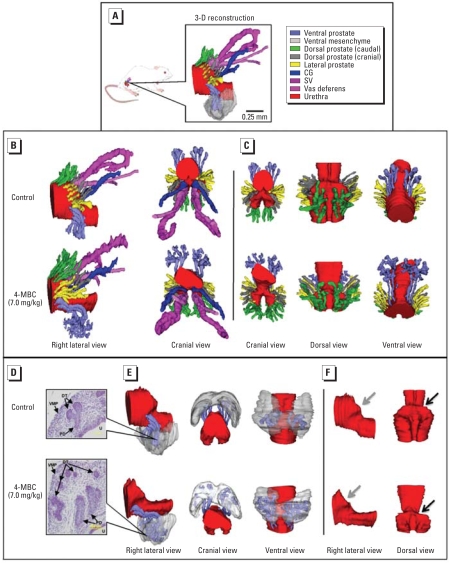
Methods: Pregnant Long Evans rats were fed diets containing doses of 4-MBC and 3-BC that resulted in average daily intakes of these chemicals corresponding to the lowest observed adverse effects level (LOAEL) and the no observed adverse effects level (NOAEL) doses in prior developmental toxicity studies. Using digital photographs of serial sections from postnatal day 1 animals, we identified, contoured, and aligned the epithelial ducts from specific regions of the developing prostate, plus the accessory sex glands and calculated the total volume for each region from three-dimensional, surface-rendered models.
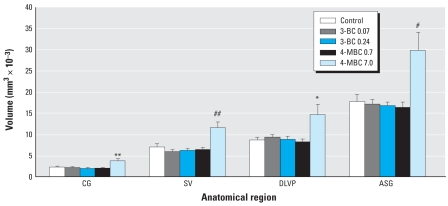
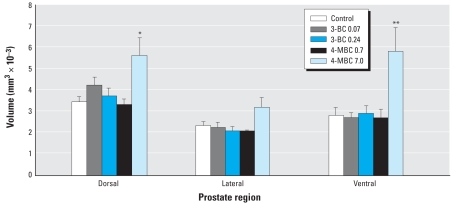
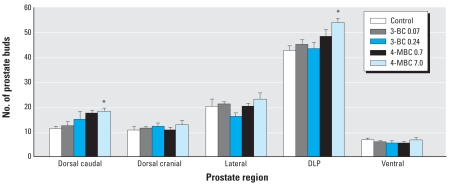
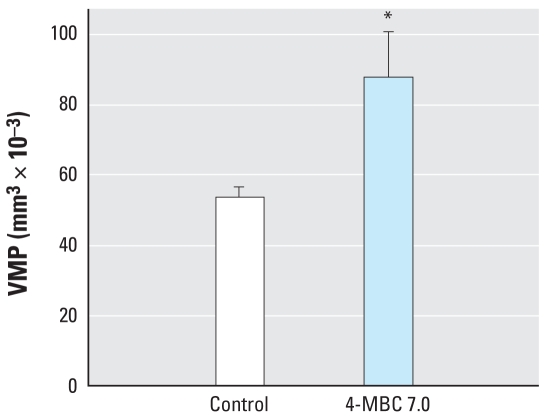
Results: Fetal exposure to 4-MBC (7.0 mg/kg body weight/day) resulted in a significant increase (p < 0.05) in tissue volume in the prostate and accessory sex glands. Treated males exhibited a 62% increase in the number of ducts in the caudal dorsal prostate. Increased distal branching morphogenesis appears to be a consequence of exposure in the ventral region, resulting in a 106% increase in ductal volume.
Conclusions: 4-MBC exposure during development of the male reproductive accessory sex glands exhibited classical growth effects associated with estrogenic endocrine disruptors. The different regional responses suggest that the two developmental processes of ductal outgrowth and branching morphogenesis are affected independently by exposure to the environmental chemicals.
Keywords: 4-methylbenzylidene camphor (4-MBC); UV filters; endocrine disruptors; prostate development.
Figures
References
-
- Balmer ME, Buser HR, Muller MD, Poiger T. Occurrence of some organic UV filters in wastewater, in surface waters, and in fish from Swiss Lakes. Environ Sci Technol. 2005;39:953–962. - PubMed
-
- Buser HR, Balmer ME, Schmid P, Kohler M. Occurrence of UV filters 4-methylbenzylidene camphor and octocrylene in fish from various Swiss rivers with inputs from wastewater treatment plants. Environ Sci Technol. 2006;40:1427–1431. - PubMed
-
- Buser HR, Muller MD, Balmer ME, Poiger T, Buerge IJ. Stereoisomer composition of the chiral UV filter 4-methylbenzylidene camphor in environmental samples. Environ Sci Technol. 2005;39:3013–3019. - PubMed
-
- Cunha G, Cooke P. Role of stromal-epithelial interactions in hormonal responses. Arch Histol Cytol. 2004;67:417–434. - PubMed
-
- Durrer S, Ehnes C, Fuetsch M, Maerkel K, Schlumpf M, Lichtensteiger W. Estrogen sensitivity of target genes and expression of nuclear receptor coregulators in rat prostate after pre- and postnatal exposure to the ultraviolet filter 4-methylbenzylidene camphor. Environ Health Perspect. 2007;115(suppl 1):42–50. - PMC - PubMed
Publication types
MeSH terms
Substances
LinkOut - more resources
Full Text Sources
Medical